

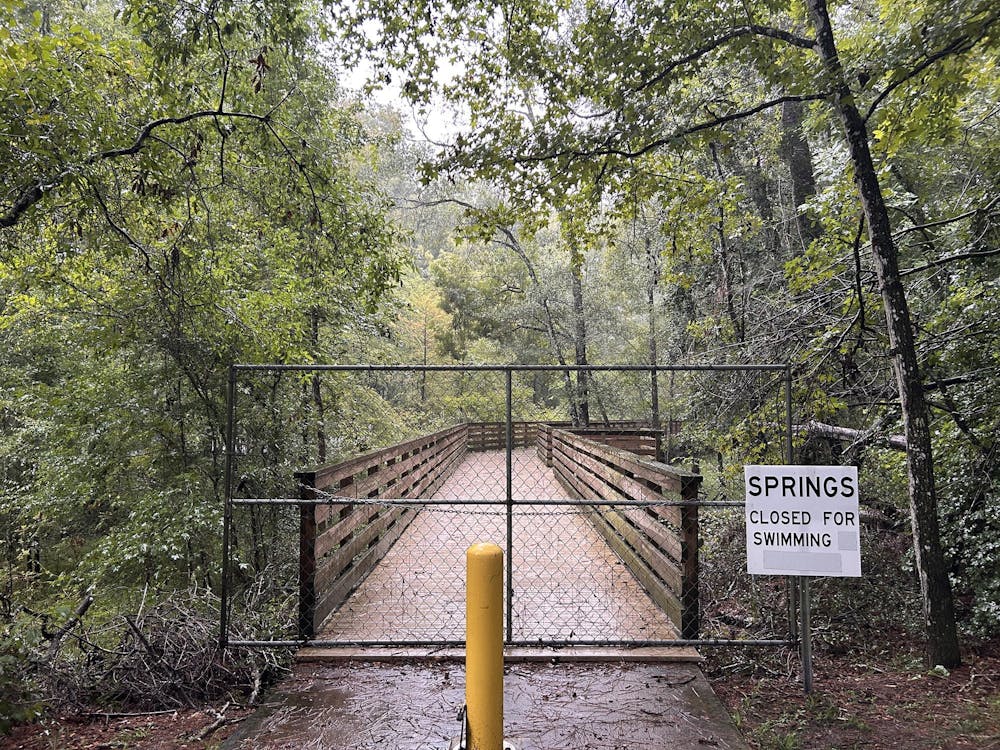
People who spent Labor Day weekend at a Florida spring may have noticed things looked and felt a little different. Experts and activists warn that many of Florida’s springs are under threat.
Drought, overpumping of the Floridan aquifer and urban developments have been detrimental to the health of the waterways, with one popular spring, Poe Springs, closed to visitors this Labor Day weekend due to low water flow.
Rick Lanese, the president of Our Santa Fe River, said the Santa Fe River, which is connected to dozens of Alachua County’s springs, is in poor condition.
Water flow from the upper Santa Fe to O’Leno sink, three miles of which is underground, has stopped completely. And about four miles of the river between River Rise Preserve and Poe Springs has “very slow” flow, he said.
At least 36 named springs flow into the Santa Fe River, and residents of Alachua, Columbia and Gilchrist counties depend on the river for their water supply and livelihood, according to the Florida Springs Institute.
Water flow from the springs and rainfall are responsible for keeping the river full, so when rainfall is low and the primary water source is the spring system, parts of the Santa Fe River become crystal clear. Lanese said that while the river may look prettier with clearer water, it can indicate an unhealthy river system.
“On the river bottom around the spring run you see incredible submerged aquatic vegetation,” he said. “Greens and blues and just teeming with fish.”
There are substantial consequences when the Santa Fe River has low flow and clear water during what are often rainier months. Under these conditions, populations of invasive vegetation and the concentration of water pollutants can increase, Lanese said.
When rainfall is closer to average and the river has a healthy flow, the river’s water is brown, which causes underwater vegetation to receive less sunlight. Typically, these conditions occur during Florida’s rainy season from June to September.
How are springs threatened?
Nitrogen and phosphorus are nutrients that, in excess, harm aquatic insects, amphibians and fish. Further, invasive aquatic plants like hyacinth, hydrilla and blue-green algae can effectively choke waterways by absorbing nutrients and regrowing rapidly, according to the Southwest Florida Water Management District.
Haley Moody, the director of the Florida Springs Institute, said one primary concern with invasive plant growth is its competition with native species.
“The natives start getting choked out,” she said “you start to have a whole cascade of issues.”
The first documented hydrilla growth in the Ichetucknee Springs system was discovered by a private land owner earlier this year, Moody said. The property owner told the Florida Springs Conservation and the Florida Fish and Wildlife Conservation, and the hydrilla was removed before it spread, she said.
Another threat to springs are human activities, but there are ways to negate these risks.
Despite drought and overpumping, Florida’s springs can still be enjoyed as long as visitors take the right precautions. Some of the best practices to protect springs are taken in everyday life.
“Reducing their water use at home, and also reducing their fertilizer use,” Moody said of how people can be responsible.
She added that it’s important for people visiting springs to keep their feet up and avoid disturbing vegetation.
Ryan Smart, the executive director of the Florida Springs Council, said springs vary in condition by region.
The Santa Fe and Suwannee, two North Florida springs systems, have struggled amidst the ongoing drought. Other springs in Central Florida, including Rainbow and Wakiwa, are doing relatively well, Smart said.
Ginnie, July, Ichetucknee, Pickard, Lilly and Rum Island springs are also enjoyable and pumping beautiful water, Lanese said.
Legal settlement leaves springs activists hopeful
The Florida Springs Council and the Florida Department of Environmental Protection reached a settlement Tuesday intended to protect and restore seven springs on the Suwannee River, according to the FSC.
Smart said the challenge against the DEP was initially filed because of the pollution in the Suwannee and Wekiva rivers, primarily by nitrogen.
Florida legislatures passed the Florida Springs and Aquifer Protection Act in 2016. It required the DEP to introduce the Basin Management Action Plan, a regulator tool used to make a dirty body of water clean again.
Smart said current restoration efforts have not met the standards mandated by the plan, which include lower pollution levels by 2038. The Florida Springs Council filed two petitions against the DEP in November, 2025, that challenged the restoration plans for Suwannee, Wakiwa and Rock springs, he said.
As part of the settlement agreement, new conventional septic tanks are slated to be banned by Dec. 31, 2030. Septic systems account for just over half of nitrogen pollution in Wekiwa and Rock Springs, Smart said, and he is hopeful that conditions will improve very quickly once the ban is in place.
Another clause of the settlement will ensure the practices used by agricultural producers to protect water quality are effective. Smart said that this provision is extremely important in rural areas where agriculture is the primary source of pollution.
The DEP also agreed to add 16 water quality monitoring stations, which measure nitrogen levels. At least ten of the 16 will be installed in the Suwannee, and six or more will be added in the Wakiva River.
The measurements are used to determine if a spring is impaired or not. If nitrate levels are high enough to label a spring as impaired, it goes into the Basin Management Action Plan.
Springs suffering from dry conditions and pollution can see short-term improvements with invasive vegetation removal and favorable weather patterns, while long-term restoration will require sustained efforts.
Contact Christian Haas at chaas@alligator.org. Follow him on X @ChristianH58745.
Christian is an environmental reporter with The Alligator, and studies journalism at the University of Florida. He is a fourth-year student who prefers to spend his free time trying new and random things, cooking, reading, watching TV, or hiking.


