

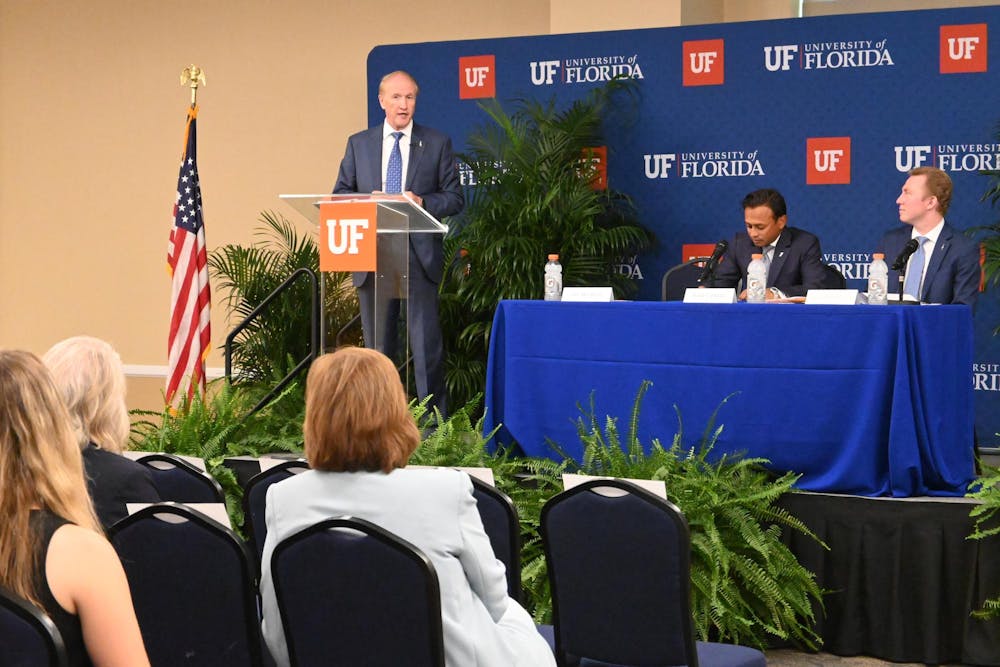
New UF president Stuart Bell is directed to prohibit equity and inclusion programs, contradicting his 10 years building DEI departments at the University of Alabama
When UF's Board of Trustees wrote Stuart Bell's employment contract this summer, it included a surprising directive: For as long as he leads the university, Bell must prohibit the use of any funding — public or private — for diversity, equity and inclusion programs and political or social activism.
This anti-DEI funding clause, item 11 of 20 performance metrics listed in Bell's five-year, $2 million annual agreement, goes further than Florida law requires.
State statute and Board of Governors regulation ban only public dollars from funding DEI, yet UF's board extended that prohibition to private donations and foundation money, according to the contract approved by the Florida Board of Governors on July 1.
Under the contract’s performance metrics, Bell’s eligibility for bonuses and contract extensions is tied to compliance with Florida directives. These goals require reviewing student activity fee distributions and steering funds away from DEI efforts and toward state-supported priorities like merit scholarships and classical civics.
Florida law caps the public-funds portion of a university president's pay at $200,000, with the remainder covered by university foundations, a structure unrelated to but often discussed alongside the same private philanthropic dollars now restricted from DEI use under Bell's contract.
Bell began his UF presidency July 1. His contract makes clear that whether he receives bonuses or an extension will depend, in part, on how thoroughly he carries out a policy his own record in Alabama once ran counter to.
Bell in Alabama
Although Florida's university system chose him to enforce the anti-DEI mandate, Bell spent a decade building the kind of programs his new contract requires him to dismantle.
Bell created a central diversity officer position in his first year as president of the University of Alabama in 2015. Two years later, he opened Alabama's Office of Diversity, Equity and Inclusion, which grew into a full division under his administration.
His 10-year tenure also saw a documented push to recruit more Black and Latino students. Under his presidency, Black and Latino enrollment surged while the amount of white students in the freshman class fell by nearly 10 percentage points.
Bell shut down Alabama's DEI division in 2024 after the state legislature passed a law banning taxpayer support for such programs. He replaced it with the Division of Opportunities, Connections and Success office, which was run by the same administrator who led the DEI division.
Bell’s history with DEI has made his hiring one of UF’s more contested presidential searches following the Board of Governors' rejection of former University of Michigan president Santa Ono over similar concerns last year.
Conservative commentators, including Manhattan Institute fellow John Sailer, argued on X that Bell was unfit for the job because he had created Alabama's DEI office and had not moved to eliminate diversity staff before state law forced his hand.
“It’s a blow to UF's reform record, as Bell founded the DEI office at Alabama and refused to fire DEI officers even when the legislature banned it,” Sailer wrote.
U.S. Education Secretary Linda McMahon also commented on X, saying Florida "deserves a president who will continue" its rollback of DEI policy.
UF answered the criticism directly. In a May 22 statement on X, the university said its board had "embedded an anti-DEI mandate within the presidential contract itself, ensuring that no university funds, public or private," would support DEI at the institution.
Critics and Florida representatives, including Rep. Daryl Campbell (D-Fort Lauderdale), have accused UF of breaking its own 2025 institutional neutrality policy, which limits higher education leaders from using university resources to take a stance on divisive political issues.
In a letter to interim president Donald Landry and UF assistant vice president for government relations Christopher Emmanuel, Campbell asked 21 questions to clarify UF’s position and policies after the post.
Throughout the letter, Campbell asked officials to better explain the university’s breach of its own neutrality policy and cite what led them to label DEI as “discriminatory by design” and “antithetical to the purpose of a university.”
“The University of Florida’s random attack on diversity, equity, and inclusion raises serious questions about why a taxpayer-funded institution is meddling in politics instead of focusing on its mission,” Campbell wrote. “For years, we’ve seen Florida’s government get more politicized while leaving the people further behind. (...) UF also appears to be failing to follow its own neutrality policy, which raises more questions about chilling free speech on campus.”
UF never responded to Campbell’s letter, according to UF spokesperson Cynthia Roldan.
Bell in Gainesville
In an email statement to the Alligator, Clay Calvert, a UF law professor and former director of the Marion B. Brechner First Amendment Project, said although the wording of item 11 in Bell’s contract only reiterates an existing ban on public funding for DEI and activism, the ban on private funding toward the activities invites a new set of problems.
This specification bans private donations or gifts for these activities, Calvert said, and UF development officers need to advise prospective donors about this change if they haven't already.
“These provisions don't directly restrict speech about these topics, but by eliminating the use of funds for activities where speech about them would occur –– rallies, panel events and guest speakers, for instance –– speech is by implication being restricted,” Calvert wrote. “If funds are cut off, then speech is cut off and the marketplace of ideas for students at a public university is restricted.”
Bell has repeatedly distanced himself from his own record. At a May 27 public forum in Gainesville, Bell told students and faculty he did not intend to bring "DEI or any form of woke" to the university. He urged skeptics to judge him by his compliance record in Alabama rather than by the programs he had once built.
He struck a similar tone before the Board of Governors July 1, telling members again that Alabama lawmakers were satisfied with the way he dismantled UA’s DEI division.
Gov. Ron DeSantis, who has frequently appointed former politicians and individuals with ties to Republican politics who lacked qualifications to higher education positions, endorsed Bell's selection in a May 18 statement on X and has not publicly revisited that support despite the backlash.
Following the board’s rejection of Santa Ono for UF president last June, DeSantis was scrutinized for appointing three state university presidents with no prior experience in university administration.
These appointments include Marva Johnson as president of Florida A&M University, where she faced intense criticism from speakers at a Board of Governors meeting for her lack of qualifications and a candidacy platform.
Amanda Phalin, a UF professor and former member of the Florida Board of Governors, publicly expressed her dissent over the decision-making process, arguing Ono was “interrogated” in a way that deeply contrasted the three candidates’ smooth confirmations.
Phalin told Inside Higher Ed this process marked the turning point in “the politicization of the state university system.”
Some faculty leaders say the DEI fight, while politically loud, may not be the most significant test of Bell's presidency.
James Finkelstein, a George Mason University public policy professor who studies university governance, said further ideological scrutiny of coursework could drive faculty away from the university.
“Having people review their syllabus for their course to make sure it doesn’t violate some DEI restriction, you’re going to see faculty leave,” Finkelstein said.
Michelle Nolan, a co-president of the United Faculty of Florida's UF chapter, the UF faculty union, said political interference in curriculum and research funding has taken a toll on faculty morale. Rebuilding trust should be Bell's central task, she said, not any single policy fight.
“The past several years have been exhausting and demoralizing for faculty at UF,” Nolan wrote.
Contact Aaron Zagal Yaji at azagal@alligator.org. Follow him on X @azagalyaji.
Aaron Zagal Yaji is a Public Relations and Economics freshman in his first semester at The Alligator. He covers El Caimán's metro beat. In his free time, he enjoys going to the beach (or reminiscing about it), cooking Peruvian food, and squandering his money on golden shiny things.


