

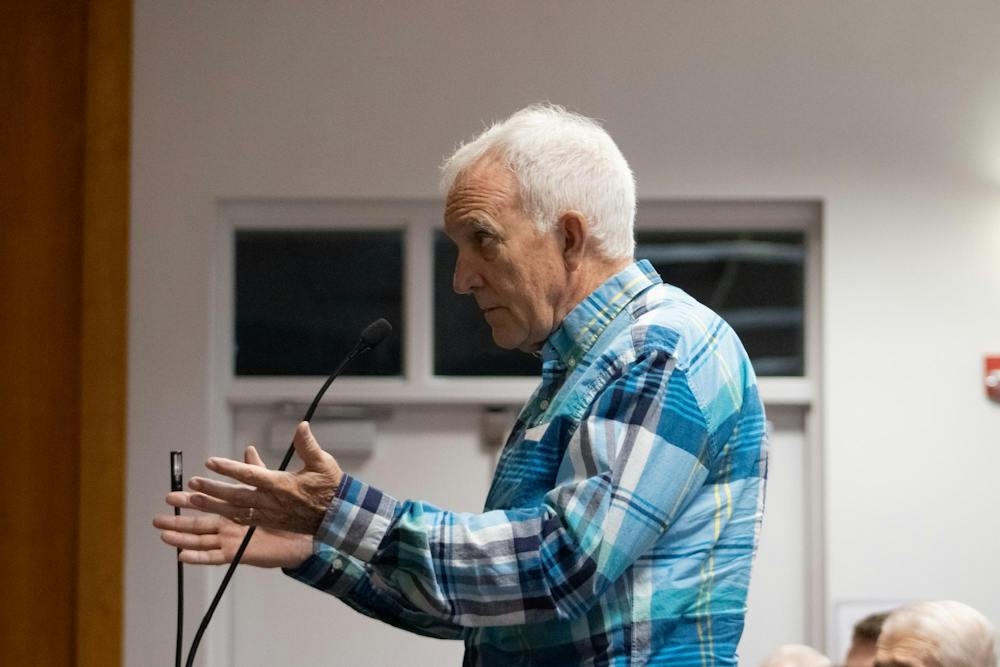
An Alachua City Commission meeting Monday erupted into chaos after a passionate discussion about data center development in the city.
At the beginning of the discussion on data centers, Alachua Vice Mayor Jennifer Ringersen made a motion for a 12-month pause on all data center development within the city, meaning no new permits would be issued to developers looking to build data centers during that time.
The purpose was to give the city time to study the impact of data centers and enact rules and regulations to govern them, she said.
Mayor Walter Welch seconded the motion, and Ringersen asked for clarification on a parcel rumored to have been a potential location for a data center.
The rumors were dismissed by Bryan Thomas, Alachua’s planning and community development director.
“There is nobody looking at the city of Alachua as a potential site for a data center,” he said.
The rumors were sparked in May when a realtor listed a property as a potential high-megawatt data center location, ensuing panic that led to a neighborhood meeting. Nearly 60 residents gathered May 14 to speak out against the rumored data center, but who has authority over the land remains disputed.
In Monday’s meeting, Thomas reiterated the parcel is in unincorporated Alachua County, meaning the city has no jurisdiction over it. However, the Alachua County Property Appraiser designates the site as located in the city of Alachua.
The site is now listed as a manufacturing site, not a data center location.
Five days after the neighborhood meeting, many of the same residents attended a workshop where commissioners reviewed the comprehensive city plan, including the regulations under which large-scale data centers would fall.
On Sept. 8, the planning and zoning board committee was set to discuss regulations over data center development, but only two of the five members showed up, which is not enough to conduct business.
A petition by the Florida Sierra Club advocating for the city to put a pause on data centers amassed just under 650 signatures as of Monday’s meeting, falling short of the 5,000 signature goal.
Of the 15 people who spoke during Monday’s public comment period, all but one voiced support for Ringerson’s motion for a moratorium.
Public comments
Sarah Younger, a committee member of the Sierra Club Suwannee St. Johns Group, said Alachua should be cautious about data centers because the relatively few long-term jobs they provide might not outweigh their consequential resource consumption.
Putting the discussion on pause isn’t enough for her, she said.
“A moratorium asks ‘How should we regulate data centers?’” Younger said. “Vice Mayor Ringersen is asking an even better question: Do we want them here at all?”
Following the public comment period, City Commissioner Jacob Fletcher said he was disappointed with the rushed nature of the discussion, which failed to outline the specifics of the pause and how it would work.
He asked the commission several questions about the details of the proposed pause to which Welch didn’t answer and instead continued to ask Fletcher if he was ready to vote. Fletcher asked the other commissioners if they would be willing to further discuss the terms at the next city commission meeting on Sept. 28 to which they all agreed, including Welch.
Fletcher made an official motion to delay the vote on the pause to further discuss the details at the Sept. 28 meeting, but he was cut off by the mayor reprimanding Haripriya Benedict, a Gainesville real estate agent, who was talking in the audience.
The mayor then moved to vote even though none of the commissioners had seconded Fletcher’s motion.
“Mr. Mayor, you have to call for a second,” Fletcher reminded Welch.
“It died,” Welch replied, to which the crowd gasped. Fletcher flung his arms in the air, and Benedict said, “oh my god,” which led Welch to order her to leave the room.
Fletcher and about 45 of the approximately 50 meeting attendees followed her out.
Benedict reflected on the incident outside city hall. She said she asked the commission if Fletcher’s suggestion to discuss the definitions in the comprehensive city plan at the next meeting was approved and if there would be time for public comment.
“Instead, the mayor started chastising some citizen who asked if there was public comment,” she said, referring to the comment that got her reprimanded the first time, adding that the mayor was not allowed to kill the motion, and that doing so prompted most of the attendees to leave.
A mayor doesn’t have more power than the rest of the commission during meeting votes, according to the city statutes, so Welch was not within his power to deny the motion before it was seconded and voted on.
It's unclear if the topic will be discussed at the Sept. 28 meeting.
Wider concerns
Data centers have been the subject of increasing national debate among lawmakers and citizens as artificial intelligence continues to expand with no sign of slowing down.
The U.S. Department of Energy advertises data centers as generators of billions of dollars in investment, creators of jobs and drivers of economic growth nationwide. Still, data centers have received bipartisan criticism over their environmental impacts, energy and water consumption and noise and infrastructure disruptions, according to Data Center Watch.
In a June 6 press release, Alachua County addressed residents’ concerns about current data center development rules, or the lack thereof. Ultimately, the county decided current rules would prohibit construction of data center-like developments, but there’s no regulation specifically addressing them. The update referenced Senate Bill 484, which was signed into law by Gov. Ron DeSantis in May to emphasize local control over data center development plans.
Florida Data Centers, an anti-data center advocacy organization, assessed each county’s risk of developing the centers and determined Alachua County is at moderate risk. This means some factors make it suitable for development, like high water and power availability, and others work against it, like high competition for land and a lack of nearby data centers.
While data centers and AI development have drawn public criticism, they’ve also garnered support.
President Donald Trump made several posts on social media Monday voicing his support of AI.
“The people that say AI is going to destroy the World, and that Data Centers are bad for your neighborhood, are the same people that said, just a short time ago, that the World would be extinguished by ‘Climate Change,’” Trump wrote in one Truth Social post, adding that climate change is a hoax.
Contact Christian Haas at chaas@alligator.org. Follow him on X @ChristianH58745.
Christian is an environmental reporter with The Alligator, and studies journalism at the University of Florida. He is a fourth-year student who prefers to spend his free time trying new and random things, cooking, reading, watching TV, or hiking.