

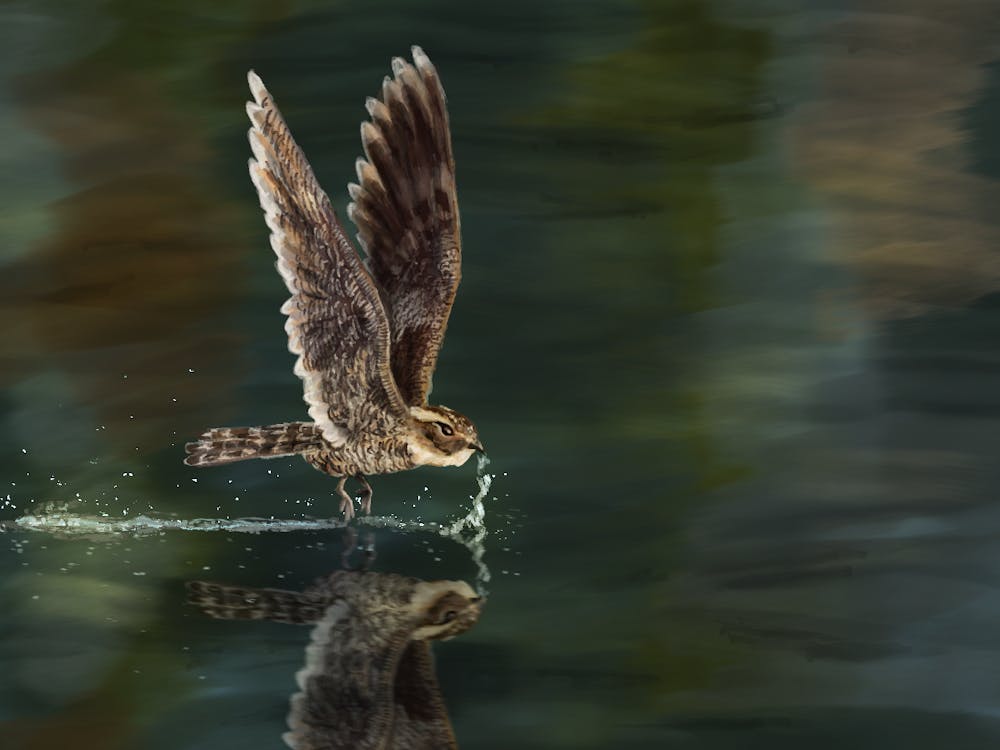
After he caught word of the lesser nighthawk sighting in Alachua County, Tim Hardin went to see it for himself. It took him three days to finally catch a glimpse of the speckled bird, with its small pointed beak and sharp eyes, against the backdrop of Sweetwater Wetlands Park Dec. 19.
Until last month, the bird hadn’t been seen in Alachua County since 1999, when a park ranger found a dead lesser nighthawk at Paynes Prairie Preserve State Park. The bird’s return was first reported by Luis Gles and Mariah Hryniewich on eBird, a popular platform for birders to record sightings.
“Rare. Second Alachua Co. record according to eBird, & 1st record alive!!!” Hryniewich wrote Dec. 16, citing her location as Sweetwater Wetlands Park.
Three days later, Hardin and around 75 others walked through the park after hours, guided by staff, searching for the bird.
“Honestly, I feel a lot happier that a lot of other people were able to see [the bird],” he said. “I've seen some phenomenal birds here that not very many people have been able to see, and I have an appreciation of the joy and the camaraderie and having those shared experiences of seeing the bird.”
On Jan. 5, Sweetwater Wetlands Park hosted a second after-hours event to spot the nocturnal bird as it starts hunting. The event drew around 145 people eager to see the lesser nighthawk, including nonbirders, which Hardin referred to as “breaking containment.”
Over 80 photos of the Alachua County lesser nighthawk have been uploaded to eBird as of Jan. 20.
Many birders keep “lifelists,” where they keep track of all the species they have seen in their lifetimes. The bird was a “lifer” for Hardin, or his first time seeing the species in person, although he has seen many common nighthawks. He differentiates between the two by the white bar on their wings — a common nighthawk’s is toward the center of its wing, while the lesser nighthawk’s is closer to the tip.
Last seen in the park Jan. 13, the bird is native to the desert and commonly found in the southwestern U.S., which is why it’s surprising the lesser nighthawk has stayed in Sweetwater Wetlands Park, said Darby Guyn, recreation leader for the City of Gainesville.
Rare bird appearances can happen for a variety of reasons, Guyn said.
Sometimes, extreme weather events or irregular wind patterns drive birds to unfamiliar areas. Other times, a bird’s internal compass is thrown off, which is what she thinks happened to a second rare bird that was seen at Sweetwater, the groove-billed ani. Another non-native bird, the groove-billed ani was spotted around the same time as the lesser nighthawk. But unlike the nighthawk, it didn’t stick around long.
“It hasn't left,” Guyn said of the lesser nighthawk. “Clearly, it is getting what it needs in this area. Now, when it comes time for breeding season, I don't know if it's just going to fly or if it's going to stick around. We really have no way of knowing how long this bird is going to be here.”
Guyn and other park staff aren’t sure why the lesser nighthawk arrived in Alachua County in the first place or why it is staying, but it’s not an endangered species and not causing harm to other local wildlife. Guyn is open to planning more after-hours events with the Alachua Audubon Society, in addition to their regular Wednesday Bird Walks collaboration.
Climate change is driving many trends in bird populations and migration patterns. eBird tracks the populations of several species and reports changes in their numbers and locations. Data on the lesser nighthawk’s range indicates that during its non-breeding season from December to March, it is rarely seen in the U.S. other than in South Florida.
“I’ve seen a number of models that they [eBird] do when they compare their data from 1980 to today, and you can see the change in migration routes,” Guyn said. “You can see that it's happening earlier or later, or it's more widespread or more narrow. So it's definitely happening within bird species. We are seeing some unusual changes.”
Casual observers like Taylor Spangler needed help spotting the lesser nighthawk.
She and her husband visited the park with their relatives, hoping to introduce them to Gainesville’s nature. The bird was an added bonus for her father-in-law, a wildlife photographer.
She was grateful for both the birders and guides who pointed out the hawk.
“They pointed out as it was moving,” Spangler said. “OK, can you see this now?’ ‘Look up,’ or ‘It's flying over to the left or to the right.’ And without that, we would have had a nice evening at the park, but we would not have seen this bird.”
Contact Juliana DeFilippo at jdefillipo@alligator.org. Follow her on X @JulianaDeF58101.

Juliana is a second-year journalism student and the Spring 2026 Enterprise environment reporter. This is her fourth semester on The Alligator, and she previously served as an Avenue reporter and the Fall 2025 Avenue editor. In her free time, she loves reading, updating her Letterboxd account and doing crosswords.


