
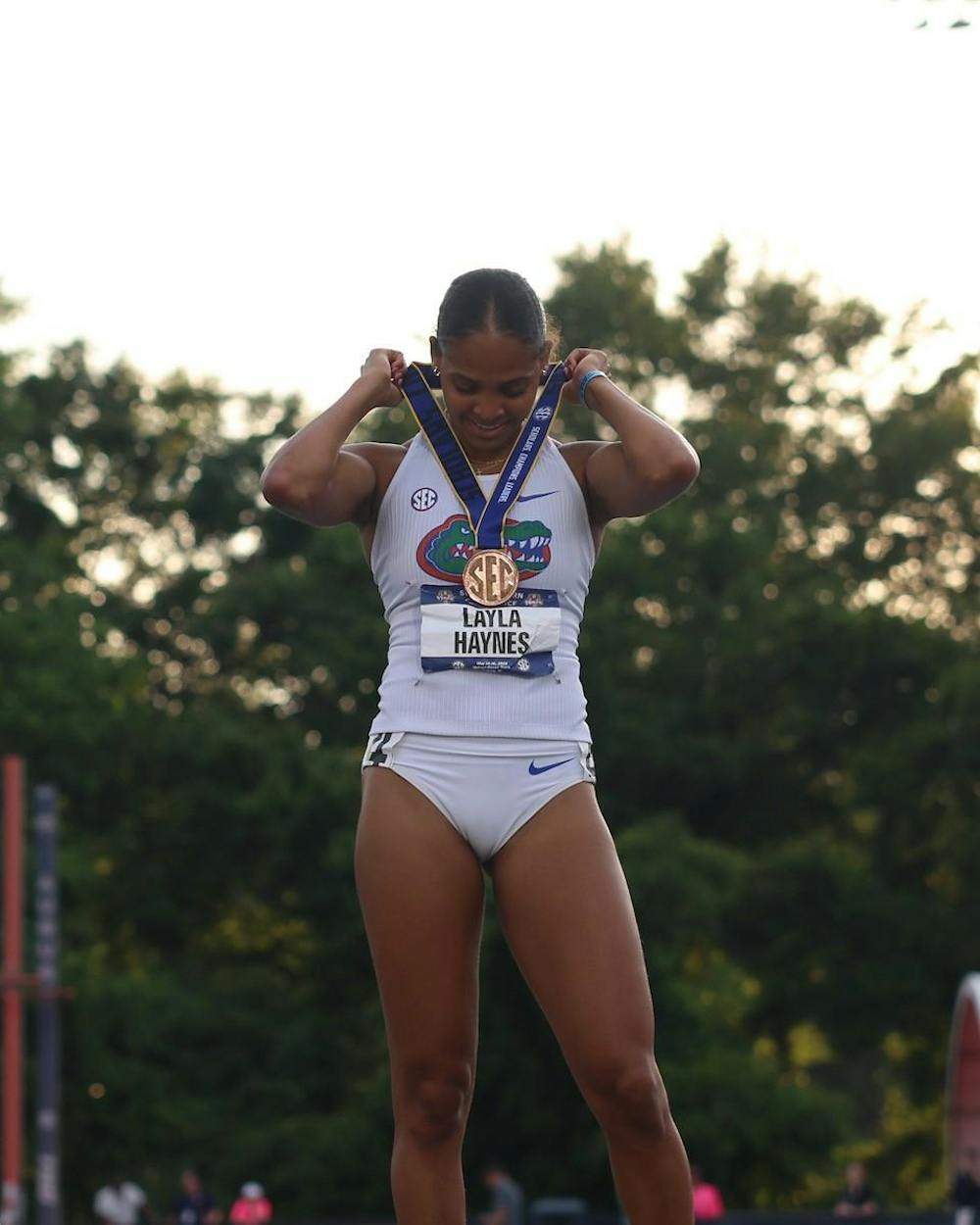
Layla Haynes has already won four Barbadian national titles and has represented her home country at several levels on the international stage, but it wouldn’t be a stretch to say that the 2026 SEC Outdoor Championships 800-meter final was the most competitive race of her career.
The Florida junior stepped up to the start line of Hutsell-Rosen Track at Auburn University on the evening of May 16 as the sixth-fastest athlete in the nine-woman field. Sanu Jallow of Arkansas lined up three lanes to Haynes’ right as the heavy favorite, having finished runner-up in this event at the last five conference championship races and being the only athlete in the field to boast a personal best under two minutes. Jallow has a reputation for running from the front of the pack and making the race fast early.
Haynes was well aware of this tendency, and she was prepared to compete.
“Sanu’s an excellent competitor,” Haynes said, “so I knew it was going to get out and I knew it was going to be fast. My thing is that if these girls are doing it, I better put myself in the race too.”
Haynes’ prediction was right, with Jallow taking control of the race early, but the Gator was willing and able to stick with the lead quartet through 400 meters. The pace was fast, too, as Haynes split 57.64 for her first lap. She was oblivious to the time, however, a fact she doesn’t regret.
“I am so grateful I never checked the clock,” Haynes said. “I simply want to race. I don’t think about time at all. I just want to actually race and execute how I’m feeling in my effort levels in that moment.”
With every stride drawing Haynes closer to the finish line, the clock she was still blissfully unaware of was in a region that she had never come close to. Haynes dipped across the finish line, placing third and entering a new stratosphere of half-mile running.
Her time of 1:59.38 was over three seconds faster than she had ever run before, making Haynes the 19th woman to break the two-minute barrier in collegiate competition and breaking UF’s 29-year-old program record – previously held by three-time Olympian Hazel Clark.
“That was a shock when I crossed the line and realized the time,” Haynes said. “My goal this year was 2:01… so it kind of shook me a bit. It took me a few days to put things into perspective and shift my goals with it, because we had to readjust for sure.”
The Florida school record isn’t the only all-time mark that Haynes reset in Auburn, as she also broke Sade Sealy’s Barbadian record, which was set in 2019. This was Haynes’ third national record of the season, having already established new bests in the indoor 800 meters and 1,500 meters, but it carried special significance given that she used to be training partners with Sealy early in her career.
“That was one of those full-circle moments,” Haynes said. “She sent me a lovely message afterwards basically saying that if someone was to do it, she was really happy it was me.”
Barbados, which has a population smaller than Alachua County, doesn’t exactly have a rich tradition of distance running. Most of the island nation’s relevance in track and field has come in the sprints. Obadele Thompson’s 100-meter bronze medal from the 2000 Games is the only Olympic medal a Barbadian athlete has won in any sport, and the country’s three World Athletics Championships medals have come from the men’s 110-meter hurdles and women’s 400 meters. The last and only time a Barbadian woman competed in a distance longer than one lap at the Olympics was in 1972, when Heather Gooding raced the 800 meters at the Munich Olympics.
Haynes could be the one to change that, as her run at SECs was just .08 seconds outside of the automatic qualifying mark for the Paris Olympics in 2024.
“I used [Sealy] to be that person for me, to realize that we can do this because someone else has,” Haynes said. “So for me to now be in that role for somebody behind me, it’s an honor.”
The early stages of Haynes’ career are a quintessential track and field origin story: She competed in many sports growing up, but a coach spotted her talent, and she joined a club when she was 11 or 12. Her proclivity for the distance events wasn’t only against typical, sprint-heavy traditions across the Caribbean, but also within her own family. Haynes’ cousin, Dylan Woodruffe, is a freshman 100- and 200-meter runner at Miami. Her maternal grandfather, Wendell Mottley, won 400-meter silver at the 1964 Olympics in Tokyo, one of Trinidad and Tobago’s first Olympic medals after gaining independence in 1962.
“To this day, there’s definitely advice that I seek after from him,” Haynes said of her grandfather. “He’s seen this sport progress… seeing it evolve from using yards to meters. If anything, when I’m telling him I felt the lactic [acid] today, he gets it.”
Distance running came naturally to Haynes, and in the summer of 2021 she made the decision to move to the United States to continue her career at IMG Academy in Bradenton. Entering as a junior, Haynes ended her first season stateside as one of the top runners in the nation, placing fifth in the 800 meters at Nike Outdoor Nationals. It was at IMG where she began focusing on the half-mile more than the 1,500 or 3,000 meters.
Spoken like a true middle-distance runner, Haynes’ event change had one primary motivation: “If I can do more 800s… then maybe I wouldn’t have to do as much cross country,” she said.
One of Haynes’ coaches at IMG was Abbie Harrelson, an 800-meter runner and All-American with the distance medley relay team at Florida from 2018-21. That connection helped Haynes turn the attention of her recruitment towards Gainesville, and she committed to run for the Gators in the spring of her senior year.
The transition to collegiate competition was made easier by the boarding school nature of IMG, because Haynes was already comfortable living and training far away from home. An increased emphasis on speed work, strength training and nutrition were all new aspects that Haynes had to adjust to, but changes that have proved worthwhile.
“The coaches and I, we worked a lot on getting the basics down and the foundations right,” Haynes said. “I feel like now I’m starting to reap the benefits of all the work we put in two years ago.”
Haynes’ indoor season this winter was her best yet. She shaved over a second off her indoor personal best, qualified for and finished fifth in her first individual SEC final, and ran on the program record-setting distance medley relay team that placed fourth in her first NCAA Championship experience.
“I see all the work that my teammates are putting in,” Haynes said. “I think the environment plays a major role in the success that I’ve had on the track this year… there’s a Gator standard that I know is the basic to reach.”
The momentum Haynes built during the indoor season was carried seamlessly outdoors, as she ran personal bests in each of her two 800-meter races in the regular season prior to her conference championship weekend breakout. The goal of those races was to see how Haynes responded to fields where there were several women faster than her, and the results were encouraging.
“The whole lineup was actually way faster than me, but that’s what I crave,” Haynes said. “So then when I’m at meets like SECs and Regionals… I’m not unfamiliar to the environment, I’m not unfamiliar to being pushed.”
The habit of immersing herself in fast races proved fruitful at the SEC Championships, and it did the same two weeks later at the NCAA East Regional.
Haynes’ quarterfinal heat went out a full second faster than the SEC final did, but she was once again willing to go into unprecedented waters to stick with the leaders. She started to drop back on the home straight, even being passed at the line and finishing fourth, but her 2:00.75 run was fast enough to snag a time-qualifying spot to her first NCAA Outdoor Championships.
“Oh, I felt it,” Haynes said of her blazing opening lap, which was nearly eight seconds faster than her closing 400 meters. “That hurt severely, but it was a good mental challenge.”
Pain comes with the territory of being an 800-meter runner. Half-milers argue it’s the sport’s hardest event, but that’s what makes it worth doing. When Haynes lines up inside Hayward Field at the University of Oregon for her semifinal on June 11, she’ll have the confidence of the two best races of her life in her back pocket. She said the nerves go away the instant she steps on the track. When the gun fires, all that Haynes can do is race with the aggression she’s proven she can and welcome the inevitable.
“I know for a fact it’s going to hurt; I signed up for that when I chose to do this event,” Haynes said. “So it’s really, ‘How much am I willing to hurt?’ That’s the question that’s going to keep me pushing.”
Contact Paul Hof-Mahoney at phof-mahoney@alligator.org and follow him on X at @phofmahoney.
Paul is a senior in his fourth semester on the track and field/cross country beat for The Alligator. In his free time, you can increasingly see him jogging around Gainesville or endlessly falling deeper down the rabbit hole that is track Twitter.