
CORRECTION: This story has been updated to reflect Fatimah Tuggar’s correct title. It previously stated she is an associate professor.
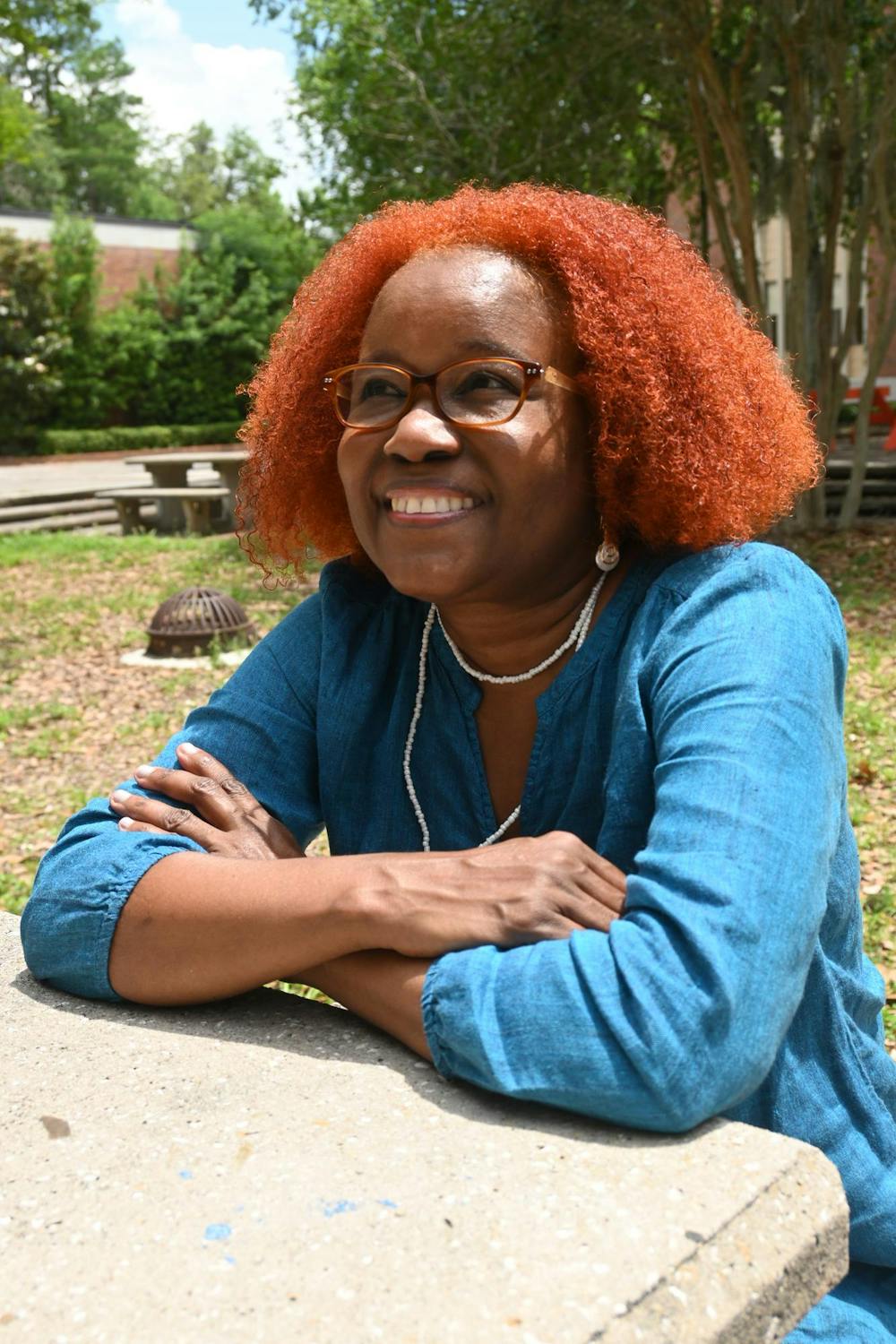
Fatimah Tuggar, a Nigerian interdisciplinary artist and professor of artificial intelligence in the arts at UF, has always kept an eye on the future.
Tuggar’s work has been featured at the Venice Biennale — a prestigious international art exhibition in Italy — and she was recently awarded a Fulbright U.S. Scholar Program Award in Visual Arts Research, which will take her to New Zealand this coming January. Fulbright scholars receive a grant to travel to a foreign country to conduct work that promotes cross-cultural understanding.
Born in Nigeria, the 58-year-old artist has spent her life across the globe. She attended the Blackheath School of Art in London and received degrees from the Kansas City Art Institute and Yale University.
Tuggar is currently working on a project centered around the calabash, a gourd that serves a variety of purposes in African cultures, like being fashioned into a drum or used as a suitcase.
Besides their many uses, these calabashes are often decorated with a plethora of patterns, varying from country to country. However, as a result of colonialism, travel between different African countries is difficult even if they neighbor each other, Tuggar said, preventing the cultural exchange of these varied patterns and uses.
Using UF’s HiPerGator, the fastest university-owned supercomputer in the country, Tuggar imagines a reality in which these ideas were allowed to flow freely.
“I am using the database of calabashes that I've created from six countries so that the hues, the patterns, … you see them intermixing infinitely and coming up with new patterns, new forms, new hues that are from a mixture of those,” she said, “to speak to this idea of how we will never know really what would have come out of the intercultural exchange, but we can imagine it through AI experiences.”
By immersing the audience in this simulated reality, Tuggar showcases the diversity of the calabash and provides commentary on what could be lost when the traditional gourds are replaced with artificial plastic containers.
While the use of AI technologies remains a contentious topic within the art world, Tuggar views artificial intelligence as a tool no different from a hammer.
“At least from my perspective, I think art has to be compassionate, and it's about really accessing human-to-human emotional intelligence and experiences,” she said. “I don't think AI has that, or maybe it will have it in the future, but it certainly doesn't have it now.”
Incorporating diverse perspectives — especially when building new technologies — is crucial, Tuggar added. She encourages the incorporation of humanities perspectives into the development of language models, arguing humanities scholars can provide useful outlooks. Pulling from her own multicultural background, Tuggar likened this multifaceted approach to how someone who speaks bilingually thinks; two frameworks of how to perceive something can lead to different interpretations.
Tuggar seeks to challenge the perspectives of her students. For 61-year-old Karen Maggs, who was one of Tuggar’s students at the University of Memphis 17 years ago, that sentiment rang true when Maggs was working on a project with QR codes.
Tuggar made Maggs realize a piece of art that requires a smartphone to view it would restrict her audience to those privileged enough to afford one.
“She continually looked for ways to push a student's work and challenge the student to think: ‘Why are you making this image?’ ‘What is the image actually saying?’ ‘What do you want to say with this?’ ‘Do you realize what you're saying is what you think you're saying?’” Maggs said.
Maggs and Tuggar remain friends, maintaining a relationship past their original teacher-student dynamic. When an injury caused Maggs to nearly lose sight in her right eye, Tuggar stayed with her through the process and even drove her to emergency surgery.
Maggs values Tuggar’s intelligence and vivacity. She’s the most honest person she’s ever met, she said.
Tuggar’s honesty is something 26-year-old studio art master’s student Dylan Taylor also appreciates. Tuggar has served as a reorienting presence, reminding Taylor of what he’s making and why.
“Fatimah’s a great voice in reminding us what we're really here for, which is not to perpetuate what's been done but to explore the frontier of what art can be,” Taylor said. “She really is phenomenal about reminding us about what our contribution not only to the field is, but to the world as artists.”
Taylor worked with Tuggar in an independent study over the Spring 2026 semester, and she helped him “encourage humor and play” in his studio practice.
Tuggar’s upcoming work will take her to New Zealand as a Fulbright scholar, where she will research the dynamic between functional and aesthetic objects in Maori culture. She’ll then compare the dynamics of the indigenous Polynesian culture to those present in West African cultures.
Blending complex understandings of diverse schools of thought, Fatimah Tuggar is a student of the world, and her upcoming trip is the next chapter in her education.
Contact Christopher Rodriguez at crodriguez@alligator.org. Follow him on X @ChrisRodri29386.