
Despite the countless initiatives, services and even new grocery stores appearing in Gainesville, food insecurity is back on the rise as of late 2025, with local food shelters such as Deeper Purpose Community Food Ministries reporting an increase from 10 to 40 phone calls per day directed toward food assistance.
Efforts to combat this issue are becoming more commonplace, such as the $100,000 stipend from Alachua County to the Bread of the Mighty Food Bank and UF’s increased emphasis on food banks and recovery services. But if UF and the city are doing so much to combat the scarcity, then why are more families, workers and students still losing access to food?
The answer is simple: Food accessibility is linked to not just the food existing within city limits, but also to the financial and temporal constraints separating people from the food. In cities like Gainesville, food accessibility depends less on whether a store actually exists and more on whether people can reach it.
When UF reduced its financial support for Gainesville's public bus system on June 5, 2025, the decision was framed as a budget adjustment. In practice, it functioned as a transportation shock. According to a City of Gainesville press release on that same day, UF cut roughly $2.9 million from its contribution to the Gainesville Regional Transit System, and a month later, RTS' operating budget decreased by over $3 million.
The response was predictable: More than a dozen routes were eliminated, consolidated or reduced, particularly those connecting campus to commercial corridors and residential neighborhoods across the city.
A grocery store does not need to disappear for food accessibility to worsen; all that has to change is the cost of getting there. When buses run less often, trips take longer and transfers become riskier. Miss one connection, and a routine grocery run can turn into an hour-long delay.
For households without cars, this extra time is not trivial; it determines how often they shop, where they shop and what they can afford to buy. This time has an opportunity cost. It comes out of work hours, child care, studying or rest. When time costs rise, people shop less and buy differently. Transit cuts, in this sense, function as a regressive cost-of-living increase.
This especially matters in Gainesville, because grocery stores and food retail are unevenly distributed. Full-service grocers, which contribute to a healthy lifestyle, tend to cluster along specific commercial corridors such as UF, Butler Plaza or The Oaks Mall, making many lower-income neighborhoods — particularly in East Gainesville — rely on transit to reach them.
As bus services decline, residents are pushed toward closer but more limited options: convenience stores, dollar stores and fast food. Over time, this shift shows up not just as a dramatic loss of access but as a steady increase in food insecurity, household food costs and worsening health outcomes. This is the standard pattern documented in the National Institutes of Health’s 2023 research on the intersectionality between food insecurity and life outcomes, and Gainesville is not an exception.
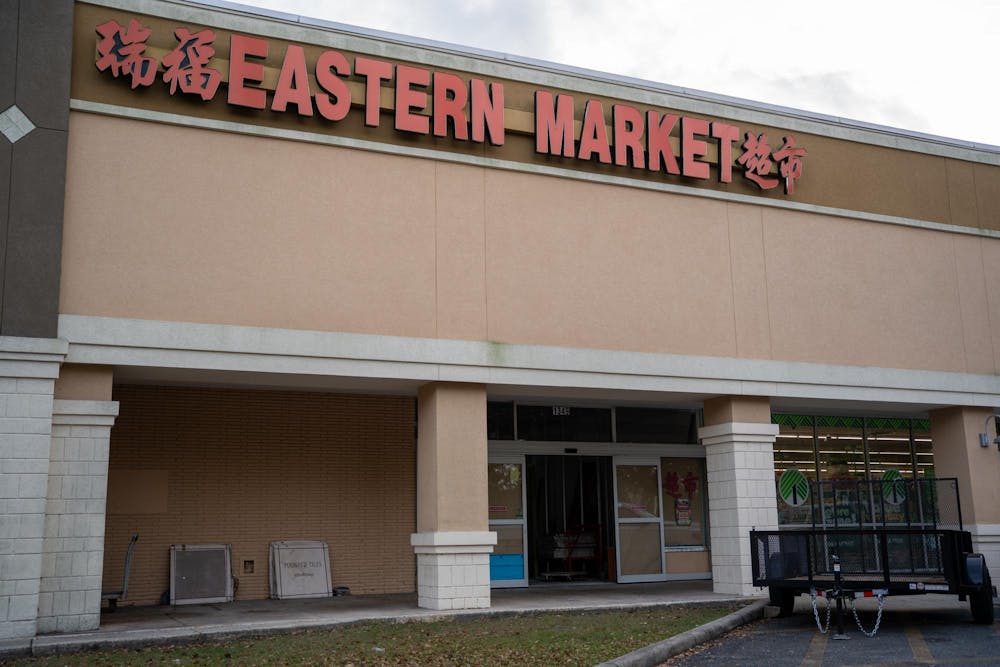
The effects extend beyond just households. Grocery stores and food retailers depend on predictable customer flows. If transit riders cannot reach stores reliably, demand falls. This makes it harder to justify maintaining or expanding full-service grocery options in already underserved areas. Eastern Market's sudden closure on Northwest 23rd Avenue highlights the volatility of these businesses. A sharp drop or a long decline in revenue will close doors, and thus stomachs become as empty as stores’ hauled-out shelves.
In this way, transit cuts in Gainesville may not just worsen food deserts; they could help create them.
The university's funding cut accelerates this process because of who uses RTS: Students make up a large share of riders, but they are not the only group affected. RTS also serves workers, families, seniors and residents without access to private vehicles. When service is reduced, the burden concentrates on those groups — especially on people whose schedules are inflexible and whose budgets cannot absorb higher transportation costs.
So how does UF as a community fight against food insecurity?
Students must use the RTS system as much as possible. UF is content with replacing buses with free Lyft rides and funding new food options on campus, yet none of those options can get students, let alone non-students, to grocery stores. A lack of systemic engagement from the student body will only dignify the university's decision to reduce support for RTS, drying up any potential to reinstate the lost RTS funding.
A significant increase in student ridership would indicate a heightened demand for the buses, requiring additional funding to hire workers, reinstate old lines and fund more frequent routes. Luckily, as students, we don't have to pay any fees to ride the bus. This means we can use RTS more than anyone else in the city, driving up ridership while not having to incur any financial costs. Even though the majority of victims of systemic food insecurity typically won't be found in the dorms, the student body may potentially have the biggest impact on rectifying the situation.
Contact Sasha Morel at smorel@alligator.org. Follow him on X @BySashaMorel.
Sasha Morel is a sophomore at the University of Florida studying Politics, Philosophy, Economics, and Law, as well as Anthropology. His returning column focuses on policy analysis surrounding domestic, global, and local politics, with a focus on targeting root causes of common issues and highlighting unrepresented perspectives. Outside of the Alligator, Sasha is a nationally recognized debate coach for high schoolers across the US.