

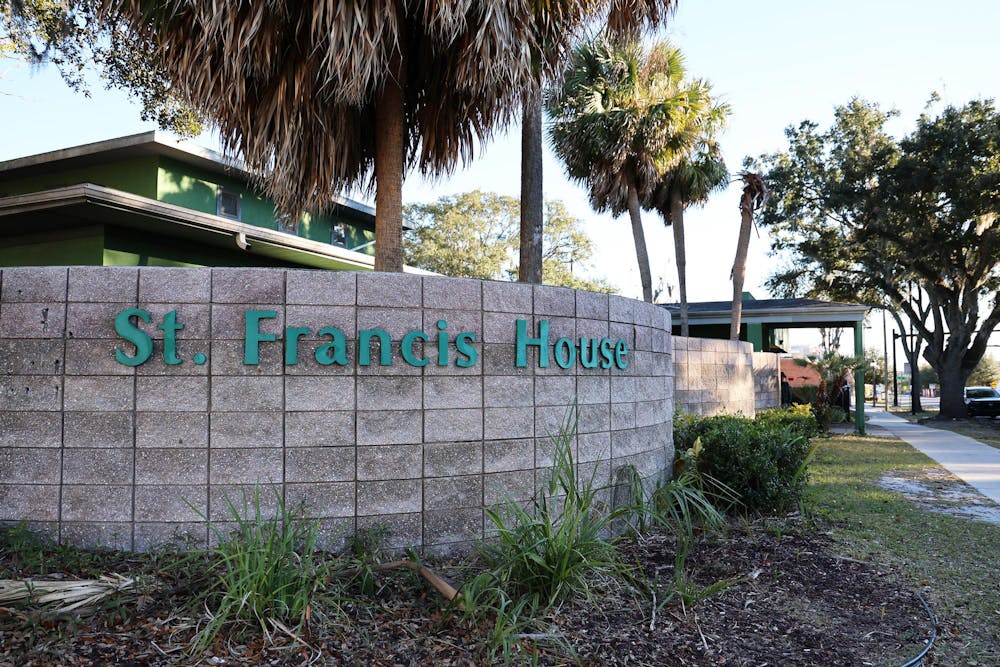
For overnight guests at St. Francis House, colder days are business as usual. Doors close at noon, and dinner is served at 6 p.m. before guests retire to their rooms. But, on Monday and Tuesday, staff routines will look slightly different as the shelter reopens its doors to cold night guests for the seventh and eighth times this winter.
Cold night shelters
When the temperature drops below 45 degrees, the shelter checks in cold night guests between 7 and 9 p.m., where they are required to show a blue card issued by the Gainesville Police Department — a document certifying the guest has no arrest warrants and is not a sexual offender.
Once indoors, guests receive mattresses and are directed to the cafeteria, where they may claim a spot for the night. Blankets and towels are distributed. Access is granted to the laundry room, bathrooms and showers. Dinner and breakfast are both served.
To shelter guests, the procedure is familiar, but to staff, winter may mean more work.
“It does put a little bit of a strain on us when we take in more people,” said Katelyn Drummet, the director of development for St. Francis House.
When the cold night initiative is activated, St. Francis House is allowed to admit an additional 60 guests. In reality, the shelter only takes in 20 to 25 more people than usual, but with the shelter already at capacity most nights, even a small influx burdens resources, Drummet said.
In preparation, St. Francis House reaches out to donors to increase its stock, she added. Linens, pillows, warm weather clothing and more food are all gathered prior to ensure proper accommodation.
Though the shelter has never had to turn anyone away, Drummet said more shelter options would “never be a bad thing.”
The main organizer
The Cold Night Shelter program is made available by the City of Gainesville and normally runs between Nov. 1 and March 31.
City Emergency Manager Alvin Jones said the program’s goal is community outreach for all residents who may struggle to stay warm in the winter, not just homeless individuals.
“Just having somewhere they can go to spend overnight, just to make sure they’re staying warm and have shelter for those times, I think that’s a big outreach for the community,” he said.
Unlike the shelters, Jones’ cold night duties begin months in advance, when he updates the city’s shelter contact list ahead of the winter season. Aside from St. Francis house, he said, the city partners with three other shelters: Grace Marketplace, Keys to Home and TaskForce Florida.
Jones said the city emergency management office monitors the weather on a daily basis and sends authorizations to shelters, typically with 48 hours notice, if they pinpoint cold weather. The authorizations, he said, include confirmations for the shelters to activate the cold night initiative, listing both the specific date and expected temperatures.
The success of the CNS program, Jones added, is owed to the shelter staff.
“If we didn’t have people who were actively finding resources to make sure they have what they need to activate those shelters, then they wouldn’t be a thing,” he said.
Outside assistance
Mark Sexton, Alachua County’s communications director, said the county’s role is secondary to the city’s. While Gainesville runs the program, Alachua County uses its social media reach to disseminate news of its activation.
“We really appreciate that the city does the organization work and gets these messages out,” he said. “We’re glad to be a part of that.”
The county is also responsible for nonprofit funding, he said. St. Francis House is a recipient of the community agency grant, a grant offered to non-profit organizations helping to bridge the poverty gap in Alachua County.
Sexton said he believes the CNS program has a “black and white goal”: to ensure people are warm and the county is proving a place where people can stay safe. He emphasized the importance of giving credit to the city and the shelters for the initiative.
“I think it works beautifully,” he said.
The cold night shelters have been activated six times this winter and will reopen Monday and Tuesday as temperatures drop.
Contact Maria Arruda at marruda@alligator.org. Follow her on X at @mariazalfarruda.

Maria Arruda is a journalism and political science junior and the Fall 2026 University Editor. Across two consecutive semesters, Maria served as the student government and city commission reporter, respectively. This past summer, she worked as a communications intern in Paris, and in her free time, she enjoys reading and exercising.


