
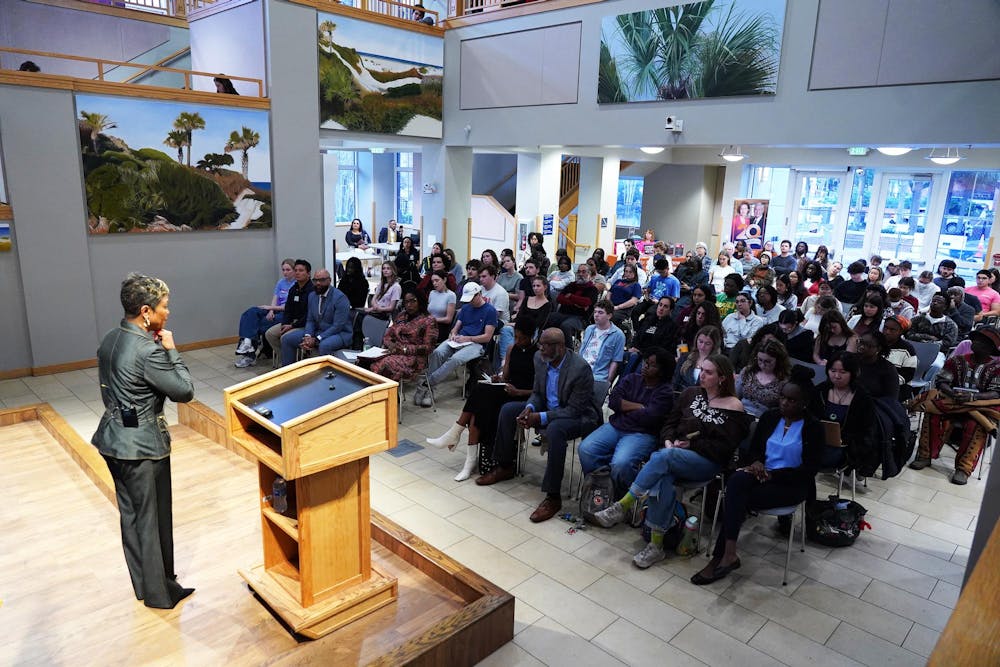
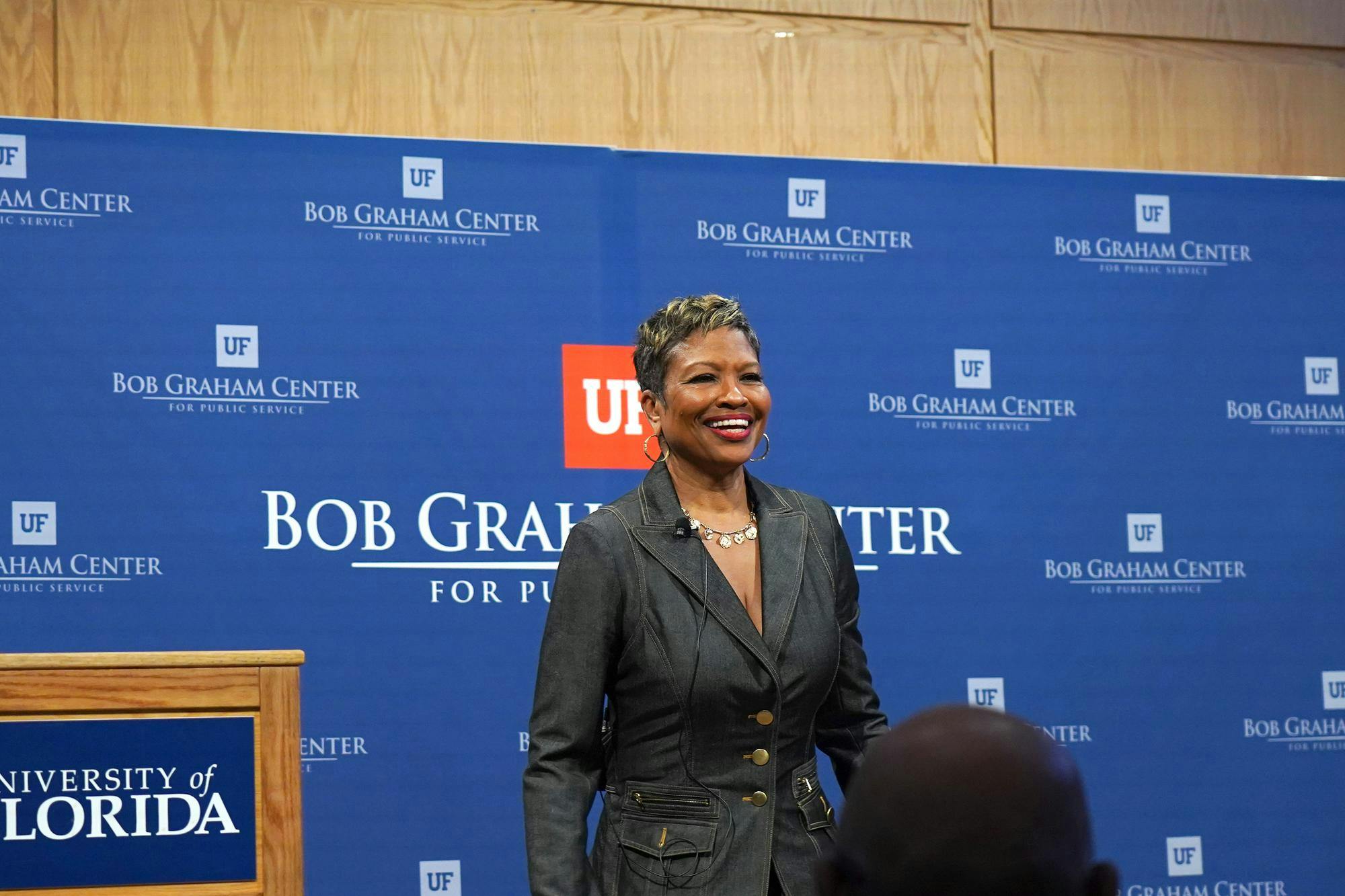
In honor of Martin Luther King Jr. Day, Dr. Kathi A. Earles visited UF’s Bob Graham Center for Public Service Thursday evening to share her research on health disparities.
The author, speaker and artist spoke to a group of about 70 people on how climate change affects environmental and physical health, particularly in Black communities.
“We are just one degree away from irreversible harm,” Earles said. “And yet one act away from turning the tide.”
The presentation started with a video, in which Earles shared the impact of climbing temperatures on air quality and health. Earles said since the first Industrial Revolution, Earth’s temperatures have risen to 1.3 degrees Celsius above what is safe.
Asthma now affects Black children twice as often as before the revolution, and floods alter the lives of the poor more than those of wealthy individuals.
Earles also shared the science behind climate change. She said gases like carbon dioxide, methane, nitrous oxide, particulate matter and fluorinated gases work together to create major weather changes that directly impact health.
For example, methane has caused damage in Cashmere Gardens, a group of homes built next to an abandoned factory in Houston, she said. Earles explained that due to a methane contamination in Cashmere Garden’s water supply, residents in that area experienced a 42% cancer prevalence, compared to a 6% cancer prevalence in all of Houston.
Alana Cumberbatch, a 21-year-old UF political science and history major junior, said the statistics of cancer in Cashmere Gardens surprised her.
“The risk of cancer being so much higher in that one community — I thought that was surprising,” she said. “It shows how disproportionate the climate change effects are.”
The unequal effects of climate change stem from systemic marginalization created by policies put in place centuries ago, Earles said, like the Homestead Act of 1862 and the GI Bill of 1944, which were both designed to affect low-income communities.
As she moved into how the impacts of climate change have transferred into today's world, she mentioned issues in South Atlanta, where many communities are built next to freeways. Earles said exposure to automobile exhaust is impacting the respiratory health of residents.
She then explained these low-income communities are being marginalized from an economic and educational standpoint. With more concrete, fewer trees and limited access to healthy foods, Earles said, younger generations are becoming more affected.
“So here we are again,” Earles said, “we have this disparity that has been systematically created.”
Earles then suggested solutions that can be used to combat climate change, including hydroponic gardens and urban green spaces. She also emphasized the importance of school-based wellness programs and health surveys to educate communities.
Even though Earles said government interference is necessary, she encouraged the audience to incorporate small actions of sustainability and environmental awareness into their lives.
“If we know better, we do better,” she said.
Activities like planting trees, recycling, using public transport and enlightening peers and family, Earles said, are all ways individuals can make a difference.
Kailyn Haddox, a 20-year-old UF environmental science junior, attended this event due to her interest in health disparities. Haddox said it made her more aware of the situations within disparities, and she was educated on the solutions.
“I had normally heard about the problem,” Haddox said, “but not as much about the solutions.”
Kayla Cash, a 23-year-old UF pharmacy student, said hearing about King’s goals beyond racial justice inspired her to learn more about the work King did.
“That was nice to hear about,” Cash said, “Makes me want to do more research into everything else he’s done.”
Contact Alabama Weninegar at aweninegar@alligator.org. Follow her on X at @AlabamaW40513.
Alabama Weninegar is a first-year journalism major and The Alligator's Spring 2026 University General Assignment Reporter. She also works a part-time job at Wyatt's Coffee downtown. In her free time, she enjoys watching her favorite shows on a rainy day or re-reading the Twilight series.