

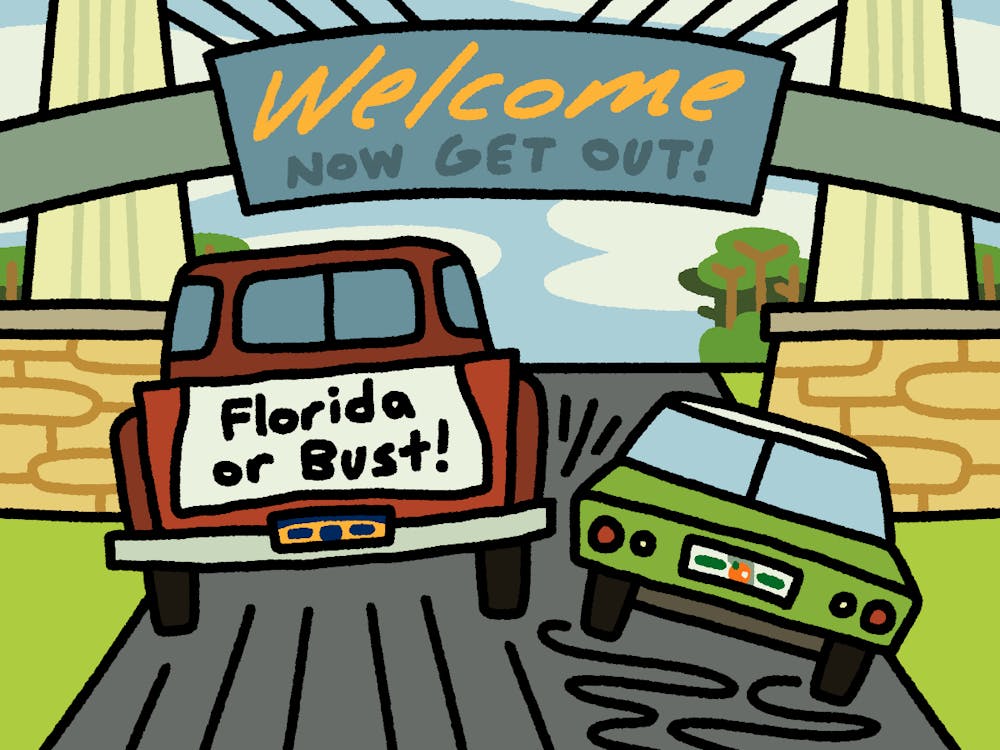
I’ve lived in Florida for my entire life. Since 2012, my family has lived in the same home on the outskirts of Orlando. Drives that once took 40 minutes now stretch into an hour or more, a result of rapid population growth and unchecked development in a state unprepared to absorb it.
Between 2012 and 2024, Florida’s population grew by nearly 4 million people, according to FL Health Charts. In 2023 alone, the U.S. Census Bureau reported a net gain of 636,933 residents through state-to-state migration.
Much of the migration came from states with vastly different economic and political climates from Florida. Census data from 2023 shows over 70,000 people moved to Florida from New York that year, over 39,000 from California, over 24,000 from Massachusetts and tens of thousands from Northeastern states.
These states share similar tax structures, costs of living and approaches to government. They impose state income taxes, maintain higher costs of living and lean toward expansive government policies. In contrast, Florida does not levy a state income tax and has historically offered a comparatively lower cost of living along with a less regulated environment, attracting businesses, workers and families seeking relief from those economic constraints.
The problem: Florida is being reshaped at a pace it cannot sustain. Within 30 minutes of my home, six massive residential developments have appeared in the last five years. Roads that once served native Floridians now struggle to accommodate the added volume, turning ordinary trips into hourlong ordeals, indicating that the state has taken on more growth than it can handle.
That growth does not stop at roads and neighborhoods. Roughly one-third of Florida’s land is currently used for agriculture, but development is steadily consuming it. Researchers at UF estimate the state is losing about 120 acres of agricultural land each day to development, amounting to nearly 45,000 acres each year. Once that land is paved over, it is permanently removed from production and from Florida’s agricultural identity.
Many transplants are leaving states burdened by the economic consequences of their own policy choices. Florida’s economy thrives on low taxes and limited government. But many newcomers bring political views that risk pushing Florida toward the same policies they left behind. Florida’s appeal depends on preserving the policies that made it an alternative to states whose residents supported policy choices that priced them out through excessive taxation and regulation.
For lifelong Floridians, the consequences are immediate and unavoidable. The influx of out-of-state residents has strained housing, infrastructure and local resources, shifting priorities away from the people who built their lives here first. Families long invested in Florida are left paying more, waiting longer and watching their state change to accommodate people who did not grow up here. As transplants advocate for the same policies that contributed to the decline of the states they left behind, Florida risks following a similar, damaging trajectory.
Florida’s growth has crossed a line. The evidence is visible in worsening traffic, rapid development and shrinking farmland. Florida is too full to absorb the consequences of other states’ failed policies. Without a commitment to protecting Florida’s economic model and land, growth will continue at the expense of affordability and livability.
Contact Alannah Peters @apeters@alligator.org. Follow her on X @alannahjp777.
Alannah Peters is a junior majoring in journalism and minoring in public relations. In her spare time, she can be found trying new coffee shops with friends, traveling the U.S. or going on hot girl walks at Lake Alice.