

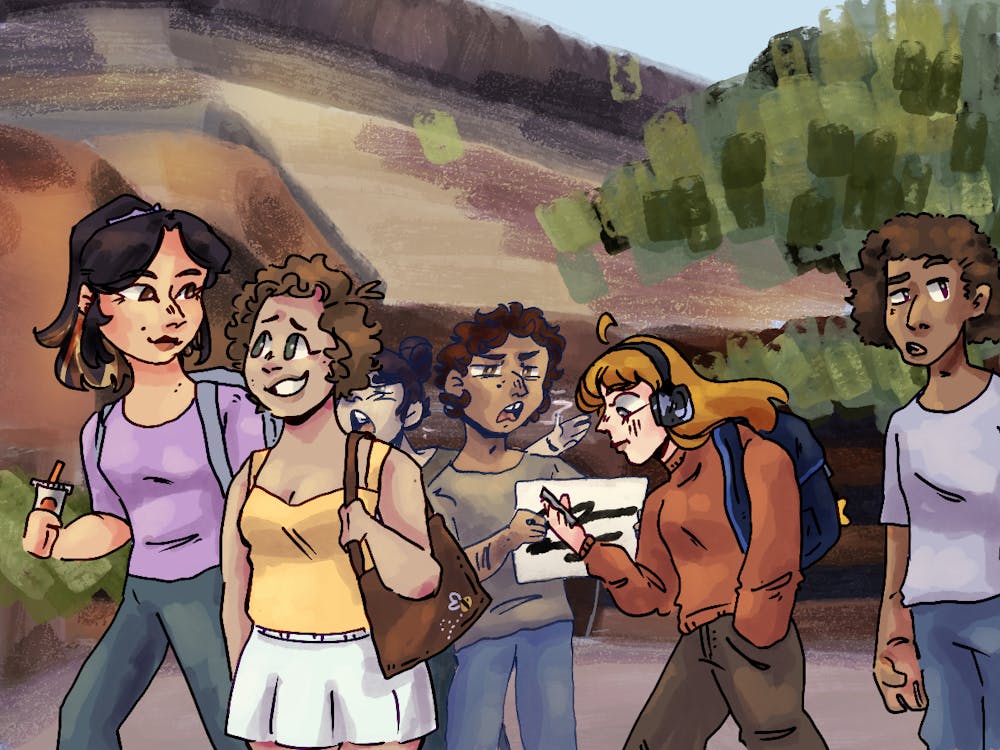
Political engagement among young people has fractured into two exhausting extremes, both of which push students toward disengagement. What once felt urgent now feels overwhelming as constant political messaging and social pressure leave many young people emotionally depleted.
On one end of the spectrum are young people who once cared deeply. They organized, marched, posted infographics and publicly aligned themselves with causes, believing visibility would translate into change. Instead, they watched intense moments of activism draw attention without producing meaningful policy outcomes, leaving frustration where conviction once existed.
On the other end of the spectrum are students who describe themselves as apolitical — not out of ignorance, but out of self-preservation. In an environment where political expression is expected and disagreement is often treated as moral failure, some students choose silence rather than risk conflict or social fallout.
A friend of mine described how a decade-long friendship became strained after repeated demands to engage politically. Her friend sent political videos, pushed for responses and insisted on public alignment despite knowing they fundamentally disagreed. Already disengaged from politics, her aversion only deepened with the pressure. She ultimately told her friend they needed to stop discussing politics altogether if the friendship was going to continue.
Experiences like this are not isolated. They reflect a broader culture of performative activism, where political engagement is measured less by action or outcome and more by visibility, language and public alignment. In this type of environment, participation becomes less about persuasion or progress and more about proving where one stands. For students who already feel disconnected from politics, this pressure reinforces disengagement rather than challenging it.
National data reflects this growing sense of disengagement. A 2024 post-election study by Tufts University Center for Information & Research on Civic Learning and Engagement found that voter turnout for people aged 18 to 29 fell from over 50% in the 2020 presidential election to about 42% in 2024. Among young nonvoters ages 18 to 34, more than a third reported not voting because they didn’t view voting as important, pointing to disengagement that extends beyond logistical barriers to participation.
This disengagement is closely tied to emotional exhaustion. A 2023 study published through the National Library of Medicine examines sociopolitical stress among over 600 college students across 10 universities. It found that two in three Gen Z youth identified the 2020 U.S. presidential election as a source of stress. The same poll found Gen Z reported significantly higher stress levels than all older generations.
At UF, where political discourse is constant and visibility often replaces substance, disengagement is frequently misread as ignorance or apathy. For many students, however, stepping back from politics is a deliberate choice shaped by exhaustion and social pressure rather than a lack of awareness.
Disengagement is not a lack of concern but the result of exhaustion. Burnout, not apathy, is shaping Gen Z’s relationship with politics.
Contact Alannah Peters at apeters@alligator.org. Follow her on X @alannahpeters777.
Alannah Peters is a junior majoring in journalism and minoring in public relations. In her spare time, she can be found trying new coffee shops with friends, traveling the U.S. or going on hot girl walks at Lake Alice.