
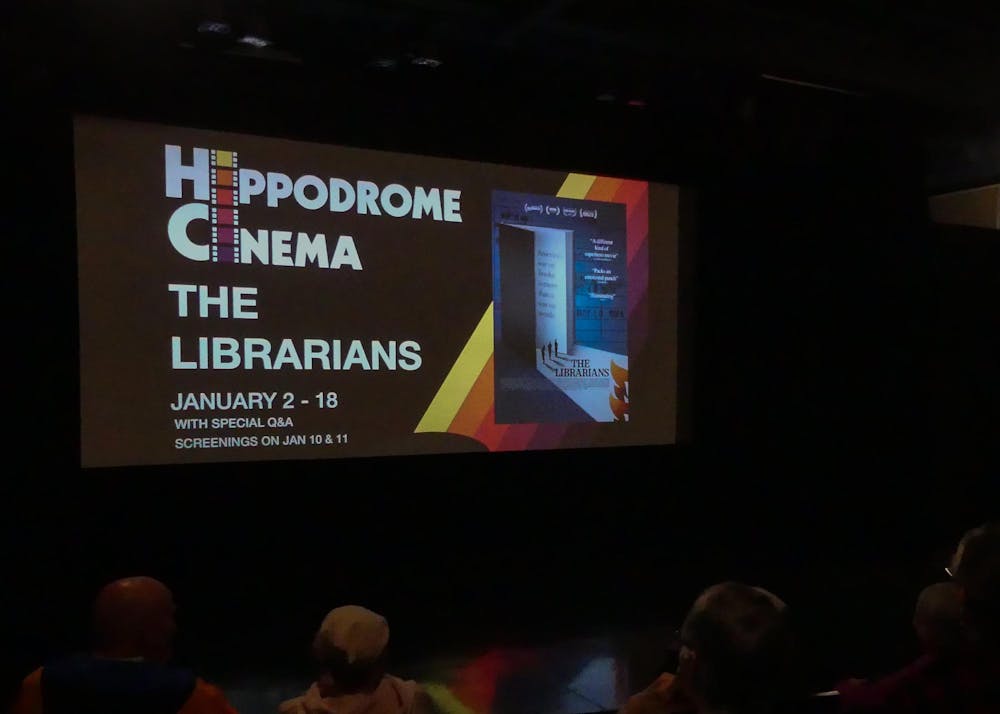
As the lights dimmed in the Hippodrome State Theatre, bringing the noise of the crowd to a sudden, hushed silence, author Ray Bradbury’s words blazed across the screen — a quote from his book, “Fahrenheit 451.”
“It was a pleasure to burn. It was a special pleasure to see things eaten, to see things blackened and changed.”
The Hippodrome’s screening of the 2025 documentary “The Librarians” on Sunday, held in collaboration with The Lynx bookstore, brought a crowded theater. The local bookstore joined organizations like the Freedom to Read Project in promoting the film during its Jan. 10-18 run at the Hippodrome.
The documentary follows several school librarians and community leaders in Texas and Florida as they navigate unprecedented book bans in their counties. Through heated school board meetings, intimate conversations and moving conferences, the film traces the political battle being waged in schools.
When she booked the film, the Hippodrome’s cinema director, 57-year-old Naheed Mojadidi, said she didn’t know it would attract audiences from around Florida, including visitors from Tampa.
“I definitely think there's something special about Gainesville,” she said. “The college town itself really lends itself to self-education. People are here to learn, people come here to learn and experience new things.”
Mojadidi said Alachua County is crucial to the state of Florida. She calls Gainesville an “island of blue” in a state that voted red in the past three presidential elections.
Despite being a democratic county, Alachua still faces challenges from conservative voices when it comes to education. According to data from PEN America, three books were banned in the county during the 2024-2025 school year. This number is relatively low compared to others in the state, including Clay County, which is heavily featured in “The Librarians” and recorded 395 book bans over the same period.
Gov. Ron DeSantis first enforced stricter policies for school reading materials in 2022 with a bill requiring public elementary schools to publish all library material. It specifically required all books to be “free of pornography.” The following year, the legislature expanded these limits with another bill, which required state approval for materials dealing with reproductive health and prohibited lessons about sexual orientation and gender identity for elementary and middle schoolers.
Similar legislative action happened in states like Texas, featured in “The Librarians.” Lawmakers targeted books dealing with LGBTQ+ themes, as well as those written by authors of color.
Sophia Brown, the 24-year-old program coordinator for PEN America Florida, shared her experiences combatting censorship as a panelist at the screening. For her, book bans are still a very real threat, even in liberal areas.
“The sad fact is that book bans, especially right now in America, they happen everywhere, regardless of if it's a Republican state, a Democratic state, a blue dot, a red dot,” she said.
During her time as a student at New College of Florida, a university in Sarasota that DeSantis overhauled in 2023, Brown saw books dealing with themes of diversity and sexuality removed from her school libraries.
While many book bans target elementary, middle and high schools, Brown emphasized bans and "educational gag orders” can happen at the university level.
Despite these changes, Brown calls coming to Gainesville “a treat” because of the community's support for free speech, which she sees in the work of The Lynx bookstore.
“Independent bookstores in Florida do a lot for this fight,” Brown said. “They do a lot to create those resources and those avenues to have these discussions that people are increasingly afraid to have in public schools and universities.”
Both students and teachers are impacted by these bans. When surveyed by First Book in 2023, 65% of educators reported that book banning negatively impacted their ability to teach. In the same survey, 72% reported that banning books worsens students’ reading engagement.
Viv Schnabel, events manager for The Lynx, tabled before the screening and spoke as a panelist alongside Brown. They offered a “Write to your Representative” kit, which visitors could use to vocalize their concern for book banning and censorship to government officials.
As a bookstore employee, Schnabel said they feel they have a responsibility to offer banned books people might not have access to through public libraries, which are subject to restrictions by the government. The Lynx has a Banned Books Club, which will collaborate with the Alachua County Jail in the future to read challenged books.
For Schnabel, book bans are not just about the books, but the people whose identities are represented in them. During the Q&A after the screening, they said they believe each book ban sends a message to the community.
“You're saying, ‘You're not welcome here,’” they said. “‘We would rather you did not exist here,’ and that is so incredibly harmful.”
Contact Juliana DeFilippo at jdefillipo@alligator.org. Follow her on X @JulianaDeF58101.
Juliana is a second-year journalism student and the Spring 2026 Enterprise environment reporter. This is her fourth semester on The Alligator, and she previously served as an Avenue reporter and the Fall 2025 Avenue editor. In her free time, she loves reading, updating her Letterboxd account and doing crosswords.