

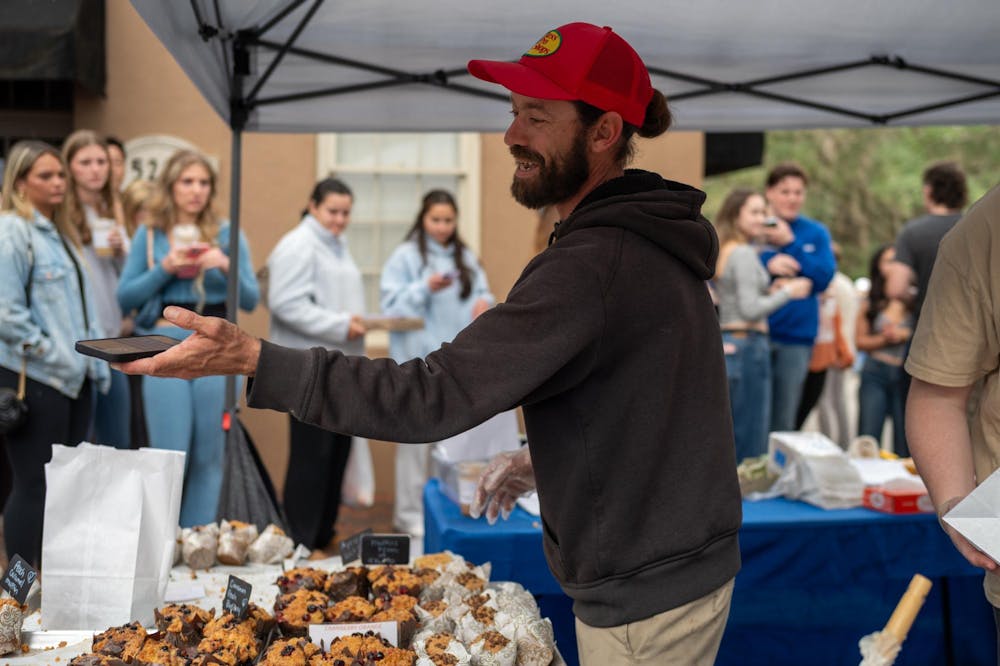
As I visited Haile Farmers Market Jan. 17, I noticed an irony — the word “farmer” in Haile Farmers Market is clearly the least important word in the sequence.
An abundance of designer-wearing and $8 cold-brew-sipping shoppers were buying goods from overpriced sticker shops and artisan carpenters. Virtually no one was seriously buying groceries from the few farmers selling produce. In Gainesville, a growing number of markets are drifting into a different identity — less “farm stand” and more “Etsy-inspired outdoor mall.”
Farmers markets are supposed to be the city’s antidote to industrial food: shorter supply chains, more money staying in the region and a direct relationship between the person who grows the food and the person who eats it.
This shift has consequences: local farmers get priced out, and customers end up paying more for less truly local food.
Let’s start with the basic math of accessibility.
Markets charge vendors fees, which aren’t inherently bad. Permitting, trash, staffing, insurance and advertising all cost money. The problem is what those fees do to small producers who operate on thin margins and what kinds of vendors these markets end up privileging.
Take Grove Street Farmers Market as an example. It lists a $70 monthly fee for a 10-by-10-foot booth space, paid in full each month a vendor participates. Haile Farmers Market lays out a $25 annual membership fee and booth fees that can be paid monthly or weekly (with weekly costing more).
These numbers might not look terrifying to a consumer walking through with a cold brew. But for a small farmer, they’re a fixed cost that comes before you sell any produce. Add fuel, packaging, labor, post-harvest loss and whatever got wiped out by rain, pests or a cold snap, and the “just show up and sell” fantasy collapses fast.
And because they’re fixed costs, fees hit the smallest farms the hardest. A larger farm can spread a booth fee across higher volume. A backyard grower with a few beds of greens can’t. So markets, unintentionally or not, select vendors who can reliably move products in quantity — or those who sell higher-margin goods that aren’t necessarily farm-grown produce.
This selection pressure is exactly how a market slowly stops being “for farmers.” The booth becomes more rational for prepared foods, lifestyle items and artisan products that can absorb costs with margins a farmer rarely gets. Meanwhile, the actual growers — especially new growers — are forced into a corner: either raise prices, sell more volume than their operation can sustainably manage or stop coming entirely.
Even when fees aren’t the main barrier, gatekeeping can be. Haile’s site notes it is “temporarily not accepting new vendors” and emphasizes that applications are accepted case-by-case by the market manager. This might be operationally reasonable (no one wants 10 identical soap stands).
But it also means access to the city’s most lucrative “local” consumer base can tighten into a kind of controlled marketplace — one where the costs and approval process are easier for established brands than for a farmer trying to scale from “I have a surplus” to “this is my livelihood.”
Now, let’s zoom out to the customer side.
When small farmers drop out, competition drops out with them. Variety shrinks. Seasonality becomes a marketing aesthetic instead of an actual constraint. Markets then lean harder into the vendors who remain year-round: packaged goods, ready-to-eat meals and artisan crafts.
This is how you end up with the second half of the problem: rising prices. If the market is dominated by higher-margin sellers, the average item price goes up — even if a few produce vendors still keep some staples affordable.
This shift undermines the civic purpose of feeding communities, which farmers build their businesses to serve. We say markets are about community health and food accessibility. But access is not built on bringing in as many vendors as possible.
It’s built on whether normal households can buy normal groceries there — eggs, greens, root vegetables and fruits — at prices that compete with supermarkets. When markets become expensive, they stop functioning as food infrastructure and start functioning as entertainment.
So, how can this be fixed?
First, markets should adopt sliding-scale booth fees based on the type of vendor and the scale of production. If you’re selling craft goods with strong margins, you can subsidize the presence of low-margin produce farmers who anchor the market’s mission. A farmers market without farmers is a brand, not a food system.
Second, markets should reserve guaranteed, low-cost slots specifically for small local growers — especially new growers — and rotate those slots so that the barrier to entry isn’t a monthly commitment.
One reason the Alachua County Farmers’ Market model matters is it clearly states a per-attendance daily space rental fee, which reduces the risk of committing cash upfront before you know whether you can sell through your harvest. More markets should build that flexibility into their structure.
Third, markets should publicly report their vendor mix: how many vendors are farm producers versus prepared food versus crafts, and how many are within a defined local radius. If a market’s identity is “local food,” the metrics should be transparent. Otherwise, “local” becomes a label that consumers assume and organizers benefit from without accountability.
Vendors that don’t prioritize low-cost food options and their customers have a right to business, and quite frankly, it’s also a cultural and economic positive for the city. But what underlies fostering a positive culture and economic growth is, and unfortunately has been, a city ravaged by food insecurity.
The irony of pricing farmers out of “farmers markets” is more than semantic. It’s a quiet admission that our local food culture is becoming less about farming and more about consumption. And if Gainesville wants “local” to mean something real, it has to be affordable for the people who grow it — and the people who need it.
Contact Sasha at smorel@alligator.org. Follow him on X @BySashaMorel.
Sasha Morel is a sophomore at the University of Florida studying Politics, Philosophy, Economics, and Law, as well as Anthropology. His returning column focuses on policy analysis surrounding domestic, global, and local politics, with a focus on targeting root causes of common issues and highlighting unrepresented perspectives. Outside of the Alligator, Sasha is a nationally recognized debate coach for high schoolers across the US.