

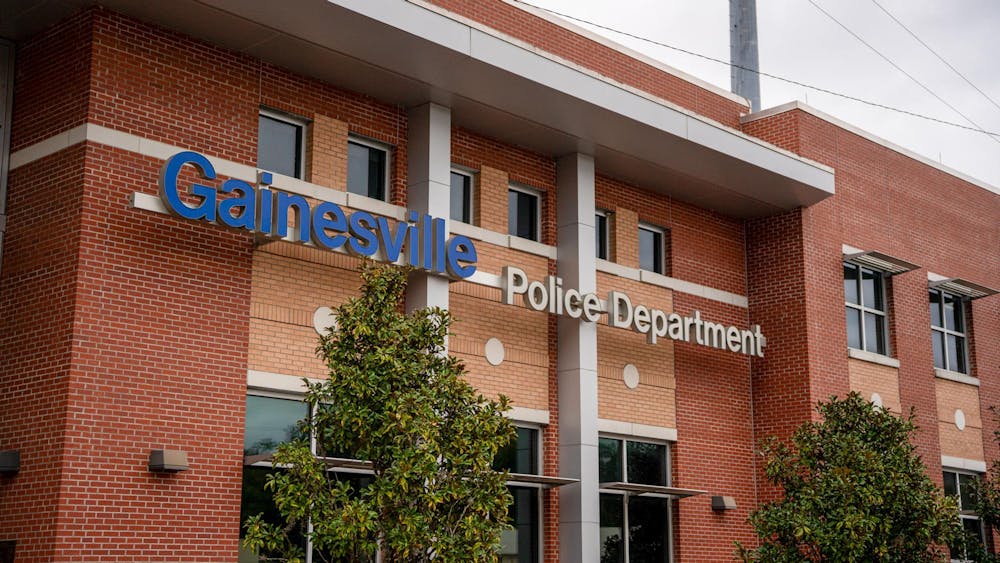
Gainesville is the second-largest city in Florida whose police department has not signed an agreement with U.S. Immigration and Customs Enforcement.
A 287(g) agreement is an ICE program that allows state and local law enforcement officers to act as deputized federal immigration agents. Under the program, trained officers can serve warrants for immigration violations, question individuals about their immigration status and detain people for potential deportation proceedings.
The Alachua County Sheriff’s Office and the University Police Department have both signed the agreement, as have police departments in large cities like Jacksonville, Miami and Tampa.
Gov. Ron DeSantis directed state law enforcement — including the Florida State Guard and Florida Highway Patrol — to enter into agreements with ICE in early 2025. All of Florida’s 67 counties have now signed agreements, and their law enforcement officers are able to act as ICE agents.
The law, however, did not specify whether cities have to sign agreements, leading to disputes between the state government and cities that have resisted signing.
In a town hall meeting in October 2025, Gainesville Chief of Police Nelson Moya said he wouldn’t sign one yet.
“It does make me nervous, because everybody around GPD and the city has, for reasons that I can appreciate, signed that agreement,” Moya said. “Because I don’t have a clearer picture, I’ve been foregoing a signature.”
However, he said he felt pressure to sign into agreements was building, and he thought it was a “matter of time before that agreement is absolutely invoked.”
Four months later, GPD is still holding out.
“Currently, we have not entered into a 287(g) agreement,” wrote Art Forgey, GPD’s public information officer, in an email to The Alligator Feb. 13. “We are carefully evaluating all available courses of action within our command structure and will make decisions consistent with our policies, legal obligations, and the best interests of our community.”
Gainesville Mayor Harvey Ward said the community needs its officers to remain focused on “the things that Gainesville Police Department does,” like improving public safety and lowering crime.
As an elected official, Ward emphasized he doesn’t direct police administrative work. But to his knowledge, no one has demanded GPD sign an agreement with ICE, nor is one in the works, he said.
“They're focused on public safety,” he said of GPD officers. “And they want to make sure that our neighbors, people in our community, are as safe as possible, and that people don't get hurt. That's where our focus has been.”
The city of Gainesville doesn’t operate a jail, Ward pointed out, which makes its police department less practically valuable to ICE. The federal agency uses local jails as its primary network for identifying, detaining and transferring immigrants.
A slow stream of ICE detainees has moved through the Alachua County Jail since last year, with the most recent ICE transit appearing in booking logs Feb. 25.
Capt. Chris Sims with Alachua County Sheriff’s Office said Gainesville, as a city, has a right to not sign the agreement.
Making assumptions about the department’s reasons for not doing so would be improper, he said, and he has not heard of any future GPD plan to sign the agreement.
“The city’s decision is that of their own. We are not part of that process,” he said.
Tim Marden, the chairman of Alachua County Republicans and mayor of Newberry, said he thinks GPD hasn’t signed the agreement because Gainesville is “a welcoming city.” Newberry does not have a city police department, and its law enforcement services are provided by the Alachua County Sheriff’s Office.
Gainesville promotes immigration, Marden said, and political dynamics prevent them from signing the agreement.
Marden said he’d “guarantee” leaders of GPD don’t agree with the workings of ICE. After living in Alachua County for more than three decades, he believes the city is politically left-leaning, pursuing green policies and social programs, he added.
“It’s a shame that they can’t see beyond their political bias as to what is good and is not good for a community,” Marden said.
Juan Osorio, the president of UF College Democrats, said he thinks GPD hasn’t signed a 287(g) agreement because its leaders are prioritizing residents’ concerns about how an agreement with ICE affects public safety, as well as upholding an inclusive environment.
“I think it’s because we elect strong public officials,” Osorio said. “Our current leadership is doing the right thing, listening to constituents’ concerns.”
In Gainesville, the city manager, rather than the elected commissioners and mayor, oversees GPD. That structure differs from cities like Jacksonville, where the mayor can appoint and remove the police chief.
Osorio said Gainesville is home to a mix of people from all over the world, and GPD makes it welcoming for everyone who resides here. Not signing the agreement is protecting a city shared by a diverse population, he said.
As of 2023, more than 17,000 Gainesville residents are foreign-born, making up 12% of the population.
Osorio said he appreciates Gainesville leaders who have not pushed for the agreement to be signed.
“To be here in a city that I know values our communities and works to protect them to the best of their ability, using every legal lever they have — I really appreciate that,” he said.
Zoey Thomas contributed to this report.
Contact Angelique Rodriguez at arodriguez@alligator.org. Follow her on X @angeliquesrod.
Lee la versión en español en línea

Angelique is a UF journalism sophomore and The Alligator's Fall 2026 El Caimán editor. She was formerly a UF Graduate School and El Caiman Enterprise reporter. Now in her fourth semester at The Alligator, Angie has reported and edited stories related to the Spanish language and culture. When she's not working, you can find Angie reading, watching rom-coms and hanging out with friends.


