
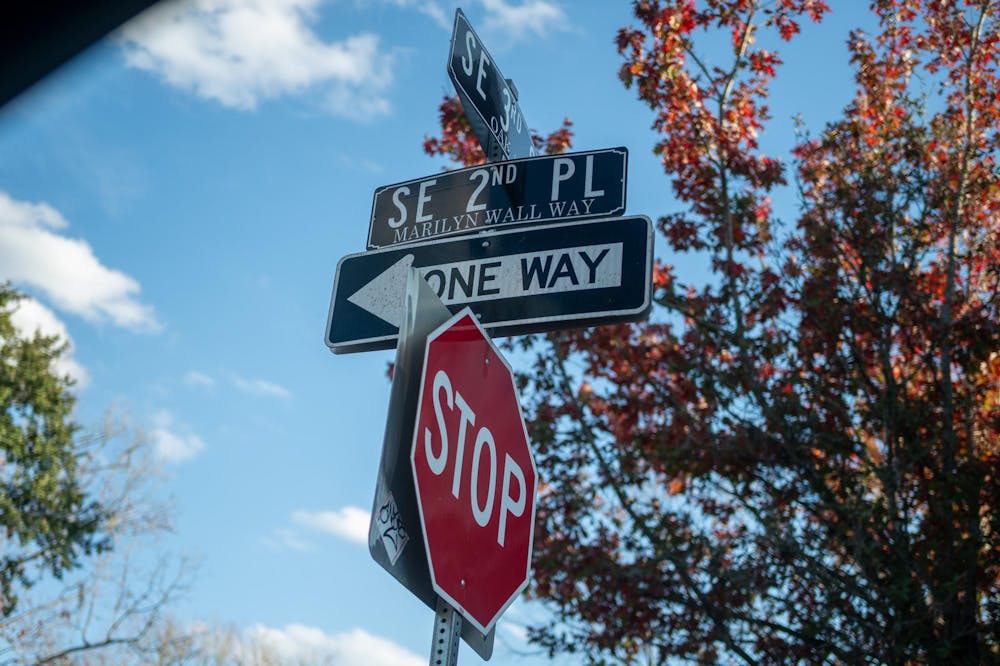
The city of Gainesville converted several streets near UF’s main campus into one-way pairs in January.
West 10th Street and West 12th Street, between Southwest Eighth Avenue and Northwest Eighth Avenue, now operate as one-ways to improve safety for drivers, cyclists and pedestrians along these busy corridors. The change affected access to popular student spots, including Sorority Row and The Swamp Restaurant.
Rossana Passaniti, the city’s public information officer, said the project has been in development for years.
“Transportation projects take a very long time,” she said. “We’re talking four years to get to this point. And so while it appears that, sometimes people think, ‘Oh my goodness, that just happened overnight,’ it’s actually been in the works quite a while.”
The goal of the one-way conversion is to reduce conflict points — areas where vehicles cross paths and crashes are more likely, she said. By removing opposing traffic, drivers no longer have to turn across oncoming lanes.
The decision to create the one-way corridors followed a traffic study conducted by tech consultant NV5, Passaniti said. The study concluded creating a one-way would reduce vehicle conflict points without worsening traffic.
Officials examined detailed traffic patterns, including how drivers enter and exit nearby businesses. For example, an analysis of the McDonald’s on West University Avenue showed relatively few drivers exiting the parking lot turn left onto 12th Street. So, converting that street into a one-way didn’t pose much of an inconvenience.
Passaniti said one-way roads keep traffic moving and make turns easier, because there’s no oncoming traffic. By eliminating flow in the opposite direction from people turning left out of McDonald’s, the city eliminates that crash point, she explained.
The urgency behind the project is reflected in city crash data. Between 2018 and 2022, 95 people were killed and 647 suffered severe injuries in crashes within Gainesville city limits. On average, 18 fatal crashes occur each year in the city.
Gainesville’s crash rate remains lower than the state average. The city is home to 0.58% of Florida’s traffic crashes but makes up 0.64% of Florida’s population, meaning residents elsewhere in Florida are about 11.8% more likely to get into a traffic accident. Though the difference seems small, it could mean a difference of 200 to 300 incidents annually.
Under Gainesville’s City Vision Zero plan, the city has committed to eliminating traffic deaths and severe injuries by 2040.
Passaniti acknowledged traffic pattern changes can be frustrating at first, especially for drivers who are used to traveling both directions on the same street.
“It certainly takes time to get used to construction projects, certainly when they change the flow of traffic. … I think it’s just really kind of an adjustment period,” she said. “At the end of the day, it’s really about public safety.”
She added safety concerns are particularly strong near student-heavy corridors like University Avenue.
“When we get the most phone calls, by far, from angry parents is when there is a serious injury or death to a student because they crossed out in front of traffic,” she said.
Students and local residents have expressed mixed reactions to the newly implemented one-way street pairs.
Marla Tokie, a 19-year-old UF journalism freshman, usually bikes around campus despite owning a car. She’s noticed changes in her daily commute since the conversion, she said.
While the one-way streets created more space for bikers and pedestrians, moving pedestrians and cyclists off of the busy University Avenue corridor, Tokie said she has concerns about how the changes function in practice.
For one, the narrowed roadway has created new challenges for drivers, like tighter road space. Tokie also noted the redesign has altered how she enters the Norman Hall Parking Garage, because she has to take a different street to get in.
“I also noticed … more cars kind of swerving around cars that are parked in that street,” Tokie said. “I’ve also noticed pedestrians kind of being more wary on that sidewalk.”
Though she acknowledged biking along University is too congested, she said the benefits of the new bike lanes don’t outweigh the added difficulty for drivers.
“I just think that as a driver, it’s really a hassle,” Tokie said. “And even as a biker, I think I would prefer for it to be the way it was.”
Steven Miller-Edwards, a 19-year-old UF applied physiology and kinesiology sophomore, lives in an apartment between Southwest Sixth Avenue and Southwest Seventh Avenue, which connects to West 12th Street. He frequently drives to the Southwest Recreation Center and to church, and he now uses Seventh Avenue when walking to class.
Miller-Edwards now has to drive an extra loop to return to his apartment, adding at least two minutes to his commute, sometimes more with traffic.
He’s concerned about how visitors will navigate the new traffic patterns during football weekends and other large events, he said.
“Making it a one-way is not that big of an issue for a resident,” Miller-Edwards said. “But especially for visitors — like my mom or … people who have just come to tailgate — I can guarantee traffic is either going to get backed up, or someone’s going to get in an accident.”
He said he was not aware 12th Street was being converted until the change occurred and assumed the road closure was due to repairs for potholes. According to Passaniti, the city made social media posts about the project, and it was also displayed during public workshops, presentations and corridor walks related to the reconfiguration of West University Avenue throughout 2023 and 2024.
At a City Commission meeting on Dec. 4, 2025, Mayor Harvey Ward acknowledged the city’s new one-way streets may be uncomfortable for residents but said the changes are necessary for Gainesville’s long-term growth.
Ward said the city's growth may be uncomfortable for longtime residents, but emphasized it is only going to continue to grow.
Ward said planning now is essential to managing future traffic, particularly as the city becomes denser.
“Traffic is going to get worse if we don’t plan for what to do differently,” he said. “The question we have to ask ourselves consistently is, ‘How do we keep traffic flowing in what is going to be a more dense city?’ — and I’m not talking about for tomorrow. I’m talking about 10 years from now or 20 years from now.”
Mia Giannicchi is a contributing writer for The Alligator.