

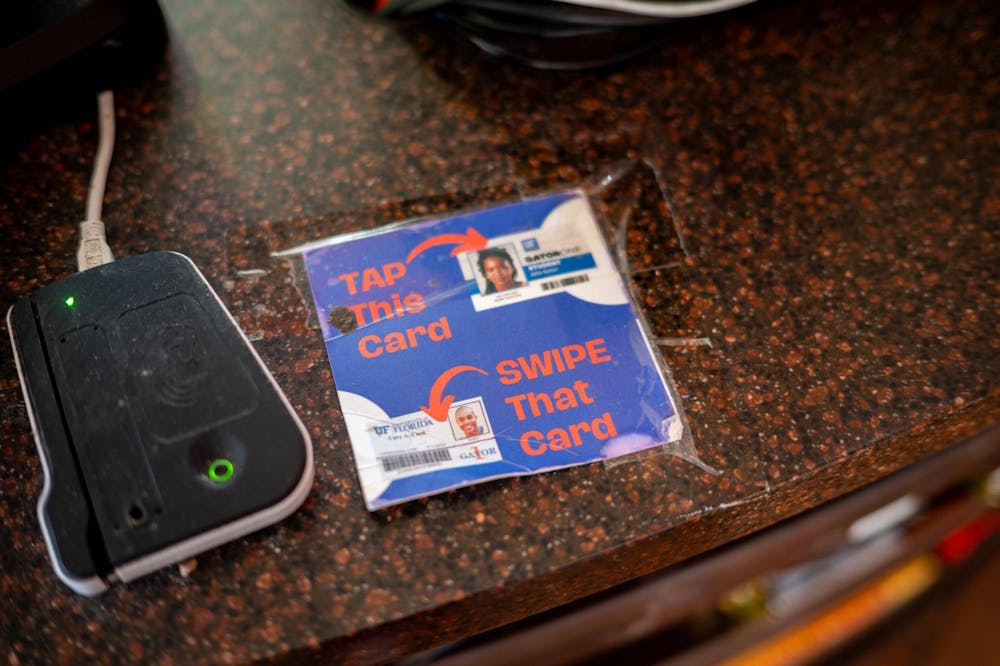
At UF, students who have meal plans are treated to an extra serving of school-sponsored food options. FLEX, derived from the word "flexible," is a currency established by the university allowing students with meal plans to spend money at restaurants on campus.
Every student meal plan, from the cheapest to the most expensive, includes at least $250 in FLEX, which has made UF’s new fiat money an unavoidable part of the dining experience. These meal plans convert real U.S. dollars into FLEX bucks, maintaining a one-to-one conversion rate at all of the restaurants accepting the currency on campus. But FLEX cannot be converted back into dollars.
In theory, this sounds like an intelligent method of creating more business on campus by encouraging students to diversify where they eat; in practice, however, I’ve noticed it seems to fail its primary goal of enriching the student experience. Instead, it locks them into an illusion of choice as UF makes itself richer and more able to control commerce in Gainesville.
FLEX has worsened the lives of both students and Gainesville residents. Here’s how.
FLEX keeps locally owned food options out of sight for meal plan owners. I’ve quickly realized FLEX doesn’t roll over between school years — only semester to semester. This pressures students to both ensure all of their FLEX is spent before the deadline and to repurchase a meal plan the following semester if they have any FLEX left.
Many freshmen — who are often the most reliant on meal plans — choose to consistently end up at the Subway inside of the Rawlings Hall Pod Market rather than locally owned options like Mom’s OG or Tela, which are right off campus.
One of the nuances that show a potential upside to the program is that a few of the businesses that accept FLEX are locally owned. The Paper Bag and B'z Gelati were created and currently operate out of Gainesville, which proves that if UF provided permanent spaces for locals to open restaurants (rather than simply expanding successful chains), FLEX could actually fuel the Gainesville economy and create a more cohesive network between meal plan owners and the city’s food scene.
But without said implementations, the use of FLEX continues to be a burden to the community — culturally and financially. Students miss out on culinary experiences that are not just better quality than what’s served on campus, but also often similarly priced. Buying into FLEX buys out the opportunity to try the cuisines and techniques curated by those whose dream is to serve food in their own restaurants.
This leads smaller restaurants, which lack the financial backing of campus fast-food chains, to fall into mere economic survival while FLEX-available restaurants prosper.
The fact that young adults can use FLEX to buy Starbucks or Peet’s coffee instead of using their checking accounts at local coffee shops means those chain stores have an oligopoly over FLEX-using students.
Year after year, reports from The Alligator and The Gainesville Sun list closures of restaurants off campus. Last year, restaurants like Applebee’s and TGI Fridays, with the backing from massive capital firms, closed. Even for chain restaurants, some of the biggest fish in our metaphorical pond, revenues are dipping below a sustainable level in Gainesville.
When we translate the same trend onto local businesses, wherein profits are try-or-die for feeding families, we begin to understand why food prices are rising in and around UF. With high rent and lowered traffic from students, there’s no way Saffron Spice, a family-owned business, could sell a portion of biryani for less than $16 and feed everyone at home.
In the last few years, Gainesville’s cost of living has pushed the community into dire straits. In 2025, the ALICE index shows that 54% of Gainesville households (including non-permanent residents) are either in poverty or are asset-limited, income-constrained and employed.
To put it simply, if we fail to attract students to local businesses, it’s highly unlikely they will find stability. Restaurants are closing and prices are rising partly because students can’t use their money freely when they commit to hundreds of dollars in FLEX.
I realize FLEX isn’t the primary reason for rising food costs, but its significance to the eating culture at UF affects the entire city. The big red string to pin on the board is that Gainesville is artificially becoming a deeply divided city. Students rarely pass the periphery of campus and interact with the permanent community that’s established itself here. Bringing both communities together is paramount to bringing forth a city that uses UF as a focal point for everyone in Gainesville.
So what can be done?
First, if you’re a student with FLEX on your meal plan, you can help small businesses by using your balance on school supplies, hygiene products and prepackaged foods across the myriad of markets located on campus. This frees up money you would’ve spent on those items for food expenses, allowing you to buy groceries from farmers markets or get a meal at an off-campus restaurant.
Second, UF should reform FLEX to be an optional add-on to meal plans rather than an unremovable feature. Forcing anyone to convert their hard-earned money into a fake, backless currency to give fast food titans and billionaire-owned corporations a bigger share of the pie is counterintuitive to enriching the student experience.
When so many of us really could use a few extra dollars for medications, textbooks or saving up for our increasingly expensive futures, FLEX does nothing. It doesn’t collect interest, it doesn’t come in handy for emergencies and more than likely, you’ll lose a chunk of it by the end of the Spring.
FLEX is just about as flexible as Monopoly money — except in this game, the bank owns the board and never lets you leave.
Contact Sasha Morel at smorel@alligator.org. Follow him on X @BySashaMorel.
Sasha Morel is a sophomore at the University of Florida studying Politics, Philosophy, Economics, and Law, as well as Anthropology. His returning column focuses on policy analysis surrounding domestic, global, and local politics, with a focus on targeting root causes of common issues and highlighting unrepresented perspectives. Outside of the Alligator, Sasha is a nationally recognized debate coach for high schoolers across the US.


