

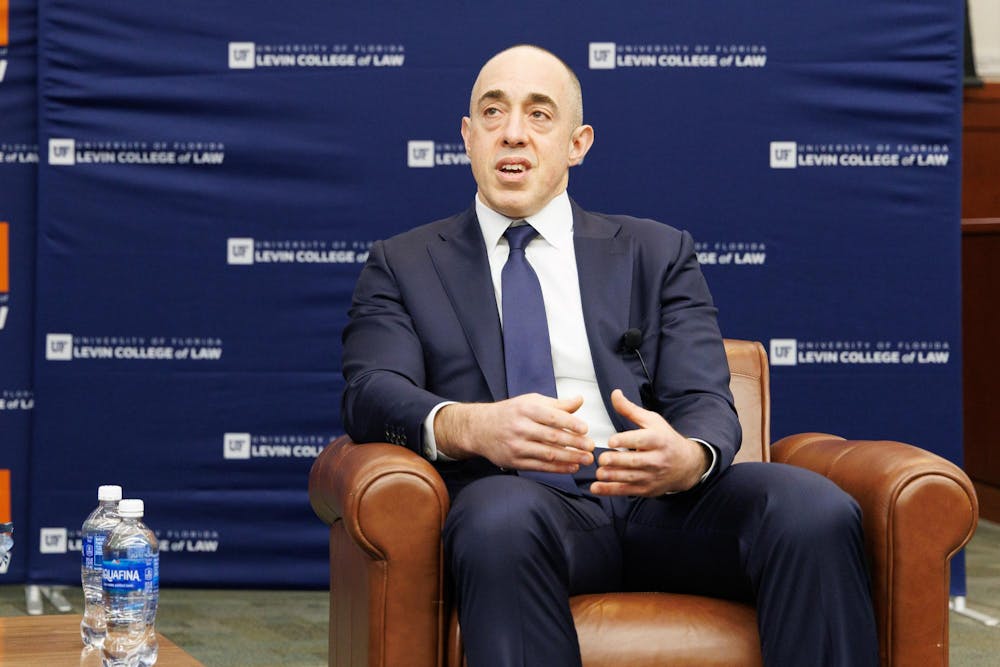
UF Levin College of Law hosted a discussion with Judge Emil J. Bove of the U.S. Court of Appeals for the 3rd Circuit in a sparsely filled lecture hall Monday afternoon.
The discussion, advertised as a “VIP Dean’s Chat,” drew criticism from some members of the law school, who viewed Bove’s invitation as a political move. But the event itself passed quietly, with only a brief nod to Bove’s controversial history. The audience consisted mostly of students in suits and members of the UF Federalist Society.
After serving as President Donald Trump’s lawyer through four indictments and one trial, in which Trump was convicted on 34 felony counts, Bove was elevated to deputy attorney general and then the 3rd U.S. Circuit Court of Appeals. His nomination to the latter led to over 80 former judges signing a letter asking for his rejection.
A whistleblower complaint detailed several instances in which Bove and other government officials said they would avoid legal scrutiny while implementing the Alien Enemies Act, which removes noncitizens with little to no due process. Bove said the Department of Justice should defy judicial court orders in order to push Trump’s agenda, saying “f--- you” and “ignore any such court order.”
Juan Caballero, a legal skills professor and director of the UF Immigration Clinic, said he thinks UF was “putting its finger on the scale of which side it’s privileging,” breaking its institutional neutrality policy, by inviting Bove. Caballero clarified he was speaking in his personal capacity, rather than a UF representative.
“You are ignoring the very recent past of this highly controversial figure, the nakedly partisan past of this individual, and claim that this is a policy of institutional neutrality,” Caballero said.
He said UF’s law school, which is supposed to teach future lawyers that respect for institutions is a core principle of the profession, is hypocritical for hosting a man who is facing credible accusations of being willing to disregard the U.S. legal institution.
“It really does sort of undermine the role of the law school as an institution that’s trying to train future attorneys,” he said.
UF Law Interim Dean Merritt McAlister declined to comment for this story.
The event itself focused primarily on Bove’s personal and professional background, rather than engaging with the controversies associated with his public record.
As the moderator, McAlister asked the judge questions such as “What was your law school experience like?” or “What excited you?” In his responses, Bove underlined the importance of mentorship and perseverance, describing the legal profession as inherently competitive, where, as he put it, “there’s a winner and there’s a loser.”
Only one question directly referenced the controversy surrounding the judge’s tenure at the Department of Justice. The singular question was framed broadly, with the interim dean asking Bove to reflect on “some controversy” that occurred during his time as a senior DOJ official and discuss what he is “willing to share” about that experience.
In response, Bove did not address specific allegations or whistleblower claims. He characterized the controversy as a broader philosophical disagreement over executive power and legal independence, saying tension between line prosecutors and political leadership occurs naturally in the Department of Justice.
“The tension was so clear that I thought the best thing to do in that moment as a leader was to sign myself,” Bove said.
Mac Dinneen, a 35-year-old UF law student, said if an onlooker didn’t know Bove was controversial coming into the event, they wouldn’t have known from the way it played out.
Dinneen said the judge received fair questions that would’ve been asked even if he wasn’t a controversial figure. If the questions had been more confrontational, the law school might be less likely to attract speakers like Bove in the future, he added.
“It’s the sort of speaker a law school should bring in,” he said. “It indicates that the university is not going to take a political side.”
Genevieve Guinan, a 26-year-old first-year UF law student, said neutrality depends on whether a range of perspectives is represented.
“If they’re going to bring controversial speakers from across the aisle … I don’t see any problem with that,” she said. “But if they’re subversively taking a nonneutral stance and only bringing speakers representing one side, that would be less acceptable from a neutrality standpoint.”
Contact Angelique Rodriguez at arodriguez@alligator.org. Follow her on X @angeliquesrod. Contact Ariana Badra at abadra@alligator.org. Follow her on X @arianavbm.
Ariana is a first-year journalism major and an El Caimán reporter for the Fall of 2025. In her free time, she enjoys reading, spending time with friends and scouring for new songs to play on repeat to an absurd degree.

Angelique Rodriguez is a journalism freshman and the Summer 2026 El Caiman Editor. She has spent two semesters at The Alligator as a University Reporter and El Caiman Reporter before becoming an editor. When she's not working, you can find Angie reading, hanging out with friends, or rewatching her rotation of favorite shows.


