

Read other stories from the "These stories were not AI-generated" special edition here.
Train, recover, repeat. It’s a cycle college athletes across the country face daily.
Being half a second faster, one pound stronger or taking one cut sharper often makes all the difference in getting a leg up on the competition. Now, artificial intelligence and wearable technologies are reshaping how athletes train and recover.
As schools across the country rush to implement new technology into injury prevention and coaching, its acceptance varies by the size, type and wealth of each institution.
In Gainesville, UF has invested in AI to help researchers, student-athletes and coaches improve their sports programs through research data interpretation, live feedback from wearables and AI-censored equipment.
Meanwhile, at Santa Fe College, the school lacks the resources to compete with juggernauts in investment. But its communications department has incorporated the use of AI for stat tracking, live game updates and insights for recap material.
UF taking control of AI in sports
UF is taking strides to not be left behind in the growth of AI. Its AI-Powered Athletics initiative launched in 2024 through a $2.5 million investment in the UF & Sport Collaborative as part of former UF President Ben Sasse’s presidential strategic initiative.
“Our project really stemmed from people in engineering and in the University Athletic Association saying we are an AI University,” said AI-Powered Athletics co-Director Jennifer Nichols. “We collect so much data on our athletes, and that data is kind of underutilized and underanalyzed.”
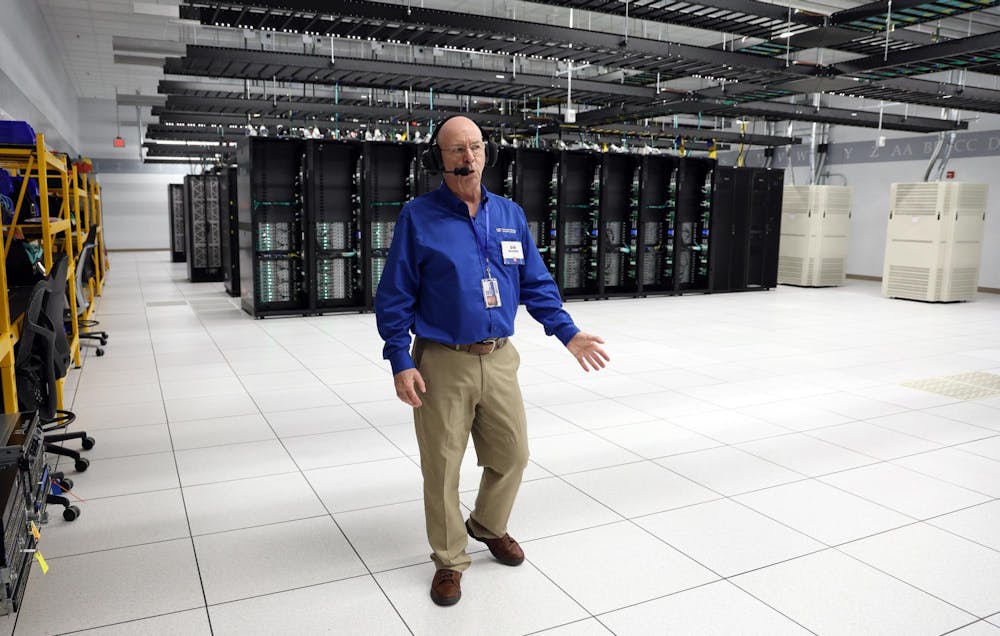
AI-Powered Athletics uses student-athlete data to inform coaches and staff's overall decision-making on what is best for Florida’s student-athletes. The researchers have collected over 1 trillion data points in the UF Athletics Databank using HiPerGator, UF’s supercomputer, to produce AI research.
It has supported more than 21 teams and 500 athletes through performance, medical and academic data collection since its commencement.
“We are not trying to replace the coaches or any staff; we are trying to augment their decision-making,” said Nichols. “The goal of a databank is to enable the collective.”
In collaboration with this project, experts from the Herbert Wertheim College of Engineering and the College of Health and Human Performance also launched the Center for Engineering Human Performance and Wellness March 23.
The new center will study wearable AI sensors embedded in footwear, clothing and headsets to better understand how the brain controls movement. The technology will evaluate how the brain’s processes turn into disease in both athletes and the general population.
The center focuses on applying information from the AI-Powered Athletics project to the general population, Nichols said. One project aims to improve balance in older adult populations, with electrical engineers building wearable devices, for example.
AI has also made its way to the football field. This spring, AI-powered tools are being used in training under new head coach Jon Sumrall.
Catapult Sports, an Australia-based analytics company, provided the team with wearable GPS, video technology and inertial sensors, which can measure an object’s motion and position.
Rachel Sallee, Gator football’s full-time staff equipment manager, has seen the incorporation of this technology firsthand.
The wearable devices have a small chip located on the back of the device, which tracks the player's movements, excretion levels and performance levels, Sallee said. During practices, the sports performance and analytics team can monitor live feedback from the device on individual players.
The football program began using Catapult during the tenure of former head coach Billy Napier and has expanded its use as the technology has improved.
“It’s less about altering workouts and more about them getting information on the individual players to prevent injuries,” Sallee said. “Not just to prevent them but to predict them.”
Along with football, UF’s basketball, soccer and gymnastics programs have tested the waters of more innovative strategies to evaluate performance.
The College of Health and Human Performance and the Warrington College of Business partnered with Florida’s men’s basketball team to improve recruitment, player evaluation and game strategy.
During the Gators' national championship run, coach Todd Golden and his strength and conditioning team used AI data analytics from the regular season to inform postseason workouts so the players didn’t feel like they were exerting that workload for the first time.
Additionally, according to EdTech Magazine, the gymnastics team incorporated force plates to measure jumping explosiveness, and members of the men’s soccer team underwent a series of tests in 2025 to screen for injury risk.
Resource gap leaves smaller institutions weary
Not all schools have the same capabilities and resources.
Smaller colleges don’t have the same resources to match the spending of Football Bowl Subdivision schools.
While Florida has tapped into AI in its athletic programs, smaller schools, like nearby Santa Fe College, often lack the resources required to effectively implement the technology into their sports programs and training regimens.
The Knight-Newhouse College Athletics Database found in 2024 UF spent $39.5 million —(22% of its athletic spending) on "facilities, debt services and equipment." Conversely, all schools without football teams combined for just $171.37 million on those services.
A study in the Journal of Emerging Sports Studies found that even Football Championship Subdivision schools face resource inequities that impact the state of facilities, availability of equipment and number of support staff. It also found that when student-athletes perceive these resource inequities, it has profound impacts on their competitive and personal development.
Jackson Matyczyk, Santa Fe College’s communications and game operations manager, said while AI is present in the college’s athletic department, it isn’t utilized as many would expect.
The college has incorporated software programs such as Hudl Assist and GameChanger that use AI in their athletic communications, he said.
But it’s treated only as a supplementary tool to help produce stat lines and ensure smooth communication. In fact, he leans more toward an “anti-AI” stance, he said, because often the product doesn’t turn out as good.
“It definitely has its benefits,” Matyczyk said. “But most of the things that I want to put out in a recap or an article is mostly my brain power and not a computer.”
While Santa Fe has incorporated AI into its communications and public relations department, it lacks the resources of schools like UF to overhaul its athletics with AI tools.
In his role, Matyczyk doesn’t see a need to change how the college approaches athletics. Instead, he’d rather spend resources in other areas that can benefit students until the tangible results of these technologies are proven.
“We’ve seen progress on the field, and our kids buy into coaches, not an AI model that we throw out there,” Matyczyk said. “I think a lot of those things that AI could solve can be solved from a coaching staff perspective.”
There are many hypothetical positives that come with implementing these AI technologies, Matyczyk said, but there are also many unknowns. Those doubts make investment risky for small colleges that lack the resources to overhaul or upgrade their athletic programs.
Matyczyk acknowledged advanced technologies aren’t as accessible at a smaller institution. But the college prefers to think of it as “do[ing] things the Santa Fe way.”
“We do things how we’ve always done them, and we’ve seen success from that,” he said. “So why change our ways when we know something is working out?”
Contact Coral Uzgiden at cuzgiden@alligator.org. Follow her on X @coraluzgiden.
Contact Curan Ahern at cahern@alligator.org. Follow him on X at @CuranAhern.

Curan is a senior sports journalism student in his sixth semester at The Alligator. He is currently a sports editor and football beat reporter for the Gators and the Jaguars. He previously served as a men's tennis and sports enterprise reporter, and he is pursuing a public relations minor.

Coral is a sophomore Sports Journalism student in her first semester with the Alligator covering Lacrosse. She also has experience writing for WRUF and covering beats such as high school football and Gators swim and dive. She is an intern for the Women of the Lowcountry and in her free time enjoys playing waterpolo, going to the gym and being outside.


