

Read other stories from the "These stories were not AI-generated" special edition here.
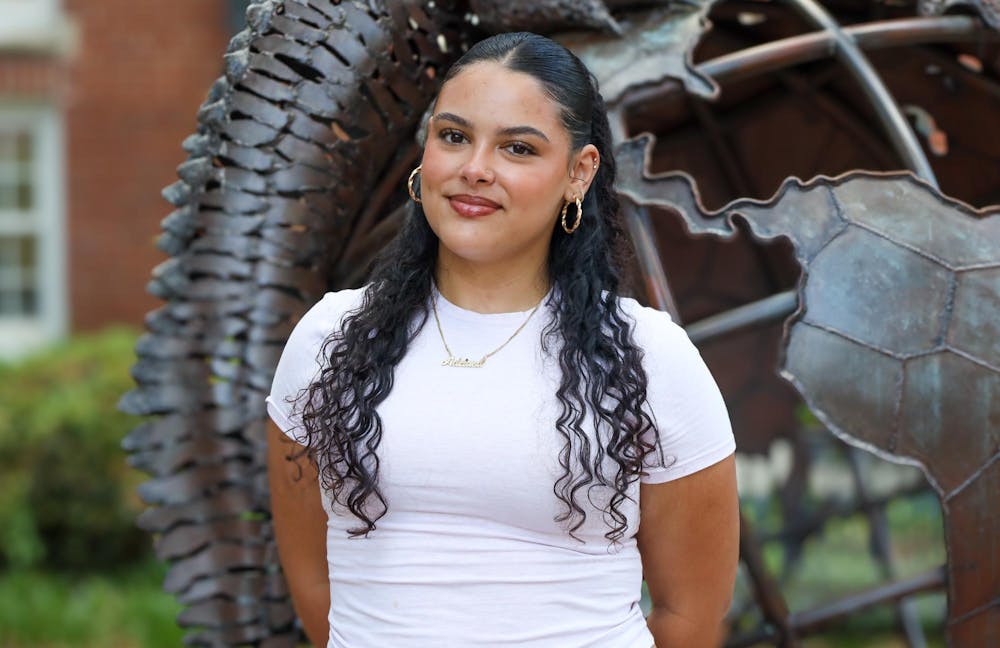
When Gabriella Palacio and her friends couldn't decipher the authenticity of a video they watched online until they read the AI-generated label, she felt scared about AI‘s development, she said.
A recent study conducted by psychologists and computer scientists at UF found participants in the study performed no better than chance at detecting pictures of deepfake faces.
Statistics like these have prompted many UF students and media literacy professionals to question the future of AI-generated content.
Palacio, a 19-year-old UF microbiology and cell science freshman, said she worries about how quickly AI-generated content is improving in quality.
“I was so shocked the first time that I saw a video that was completely AI, and I thought it was real,” she said. “So I guess the more it evolves, the more that I'm scared of it.”
According to TikTok’s support page, the platform allows creators to label AI-generated images to avoid confusion amongst viewers. TikTok’s labeling is done by the creator before the video is posted, meaning it is up to the creator to decide whether or not to label the content, leaving room for mislabeling. Instagram has since followed suit.
Palacio also said she is concerned about AI being able to impersonate others’ voices.
“You could say a couple of words, and they can have your voice say anything,” she said. “That’s crazy to think that someone could get a couple of words of my voice and call my mom and tell her that I'm in danger."
Donelle Probst, executive director of the National Association for Media Literacy Education, said she thinks as time goes on, students are noticing AI is not as obvious as it used to be.
Probst also said she thinks one of the hardest parts of AI’s rise is how society contends with it, but she emphasizes the importance of digging into the content’s origins.
“You know, fact-checking platforms that exist out there, things like that, are really helpful,” she said.
AI-generated videos and images range from comedic to targeting real-life sources or topics, Probst said. This type of content is becoming harder to recognize with improvements in AI.
“I think sometimes, seeing that difference between AI that is designed to entertain or to make us laugh, versus AI that is used to try to manipulate or convince us of things, and so those differences are becoming greater,” Probst said.
Seungahn Nah, the Dianne Snedaker Chair in Media Trust and research director of the Consortium on Trust in Media and Technology, said AI-generated content is hurting the reputation of media and creating a lower level of trust in the media.
“Certainly AI has, you know, kind of transformed or changed the ways that audiences interact with their respective platforms, especially social media venues,” he said.
Nah said students can learn to detect AI-generated content by finding key factors in the media. However, these inconsistencies in AI content are becoming difficult to find.
Looking for specific inconsistencies with unnatural facial movement, irregular lighting, messed-up audio or lip synchronization and unusual backgrounds are ways to differentiate an AI-generated video, he said.
UF marketing sophomore Adriana Lima, 20, said she is worried for her future career as AI-generated media becomes more popularized, but she believes human knowledge is still more powerful.
"I think [AI] will definitely have a lot of change in the next coming years,” Lima said. “Because as it keeps developing, it's going to get more and more out of hand, and then it's going to need more and more taming.”
Contact Lilianne Fernandez at lfernandez@alligator.org. Follow her on X @ltfernandez8.
Lilianne is a first-year English student and the University desk's Spring 2026 Santa Fe reporter. In her free time, she enjoys going on runs, hanging out with friends, or listening to music.


