

Nestor Vallejos said he lives every day not knowing when his job, home and family will be taken from him.
Vallejos has resided in America since he emigrated from Buenos Aires, Argentina, in 2001 at 6 years old. Now 31, he has built a household, career and life in West Palm Beach, Florida. He is a recipient of the Deferred Action for Childhood Arrivals program, an Obama-era program that provides deportation protection to undocumented immigrants who were brought to the U.S. as children.
While DACA does not provide a legal immigration status to its recipients, commonly referred to as Dreamers, it allows them to hold work permits, obtain Social Security numbers and live in the country. Dreamers have to renew their protection every two years.
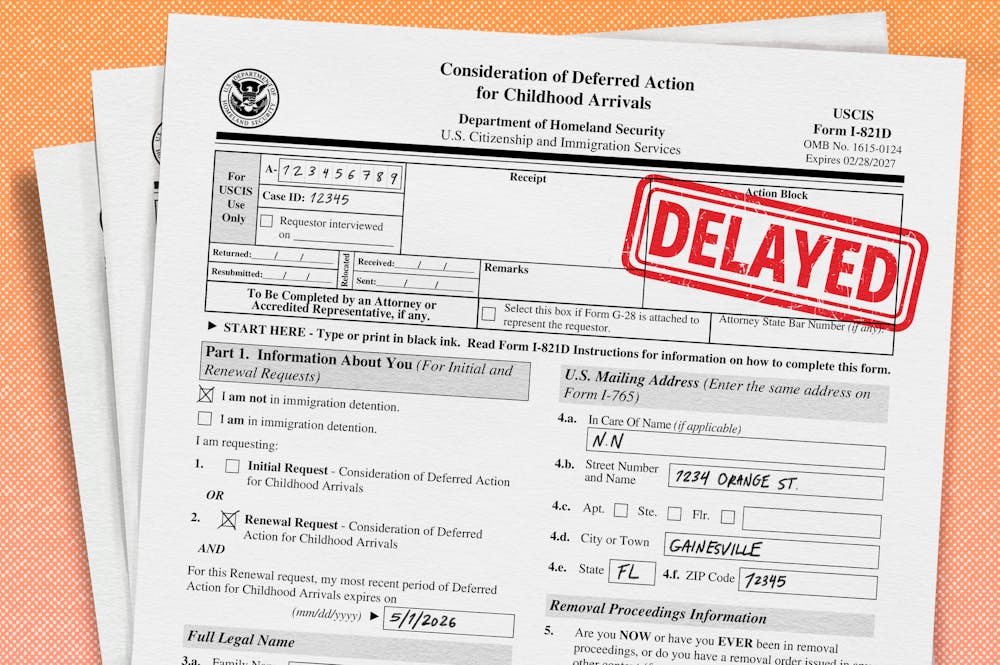
However, as of recently, Dreamers across the country are experiencing delays in their DACA program renewals, making it possible for them to be detained and deported.
In March 2026, National Immigration Law Center confirmed cases where U.S. Citizenship and Immigration Services has paused processing DACA renewal requests for people who are nationals of certain countries listed in Presidential Proclamations 10949 and 10998. These countries include Haiti, Venezuela and Cuba.
Vallejos said the administration’s handling of DACA negatively affects his daily life. He lives every day in fear, he said, knowing the possibility of the program’s erasure.
“It’s like living in limbo,” he said. “You never know if tomorrow’s the day the administration will cancel the program … Everything I’ve worked for could just be taken away overnight.”
It’s possible he could be detained and deported, Vallejos said, when the U.S. is all he’s known since childhood.
And the threats haven’t just affected his personal life; they’ve also impacted Vallejos in his career. After graduating from the University of Central Florida in 2021 with a degree in computer engineering, he worked as a software engineer. But in December 2024, when his DACA renewal didn’t come in time, he had to take an unpaid leave of absence for about a month.
It was stressful and anxiety-inducing, Vallejos said, especially as the head of his household, to not be able to provide for his parents and brother even after filing his renewal application on time.
“The worst thing is not even so much the economics,” Vallejos said. “It’s the emotional hardship that it puts you through, because you don’t know if this time they’ll approve it.”
Now, he can’t find a computer engineering job that allows him to work as a Dreamer, even though he holds a work permit. On top of the difficulties of today’s job market, he said, most computer engineering jobs require citizenship. So, he works as a banker.
“That does limit me in what I can do, so not being able to apply to everything I’d want to hurts,” Vallejos said.
He said people outside the immigrant community don’t understand what this uncertainty feels like. The average American citizen doesn't live every day not knowing if they will be able to work — or legally drive a car — the next day, he said.
“It gets harder every day to see a future here, given the very little support there is,” Vallejos said.
He and many other Dreamers have begun to think of backup plans, like leaving the country.
“I’ve been thinking about what it would look like to leave the U.S.,” he said. “It’s so heartbreaking to think that, because this is everything I know … I don’t know any other country, not even my own.”
After joining a forum that provides legal updates and assistance for DACA recipients, Vallejos said he met hundreds of Dreamers across the country with the same struggles. He created a WhatsApp group to connect with them, and it’s grown to 110 people in two months.
The group has created action plans to advocate for themselves, such as writing to their representatives and connecting with other Dreamers on social media.
Vallejos said he has faith in the future. Many Dreamers are starting to speak up online, advocating for reform in a way he hasn’t seen before. His hope is for a pathway to citizenship.
“We’re not asking for much,” he said. “We’re just asking for a chance.”
Blanca Angarita, an associate paralegal in Fort Myers, Florida, said while the DACA program remains in effect, its future is uncertain as it faces legal challenges in federal courts. While current recipients can still submit renewal applications, first-time applications remain on hold pending further court decisions.
Angarita said the ongoing legal debate has created uncertainty for many DACA recipients. Renewals are still being accepted, but many immigrants remain unsure about how long the protections will remain in place and whether they will be able to rely on the program in the future.
DACA recipients should seek legal guidance, she said, and they shouldn’t let fear prevent them from exploring options unique to their case, such as family-based petitions, adjustment of status applications or waivers already in process. Recipients need to stay informed, renew documents on time and consult immigration attorneys to identify potential pathways to more permanent immigration relief, she said.
“What is important is that each person, based on their own history, seeks professional legal guidance and gets answers about their situation so they can move their cases forward,” Angarita said.
She said communities should approach immigration issues with empathy. Many Dreamers arrived in the U.S. as young children and had no control over the circumstances that brought them to the country, she added.
“We should humanize the immigration experience and recognize all those hardworking individuals who are trying to contribute positively to society while facing these uncertainties and vulnerabilities," Angarita said.
Diego Dulanto Falcon was born in Lima, Peru. He immigrated to the U.S. at 4 years old in 2003. Now 27 years old, he’s been a DACA recipient for a decade.
Dulanto Falcon hasn't had the chance to renew his application yet, he said, but he will soon. He’s often struggled to find funding to renew it.
And he’s not alone in the dilemma — many DACA recipients struggle to pay renewal fees, Dulanto Falcon said. The shift to electronic and credit card payments has made it harder for some organizations to help cover costs, he added, because many previously provided assistance through paper checks.
“There's no resources to actually pay for this stuff,” Dulanto Falcon said. “They've made it harder.”
He said he knows other DACA recipients in his community who have waited months for their Employment Authorization Documents. One recipient's DACA status expired in March, Dulanto Falcon said, and they still haven’t received a new work permit. Without one, recipients can’t legally work, which can disrupt their income and financial stability.
Dulanto Falcon used to pay out of pocket for his renewal, which cost $495 before shipping fees.
But after April 1, 2024, online DACA renewals cost $555, and paper applications cost $605, according to United We Dream.
Dulanto Falcon said the increase makes the process even more difficult for recipients who already struggle to find support. Many of his friends with DACA either pay the renewal fee themselves or delay renewing because they don’t make enough money to cover the cost.
He encouraged other DACA recipients to keep moving forward despite current challenges. Even with increasing barriers, Dreamers must continue pursuing their goals and not give up, he said.
“We've been here for almost 20 years now, as DACA recipients,” he said. “We have no choice but to keep moving forward, and we will, no matter how hard it is.”
Nestor Vellejos’ brother, Alexander Vallejos, a 26-year-old computer science senior at the University of Central Florida, is also a DACA recipient. He was brought to the U.S. from Buenos Aires, Argentina, when he was just 1 year old.
In high school, he discovered he didn’t have a Social Security number when he tried to obtain a learner’s permit through a class program. Later, when he wanted to get his first job at 18, he learned he could not legally work without immigration authorization.
Alexander Vallejos first applied for DACA in 2018, at a time when the program’s future was uncertain.
“It was all very confusing to me,” Alexander Vallejos said. “Like, what am I? What does this mean? I didn't understand it.”
Since receiving DACA at 18 years old, he has renewed it every two years. The program has allowed him to work legally, obtain a driver’s license and receive a Social Security number.
But he’s faced a significant challenge while pursuing higher education, he said. After enrolling in community college, he repeatedly attempted to apply for a Florida scholarship that high school officials had told him he qualified for.
After two semesters of seeking answers, he was informed that while he met the academic requirements, he was ineligible because he wasn’t a U.S. citizen — and DACA recipients did not qualify. It was heartbreaking, he said.
Alexander Vallejos said he has not personally experienced delays, and his most recent renewal was approved on time. But his brother’s DACA renewal delay caused economic hardship in the family when he had to take a leave of absence from work.
Uncertainty has always been part of the DACA experience, Alexander Vallejos said.
“It feels like a temporary subscription that's always been there,” he said. “I've talked to other residents; we all relate to that.”
Alexander Vallejos said many people outside the immigrant community hold misconceptions about immigrants. They often assume immigrants can simply apply for legal status, he said, when in reality DACA recipients don’t have a pathway to citizenship.
DACA recipients undergo background checks every time they apply, Alexander Vallejos said. They’ve spent most of their lives in the United States, and, in many cases, had no choice in their immigration circumstances as children.
“I literally spent my whole life here,” he said. “I don't know anything else. I didn't even make that choice … All I did was work hard.”
Alexander Vallejos encouraged other DACA recipients waiting for renewals or decisions on their applications to continue pursuing their goals despite the challenges.
He said Dreamers should remain active contributors to society, continue working hard and share their stories publicly.
“Don’t be afraid to say, ‘I'm a Dreamer’,” Alexander Vallejos said. “I think that that's amazing.”
Contact Angelique Rodriguez at arodriguez@alligator.org. Follow her on X @angeliquesrod.
Contact Ornella Moreno at ormoreno@alligator.org. Follow her on X @ornellamorenom.

Angelique is a UF journalism sophomore and The Alligator's Fall 2026 El Caimán editor. She was formerly a UF Graduate School and El Caiman Enterprise reporter. Now in her fourth semester at The Alligator, Angie has reported and edited stories related to the Spanish language and culture. When she's not working, you can find Angie reading, watching rom-coms and hanging out with friends.

Ornella Moreno is a senior journalism student with a concentration in psychology in her second semester at The Alligator. She covers El Caiman. Previously, she worked as a radio anchor for WUFT Noticias. In her free time, Ornella enjoys doing yoga, reading and going to the movies.


