

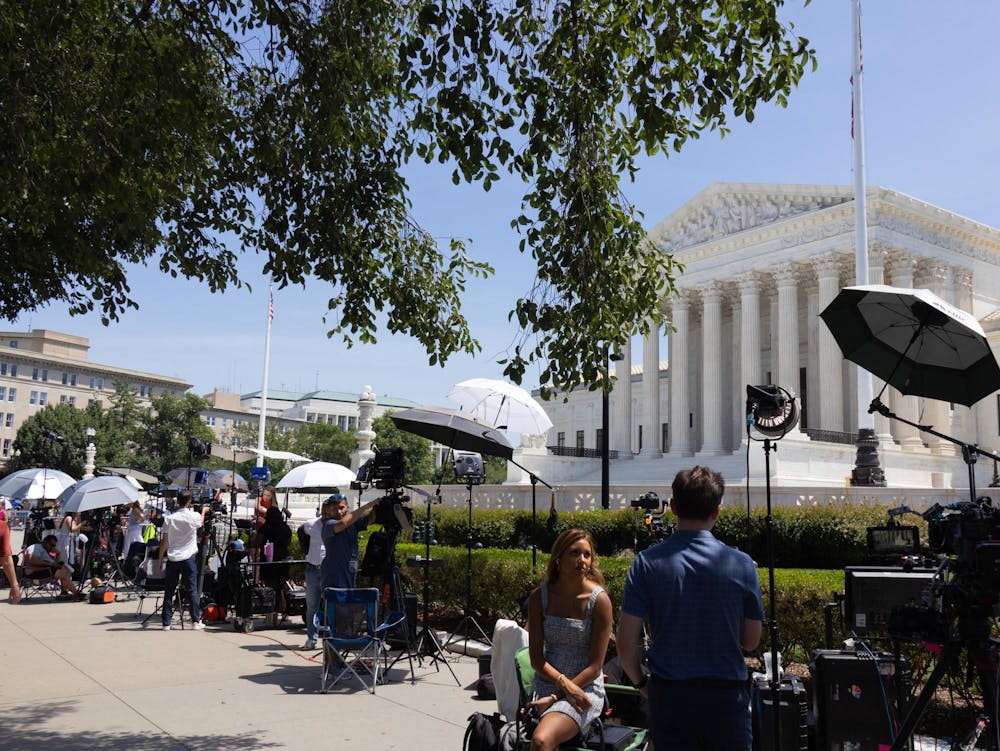
The Supreme Court voted on Tuesday to uphold birthright citizenship, a guarantee under the 14th Amendment that states every person born on U.S. soil is a citizen.
The Citizenship Clause under the 14th Amendment holds that “All persons born or naturalized in the United States, and subject to the jurisdiction thereof, are citizens of the United States and of the State wherein they reside.”
The decision of the case, Trump v. Barbara, rejected President Donald Trump’s Jan. 25, 2025 executive order declaring children born to people who are in the U.S. illegally or temporarily are not U.S. citizens.
The executive order, which Trump called “Protecting the Meaning and Value of American Citizenship,” said American citizenship should not apply in two cases: when a person’s mother is not in the U.S. legally, and the father is not a lawful citizen or permanent resident; or when the mother’s presence in the U.S. was lawful but temporary at the time of birth, and the father was not a lawful citizen or permanent resident at the time of birth.
In 2023, the number of undocumented immigrants in the U.S. hit a record high of 14 million, according to the Pew Research Center. As of 2024, Data USA reported about 18,000 people in Gainesville are foreign-born, accounting for about 12% of the city’s population.
A large part of Trump’s administration is dedicated to a crackdown on immigration and immigrant rights. Last year, the administration removed deportation protections and took work permits from about half a million parolees from Latin American countries like Cuba, Nicaragua and Venezuela; stopped accepting asylum applications for immigrants entering the U.S.-Mexico border — which has been challenged in court — and attempted to overturn the constitutional principle guaranteeing citizenship to children of immigrants.
This latest attempt, in a 6-3 vote, was found to violate the Constitution.
Justices Elena Kagan, Sonia Sotomayor, Amy Coney Barrett, Ketanji Brown Jackson and John Roberts joined the majority opinion. Justice Brett Kavanaugh, one of the three minority votes, filed an opinion concurring in the judgement and dissenting in part. He disagreed with the decision but said Trump violated a federal statute.
“Congress could — consistent with the Fourteenth Amendment — amend §1401(a) or otherwise enact new legislation establishing exceptions to birthright citizenship for children born to foreign citizens unlawfully or temporarily in the country,” Kavanaugh wrote. “But Congress has not yet done so.”
Chief Justice John Roberts wrote the majority opinion for the court, stating that the 14th Amendment must be upheld. He cited landmark cases like Dred Scott v. Sandford and the Civil Rights Act of 1866, which both protect the “common law of citizenship — known as ‘jus soli,’ or right of the soil,” Roberts wrote.
“Citizenship, then and now, was the right to have rights — to freely participate in our political community,” Roberts wrote. “The Framers of the Fourteenth Amendment extended that promise to ‘every free-born person in this land.’ We keep that promise today.”
Contact Angelique Rodriguez at arodriguez@alligator.org. Follow her on X @angeliquesrod.

Angelique is a UF journalism sophomore and The Alligator's Fall 2026 El Caimán editor. She was formerly a UF Graduate School and El Caiman Enterprise reporter. Now in her fourth semester at The Alligator, Angie has reported and edited stories related to the Spanish language and culture. When she's not working, you can find Angie reading, watching rom-coms and hanging out with friends.


