
The state of Florida executed 74-year-old Dennis Sochor at 6:16 p.m. on Tuesday.
Sochor, a former Army paratrooper, was convicted of the 1981 murder of Patricia Gifford in Broward County.
Witnesses of the execution said Sochor spoke too quickly for his final statement to be fully transcribed. In his remarks, he apologized to the victim's family, thanked loved ones, made religious references and committed his spirit to Jesus.
Sochor was the 10th person executed by the state this year and the 38th since Gov. Ron DeSantis took office.
The crime
On New Year's Eve 1981, 18-year-old Gifford was celebrating with a friend at a Broward County lounge when she encountered Sochor. When her friend became sick, Sochor and his brother, Gary, helped her friend outside to a car.
Gifford then went back inside — and never returned to her friend.
Police later found a photo from that night showing an unidentified man sitting near Gifford at the bar. After the image aired on television, the man was identified as Sochor. Investigators said his roommates told police he left abruptly after seeing himself on TV. Gary also told investigators his brother was involved.
Sochor was later indicted on first-degree murder and kidnapping charges after his arrest in Georgia on an unrelated offense. He was extradited to Florida in 1986. Gifford’s body was never found.
At trial, Gary testified that he saw Sochor on top of Gifford with her hands pinned down and heard her scream for help after they left the lounge for breakfast. The state also played three taped confessions in which Sochor said he became angry after Gifford rejected his sexual advances, choked her and later disposed of her body.
Patricia Gifford's sister, Marilyn Gifford, said during a press conference that she remembered her sister as "fun with a capital F-U-N" with a bright smile, which she said "lit up every room she entered."
Marilyn said the execution brought her family "a modicum of closure" after more than four decades, though she said they continue to grieve because her sister’s remains have never been found. She urged anyone with information about their location to contact the Broward Sheriff's Office.
“We hope and pray that now, after tonight, when we think of Patty, it will be about the 18 years she lived and not the awful way she died,” Marilyn said.
The punishment
A jury convicted Sochor of both kidnapping and first-degree murder by a vote of 10-2 and recommended the death penalty. The trial judge sentenced Sochor to death, finding no factors weighed in favor of a lesser punishment and four favored a death sentence.
Sochor was previously convicted of a felony, and the murder occurred while he was committing another felony. The judge also decided the murder was especially heinous, cold and had no moral or legal justification.
Sochor unsuccessfully challenged his conviction and death sentence through multiple post-conviction appeals. He claimed Florida's lethal injection protocol violated the Eighth Amendment's prohibition on cruel and unusual punishment.
His first appeal, filed in 1995, was denied and upheld by the Florida Supreme Court in 2004. A second motion filed four years later was also denied.
On July 11, Sochor's attorneys asked the U.S. Supreme Court to temporarily halt his execution and review their claim that Florida's court system made it nearly impossible for death row inmates to challenge the state's lethal injection protocol.
The petition was denied.
Day of execution
Across the prison lawn, death penalty supporter Bill Campbell stood alone with two Bluetooth speakers and a pair of earplugs, using music to drown out protesters. Campbell’s previous playlists featured artists such as Dolly Parton, but this time he added church songs to the mix.
His first selection, however, was not a hymn. Campbell opened with the Soviet Army march, saying he chose the song because he believes the protesters on the other side of the lawn are “a bunch of communists.”
“They think they’re church people?” he said. “Church people come over here [to the pro-death penalty side], too.”
Campbell said he believes religious opponents of the death penalty do not have a moral advantage over supporters of executions. Executions are a necessary response by the state, he added, describing each case as “the next one” in a process he believes must continue.
“I’m here to support the state,” Campbell said.
While Campbell came prepared with a playlist, protesters across the lawn arrived with a different message: The state should not have the power to take a life.
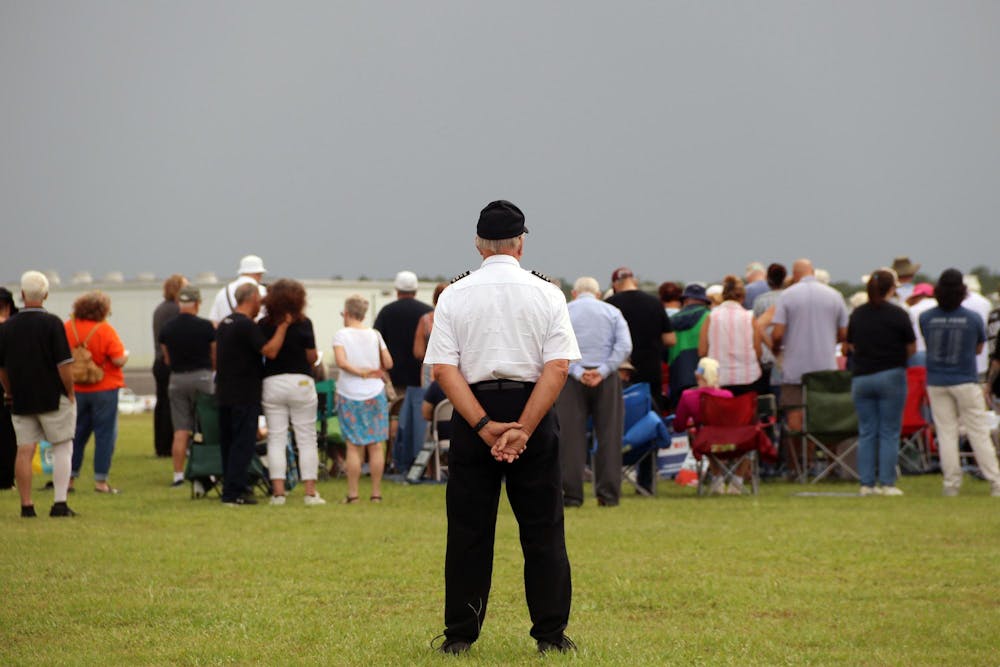
Roughly 50 people protested Sochor’s execution outside the Florida State Prison. The group was made up of members of Floridians for Alternatives to the Death Penalty and parishioners from Our Lady of Lourdes Catholic Church.
One protester, Joe Cinelli, said he came to the execution because he believes the state shouldn’t take a life, arguing only God has the right to do so.
"We don't believe that the state should kill you," Cinelli said. "When they do that, they're doing it in our name. They're doing it in the name of the citizens. That's what we're against."
The group’s opposition was rooted in both personal beliefs and religious convictions. The Rev. Philip Egitto, a pastor with Our Lady of Lourdes Catholic Church in Daytona Beach, joined other death penalty opponents in a prayer vigil before the execution.
"None of us wants to be judged by the worst things we've ever done," Egitto said. "If we don't see that we're killing broken people who were broken before they committed horrendous acts, what does that say about us?"
Contact Julianna Bendeck at jbendeck@alligator.org.
Julianna Bendeck is a first-year journalism student and the Summer 2026 criminal justice reporter. She previously worked as a contributing writer and race and equity reporter at The Alligator. Outside the newsroom, she enjoys reading, surfing the web and playing video games.