
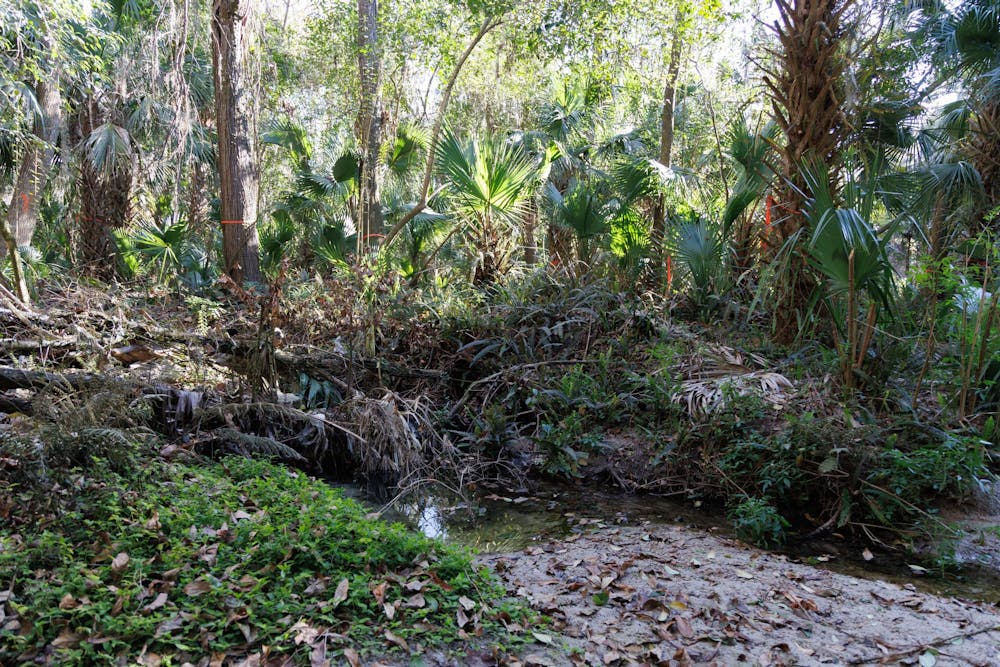
In February, the UF Lakes, Vegetation and Landscape Committee proposed the destruction of Graham Woods, a 7.5-acre conservation area on campus, suggesting the removal of over 200 invasive trees and more than 900 native ones, including nearly 70 heritage trees.
The plan has raised concerns about deforestation and habitat loss for local wildlife, including a colony of UF’s beloved campus cats.
The proposal’s justification centers around the woods’ stormwater drainage capabilities. According to the committee, the woods function “at 40% of what a high-quality wetland should be functioning,” and its destruction would serve an overall benefit to the greater Lake Alice watershed.
In a statement to The Alligator, UF spokesperson Cynthia Roldán wrote that UF “aims to achieve a balance between supporting the future growth of the university and the stewardship of natural resources on campus,” and that although there is no dedicated team for the maintenance of conservation areas, “UF has a robust facilities and grounds team that is actively engaged in monitoring and maintaining UF’s campus, including natural areas.”
But this reasoning hasn’t come without criticism. Many believe there are alternatives to improve the woods’ stormwater drainage without the need to cut down any trees.
One such person is Matthew Hurst, a Gainesville native and longtime Sierra Club member. He attended UF from 1999 to 2003 and lived in Weaver Hall — right next to Graham Woods.
Hurst described the decision to cut down the trees as “bureaucracy on autopilot.” Formulas designed to optimize stormwater drainage fail to take into account the consequences of the land they destroy, Hurst said, and have led to an unjust decimation of natural land.
“I think it's a big target for stormwater basins just because it's there, and the stormwater engineers don't particularly care about preserving a natural area,” Hurst said.
Rather than attempting to search for alternative solutions to improve stormwater drainage or to repair the woods’ drainage capabilities, Hurst suggested UF has opted to take the path of least resistance while disregarding the woods’ other benefits, he said.
“[The woods] are going to consume your nitrogen, your phosphorus, these other nutrients that become pollutants when they go in excess amounts into the water bodies,” Hurst said. “I think the bigger problem with their stormwater rationale is that they're not taking into account the existing functioning of what's there. They treat it as if it was like a parking lot.”
Another consequence of this “parking lot” treatment is the loss of habitat for local wildlife. At least 40 unique species call the woods home. Many are migratory species that rely on the woods to nest, said Cheyenne Lukander, the founder of the Gainesville Animal Defenders and UF urban planning graduate student.
While Lukander believes the plan to tear down the woods has long-term benefits for the environment, she said it’s a response to a problem UF created itself through the construction of Heavener Football Center and the UF Student Healthcare Center.
Lukander said the woods could have been salvaged if UF planned these buildings with greater foresight.
“The Graham Woods are not the problem,” Lukander said. “The problem is more so the development that has exceeded the stormwater capacity of what those woods could handle.” .
The woods’ destruction will inevitably lead to some wildlife death, but Lukander said there are methods to repair the woods’ stormwater drainage capability while reducing animal fatalities, like relocating the animals while gradually cutting down trees. But clear-cutting the entire forest in one sweep is the cheapest and least labor-intensive method, which likely motivated UF to choose that path, Lukander said.
In her eyes, the decision to tear down the woods shows a disregard for animal life.
“I think that if we really were prioritizing animals in this, we would consider perhaps relocation of animals, or maybe incremental changes to the landscape rather than clear cutting it all in one day,” Lukander said. “Things like that might be solutions to these things if we were to consider animals' lives just as valuable as our own.”
To many students, feral cats are one of the more notable species to call Graham Woods home. Four campus cats live in the woods, and finding a new place to stay would be difficult for them, said UF research coordinator Ines Aviles-Spadoni, who runs the Instagram page @campuskittiesfl.
The cats take shelter in the woods, seeking shade from the brutal Gainesville sun. Without the cover of the trees, they may be exposed to dangerous levels of heat, Aviles-Spadoni said.
Relocation won’t be easy, she added, because these cats have called Graham Woods home for most of their life. The destruction would place a large amount of stress on the felines.
“It's definitely going to traumatize them because that's been their home for more than six years,” Aviles-Spadoni said.
The destruction of the woods would lead to more than just an increase in stormwater drainage. It would demolish the home of Ellen, the friendly leader of the Graham cats; Mr. BB, who’s so fat his stomach swings from side to side; Diane, a shy cat with a bad eye; and Frankie, the youngest cat, who darts away at human contact.
The fate of these cats — and the rest of the Graham Woods wildlife — remains in question as plans proceed to take down over a thousand trees.
Contact Christopher Rodriguez at crodriguez@alligator.org. Follow him on X @ChrisRodri29386.