
Despite being from Havana and having built a life in America for the last three decades, Rafael Crespo-Garcia, 54, now lives in Mexico after being deported in January.
Crespo-Garcia stays in the extra room of a stranger’s house, where he sleeps on a mattress on the floor — the only piece of furniture in the room. He’s still grappling, he said, with the lasting effects of being detained at the Baker Correctional Institution, better known as “Deportation Depot,” in Sanderson, Florida, about an hour north of Gainesville.
From his detainment six months ago to the three months he spent in Deportation Depot to his eventual deportation, he alleges he experienced medical neglect, abuse and degradation.
From Cuba to Baker County
Crespo-Garcia came to America in 1991 in a raft as a Cuban refugee. He became a business owner and a truck driver, settling into a long-term relationship along the way.
On Oct. 20, 2025, he reported to the Immigration and Customs Enforcement office in Orlando, as he had every year since 2005, for a check-in due to a criminal record from his involvement in two physical fights dating back to 1994. There, ICE agents arrested him.
He was booked the next day and sent to Baker Correctional Institution.
“I swear, I went through hell,” he said. “It’s so painful. … I cry every day.”
He said the officers at Deportation Depot would often spray the inmates with pepper spray, sometimes for no reason. Previous reporting by the Associated Press describes multiple instances of guards pepper spraying inmates, including on Oct. 29 in an incident Crespo-Garcia said he was involved in.
Baker County officials, in a statement to the Associated Press, said pepper spray was used by the guards because an inmate was refusing to return to their cell and got violent toward an officer. Crespo-Garcia only mentioned inmates yelling at officers.
“They all behave bad,” Crespo-Garcia said of the Deportation Depot officers. “I would say 95% of these people. No heart, no nothing.”
The medical facility at Deportation Depot did not respond to requests for comment.
ICE responded by asking for a list of questions via email. After an Alligator reporter responded with the requested list, the agency did not respond further.
‘I wanted to die’
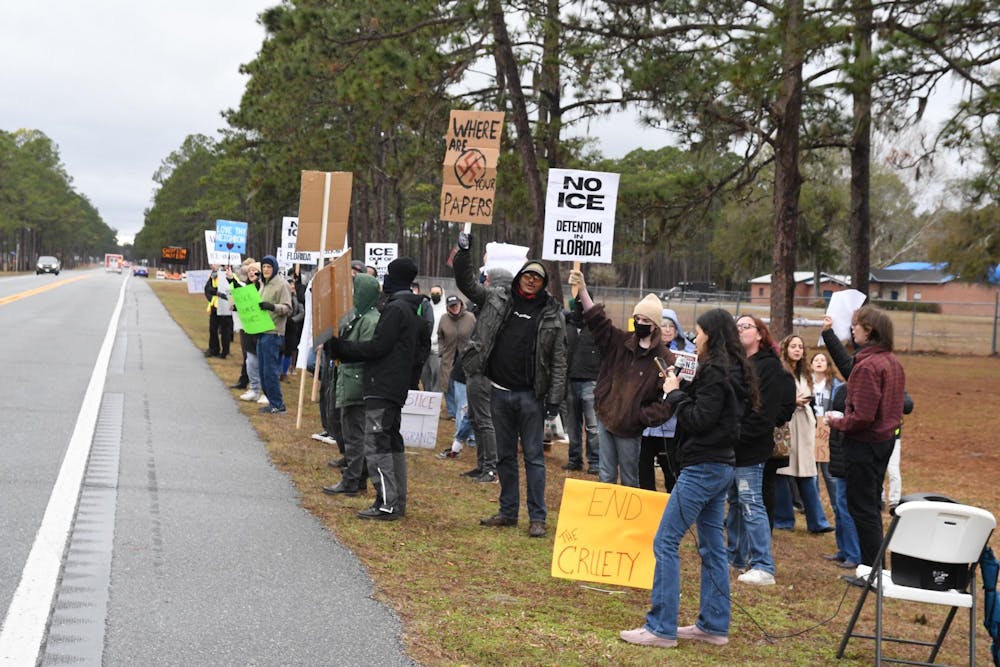
Deportation Depot’s opening was announced on Aug. 14, 2025, by Gov. Ron DeSantis as an expansion of Florida’s mission to detain and deport illegal immigrants. It was placed at Baker Correctional Institution, a former state prison, amid the legal controversy over Alligator Alcatraz. The South Florida immigration detention center opened two months before Deportation Depot. One day after Deportation Depot’s opening, federal judges blocked any more detainees to be sent to Alligator Alcatraz.
Crespo-Garcia said the abuse began Oct. 29, 2025. He woke up with a fever and difficulty breathing, he said. He then went to the medical building, where he said staff told him his medicine would be ordered and sent to the facility the next day.
Later, he said, the inmates went to have lunch, only to be turned away when they arrived “because the kitchen broke.” According to Crespo-Garcia, guards instead gave them a box of bread, which was supposed to last them until 6 a.m. the next day, 19 hours after their last proper meal.
ICE food service operations standards specify inmates should receive three meals daily. The dining room schedule must allow no more than 14 hours between the evening meal and breakfast.
Some detainees began to scream, Crespo-Garcia said. Guards responded by bringing out weapons, spraying gas into peoples’ rooms from the roof when they began to run away.
Struggling to breathe, Crespo-Garcia climbed on his top bunk bed in a panic to reach the window.
“I started coughing, and I was choking. I wanted to die right there. I can’t breathe,” Crespo-Garcia said.
He fell 5 feet off the bed, landed on his back and started running downstairs, searching for a source of air. There, he saw people lying down like sprayed roaches, he said.
Around midnight to 1 a.m., he said, the guards handcuffed everyone, hands and feet, and dragged them outside. The inmates sat on the wet grass, where guards sprayed them down with cold water while laughing, he said.
Following the incident, the inmates were locked up for a week, unable to call lawyers or family members, and given only an ounce of water every 12 hours, Crespo-Garcia said. They also couldn’t shower or change clothes.
Medical attention in detainment
On Nov. 3, 2025, Crespo-Garcia said he stood up from his cell toilet, which he was using as a seat, and collapsed, banging his head on the floor in the process. His cellmate called the guards, who called an ambulance to Ed Fraser Memorial Hospital.
When Crespo-Garcia was in the ambulance, the officers in the ambulance started playing the song “Bad Boys” at a loud volume while laughing at him, he said. He submitted a grievance form and cited a witness who was in the ambulance, but he never heard back from the detention center on the matter.
He received attention for his head and lower back pain. According to a document given to Crespo-Garcia from Ed Fraser Memorial Hospital, which he shared with The Alligator, he was given a CT scan and diagnosed with a chronic lipoma, a type of benign, inherited tumor, on his back.
Over the next two months, he had more visits to the hospital due to abdominal pain and received a check-up. Hospital imaging also revealed he had a spine fracture, grade 3 liver hematoma and bleeding in the liver, according to his medical documents.
His medical plan ordered medication, monitoring by the detention facility, activity restrictions and medical consultations. He was also required to have an abdominal binder, a wheelchair for long distances, a walker and a lower bunk bed in the lower tier of the cell section.
Crespo-Garcia said the walk back to his cell felt long and straining without a wheelchair, which his medical documents said were only required for significant distances.
“I said, ‘One day I’m going to be free. I’m going to tell everybody what you guys, all you, do to me. They’ll see what you’re doing, and you’re a piece of garbage,’” Crespo-Garcia said. “They don’t care. They’re not human.”
The next day, on Dec. 24, 2025, he was transferred to Krome Detention Center, a Miami-Dade-based detention facility, before being deported to Mexico.
Today, Crespo-Garcia said he feels grateful he is able to contact his family, who are helping him pay rent and buy food. But, he said, he doesn’t know anyone and feels constant physical and mental pain.
“I don’t belong here, I don’t know nobody here,” he said. “I have no family, no friend, I can’t work, I’m in danger, I don’t have nothing here.”
He said he feels betrayed by the U.S. for kicking him out.
A trend of neglect
Vilerka Bilbao, the owner of Bilbao Law Firm and an immigration lawyer who works with detainees at Deportation Depot, said many of her clients’ claims match up with Crespo-Garcia’s, including medical neglect.
Many people who have, for example, high blood pressure are given their medication hours off schedule, and sometimes not at all, she said. Many detainees are also being denied insulin, Bilbao said. Such claims fit into a trend of medical neglect allegations leveled at ICE facilities.
“I know it’s a jail. I know it’s not a hotel. But the government has a responsibility to provide adequate medical attention to people, and a delay in medical care becomes negligent,” Bilbao said.
She said she has never been able to get records from Deportation Depot, despite several clients who have requested medical records. So, she said, she doesn’t know what kind of medical records they are keeping.
Another detention jail in Baker County, Baker County Detention Center, has a history of medical neglect and lawsuits against them for fudging medical records for detainees, so she wouldn’t be surprised if Deportation Depot is doing something similar, Bilbao said.
Bilbao corroborated Crespo-Garcia’s claims of the guards reducing inmates’ water intake. She said her clients often see a dirty, white residue in drinking water and complain it tastes “unfiltered” and “disgusting.”
She also corroborated Crespo-Garcia’s claims about the inmates’ dusty clothes and linens rarely being changed, causing coughing and sickness. She said her clients have also complained of the heat being turned off when it is cold.
Inmates being pepper sprayed is also common, she said. The amount and quality of the food that is given to them has caused inmates to lose 10 to 30 pounds. Sometimes, the times inmates are given food vary greatly, she said.
The former deputy legal director of the American Civil Liberties Union of Florida, Katie Blankenship, said when she was working for the ACLU, she received complaints about both of the Baker facilities for years. The ACLU has a legal case against them and is representing many detainees who struggled in detention, she said.
When Blankenship visited Baker, she said, she saw and heard “really rampant human rights abuses and neglect,” which she said were systemic.
“Folks suffer from pretty significant medical neglect there,” Blankenship said.
As long as immigration detention centers exist, abuse and neglect of detainees won’t stop, Blankenship said. For her, the only way to curb instances of abuse is educating the public about them.
“All it does is create a system where we prioritize profit over human lives,” she said.
Contact Angelique Rodriguez at arodriguez@alligator.org. Follow her on X @angeliquesrod.

Angelique is a UF journalism sophomore and The Alligator's Fall 2026 El Caimán editor. She was formerly a UF Graduate School and El Caiman Enterprise reporter. Now in her fourth semester at The Alligator, Angie has reported and edited stories related to the Spanish language and culture. When she's not working, you can find Angie reading, watching rom-coms and hanging out with friends.