

When Gainesville K-12 students went back to school Aug. 10, some schools may have felt emptier than others.
Tina Days, a 48-year-old mother of four children attending East Gainesville schools, said rezoning can benefit the community. But she didn’t feel heard when discussing rezoning proposals with the Alachua County School Board last spring.
“Our feelings [were] not taken into account that we did not want the schools to close,” Days said. “We [were] opposed to that.”
Alachua County Public Schools decided three schools will close across the next two years: Alachua, Foster and Williams elementary schools. This year, Foster was closed.
According to data from the 2025-26 school year, some Alachua County Public Schools in East Gainesville were well below capacity. The Duval Early Learning Academy was less than one-third full as of February 2026, enrolling just 119 students of its 408-student capacity. Lake Forest Elementary School is just over 40% full, filling about 250 seats of its nearly 600-student capacity.
The same data paints a different picture for west Gainesville. Schools like Meadowbrook Elementary and Idylwild Elementary were over capacity by nearly one class each.
Enrollment data isn’t yet available for the 2026-27 school year.
Days’ daughter had to be moved to a different class because there weren't enough students in her original class, she said.
She said she’s also heard many teachers were unhappy they had to teach at East Gainesville schools because of the stigma of their students having behavioral problems.
“They’d rather quit than come over to teach over on the East side,” she said. “I've seen it on Facebook where one man said that he’s glad the school closed, because it's a waste of money, that the kids over here can't be taught. But you're talking about my kids. It's disgusting to me that we are always the brook of everything, and we are the least served.”
Jackie Johnson, the ACPS spokesperson, noted the county’s population has seen a decadeslong westward shift, which has contributed to underenrollment in East Gainesville schools.
“Attendance is an issue in those schools,” Johnson said. “We can't teach kids if they are not in school.”
ACPS’ rightsizing plan, approved in March, aimed to avoid unnecessary spending on severely underenrolled schools so the funds can be redirected to new programs and additional student services, Johnson said.
Some of that funding has gone toward courtesy buses for East Gainesville students who live within 2 miles of their schools, she said, to improve attendance.
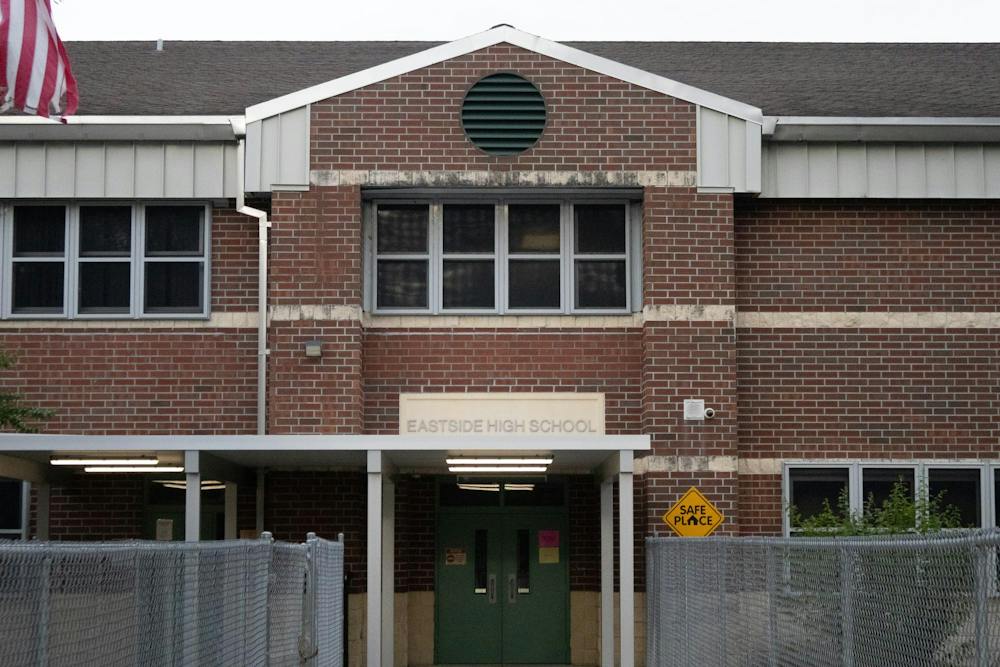
Magnet programs have brought west Gainesville students to East Gainesville schools, Johnson added. Many Eastside High School students live in west Gainesville but attend Eastside to access its exclusive Institute of Culinary Arts or the International Baccalaureate Program, she said. Eastside also provides specialized programs to teach medical skills and barbering.
“Those have both been enormously successful,” Johnson said of the IB and culinary programs. “There are many options for students in East Gainesville schools.”
About $1.4 million in state grant funding is directed to four East Gainesville schools, Johnson said, which can be used to cover academic field trips, tutoring, curriculum materials and hiring personnel for instructional coaching and behavioral or academic interventions.
The district has set aside $1.2 million this school year to give bonuses to new East Gainesville school teachers who have a shown record of improving student proficiency. The bonuses are guaranteed for three years to help the schools keep strong teachers and maintain stability.
In addition to state incentives, teachers can receive between $11,000 and $26,000 in bonuses for this school year alone, Johnson said.
Chris Curran, a UF professor of educational leadership and policy, said there are many factors that explain why families tend to live on the west side of town. Parents moving to Alachua County and thinking about which schools their children will attend may look at neighborhoods zoned for schools with higher average achievement levels, he said.
“The East side tends to have lower school grades from Florida's accountability system compared to many of the schools on the west side,” Curran said.
An Alachua County racial isolation study conducted from 2021 to 2025 by Michael Gengler, a Gainesville resident and author of the school desegregation book “We Can Do It,” reveals poor performance according to state standards in seven Eastside schools, where predominantly Black students were enrolled:
- Williams Elementary
- Lake Forest Elementary
- Rawlings Elementary
- Metcalfe Elementary
- Lincoln Middle
- Bishop Middle
- Eastside High
East Gainesville schools such as Williams, Rawlings, Lake Forest and Metcalfe have average grades ranging from D to F, compared to West Gainesville schools such as Meadowbrook, which has an average grade of A. Other West Gainesville schools have average grades ranging from A to C, according to ACPS’ history of school grades.
Gengler said that, according to a school board meeting July 30, on the board website, Williams Elementary continued in D and remains in turnaround status, designating the school as chronically low-performing. Lake Forest, Rawlings and Metcalfe will be in turnaround status for 2026-27.
Student achievement reflects far more than classroom instruction, Curran said, because children arrive in school with vast differences in readiness shaped by parents’ education, family income and access to early learning opportunities.
“When we think about things like a school grade or student test scores, a lot goes into that, and a lot of it doesn't actually have to do with what's necessarily happening inside the school,” he said.
Closing gaps between student groups or between schools in different parts of town requires holistic investment in communities, he added, from early childhood education to economic stability, so families can support children long before kindergarten.
“Factors like socioeconomic statuses of families that are served by those schools and the communities that they live in shape a lot of what we actually see in terms of test scores in schools,” Curran said.
Walter Fernando Balser, a UF clinical assistant professor who researches the changing ecosystem of K-12 education, said districts have historically used magnet programs to attract students who wouldn’t normally be enrolled in certain schools. But magnets usually can’t balance school populations long term because there often aren’t enough students willing to go to schools in communities they’re unfamiliar with, he said.
“There's so many wonderful elements of magnet programs that have been successful, but at scale, we wouldn't be where we're at if that was the solution,” Balser said. “District leaders have to look beyond what they've been doing for 10 or 20 years.”
Solving this deep-rooted issue — which goes back to the ‘60s and ‘70s — will require confrontation, innovation and community discussion, he said.
“They cannot just keep schools that are not just a little bit underenrolled, but schools that are dramatically underenrolled,” he added. “What school districts can do is find ways to innovate within the district, within the system.”
Schooling is shifting, he said, and education systems will need to rethink their structure to close persisting equity gaps.
“Once we begin to do that, I don't think we're going to be talking about ‘east side, west side,’” he said. “We're going to be talking about educational systems that are meeting students' needs in all new ways across the board.”
Contact Sara Dhorasoo at sdhorasoo@alligator.org. Follow her on X @saradhrs.

Sara is a journalism senior at UF. She is currently serving as The Alligator's race and equity reporter, and previously served as the first amendment reporter, in Spring 2026. Before transferring to UF, Sara earned her Associate of Arts in Mass Communications/Journalism from Miami Dade College, where she served as staff writer for The Reporter. She grew up in France and aspires to return there and work as a journalist after graduating.


