

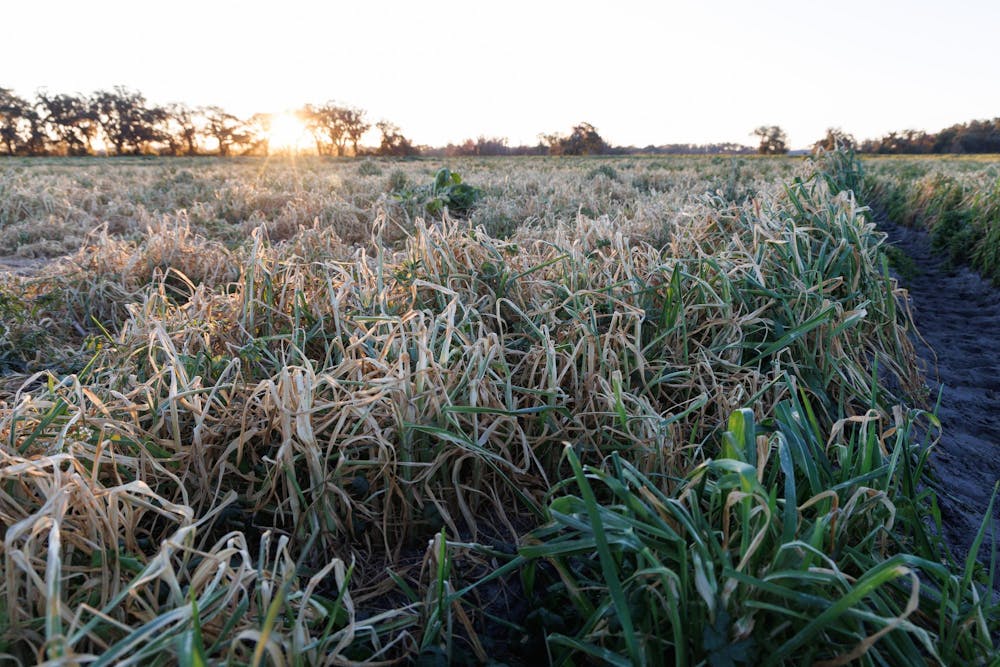
The temperature range in Alachua County this winter has been a rollercoaster ride. While people can simply add or subtract layers, the temperature extremes pose a larger problem for farmers.
The agricultural industry is the third largest employer in Alachua County, making up 17.5% of the workforce, according to UF/IFAS Extension Alachua County. A majority of agricultural land is pasture land used for grazing livestock and producing forage, which is food for livestock.
There are two growing seasons for forage: warm and cool. When the warm-season grasses go dormant in winter due to cooling temperatures, forage is limited, so farmers plant wintertime alternatives: oat, rye, triticale and ryegrass.
This winter, farmers’ cool-season forages are underperforming, said Kevin Korus, the Alachua County agriculture and natural resources extension agent.
“They're just not as tall as they should be, and they're very yellow as well,” Korus said.
Cool-season forages grow best between 55 to 75 degrees, and Korus said warmer temperatures can cause complete crop failure for those varieties. He had one grower report all of his planted oats “burned up” — dried into a crisp — due to the warm and dry conditions.
Korus also believes the county’s recent temperature swings contributed to the forages’ poor productivity. Gainesville experienced a high of 83 degrees on Jan. 10, according to the National Weather Service.
Five days later, temperatures dropped to a low of 32 degrees and hit as low as 24 degrees the next day. That freeze may have been most detrimental to the forages, Korus said.
“The fact that it was like in the 80s and then there was just a sudden drop one night to below freezing,” Korus said, “that's when severe damage can occur.”
Eight to nine growers reported underperforming forages to the UF/IFAS Extension Alachua County team, but Korus estimates the number of affected farmers is much higher.
Poor forage production can have serious impacts on farmers. Korus said many farmers opt to grow forage because hay is expensive. When a forage is underperforming, farmers not only lose the resources they put into planting, but they have to rely more on hay.
“In a time where input prices are extremely high and commodity prices are extremely low, it's really hard for farmers to sustain that kind of loss,” Korus said.
This season’s lack of rain also contributed to the underperformance of forages, said UF IFAS Forage Extension Specialist Marcelo Wallau.
He noted August and September 2025 were extremely dry, and there has been very little rain throughout the winter months. On his farm in Orange Heights, about 12 miles east of Gainesville, his weather station data recorded 1.5 inches of rainfall for the past 30 days and 3.8 inches for the last 90 days, which Wallau estimates to be half the typical amount of rainfall.
In order to plant, growers need moisture in the ground. The limited rainfall forced some farmers to plant as late as December, Wallau said.
The most perplexing case for Wallau is the poor growth of the dairy farm fields. Normally, he said, those fields are the most successful because of their high nutrient levels and irrigation, but lately they have not been performing well. While he cannot pinpoint an exact explanation yet, he said he believes there are a number of contributing factors.
“It's the first time that I'm seeing to this level,” Wallau said, “especially on the high production fields, which are the dairy fields.”
He said the sudden change from warm to cold does not allow plants to properly acclimate. Farmers can use techniques like forage mixers, proper management and irrigation to better protect their forages, he explained, but further action may be needed.
“If we still get temperatures like this often, that can be a problem for the future,” Wallau said. “Then we need to start breeding forages that are more tolerant.”
During winter, the normal temperature range in Alachua County is a nighttime low in the 40s and an afternoon high in the 60s, said meteorologist Megan Borowski. Near-freezing temperatures in Alachua County are expected each year, but the “extreme fluctuations" are not, she said.
This season saw a record high 83 degrees on Christmas Eve. The warm conditions persisted for about 10 days then lowered significantly, hitting 31 degrees, she said.
“These numbers are very unusual,” Borowski said. “We will likely hit record lows.”
Alachua County is also undergoing extreme drought conditions, according to The National Integrated Drought Information System. In Gainesville, for the month of December, Borowski said the recorded amount of rainfall was 11 inches below normal.
She attributes the deficit to the low rainfall this rainy season and lack of landfalling hurricanes in Florida this year. While Alachua County has experienced drier conditions in the past, Borowski said, the drought conditions worsens the ground’s ability to absorb water.
Caroline Walsh is a contributing writer for The Alligator.
Caroline is a freshman sports journalism student in her second semester at The Alligator. She is a photographer for the Multimedia desk. In her free time, she enjoys running and watching hockey.