

Around 2 a.m. on Saturday, Edgar Rodriguez’s mom shook him awake, saying, “They attacked Venezuela.” The 20-year-old UF history and Latin American studies alumnus was so perplexed he couldn’t form words, he said.
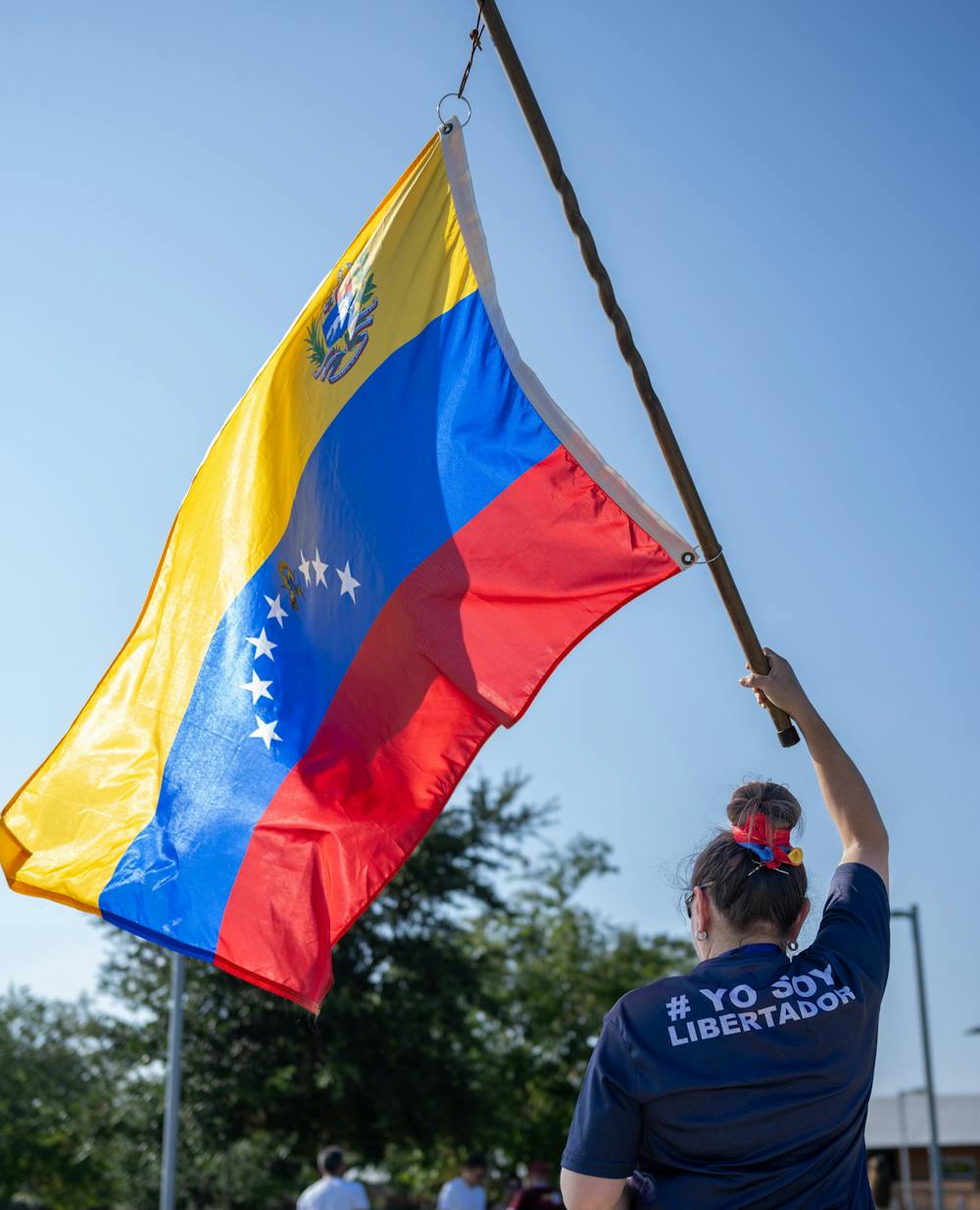
Venezuela’s president, Nicolás Maduro, was captured and flown out of the country Saturday morning following a large-scale U.S. attack launched a few hours before sunrise, prompting swift reactions across UF and Gainesville. Faculty, students and community members expressed a mix of hope and fear for the future of their country and its citizens living in the U.S.
The strike on Venezuela came amid an expanding U.S. military presence around the Caribbean nation and a months-long pressure campaign on Maduro by President Donald Trump's administration. The administration carried out a series of operations targeting vessels accused of drug trafficking.
The campaign culminated in a quick attack in which Maduro was captured by U.S. forces.
Many Venezuelans celebrated the apparent end of Venezuela’s long-standing Chavismo regime, which began with the election of former President Hugo Chávez in 1998. After Chávez died in 2013, Maduro took power.
The Chavismo political system was accused of causing a humanitarian crisis and financial collapse. Instability and famine have impacted millions since the regime began. Venezuela has had multiple waves of protests against the government. In 2017, around 157 people, mostly college students, were murdered in the streets while protesting for freedom and education.
Reactions in Gainesville
In Miami, Rodriguez’s home was among those celebrating.
“It was just an explosion of emotion,” Rodriguez said. “I raised the window, and I was like, ‘Maduro is captured!’ I just wanted everybody to know that this was the moment we’ve been waiting for years.”
As a historian, Rodriguez said, he is concerned for the well-being of his home country. As a Venezuelan, though, he said he feels hopeful Venezuela will return to a democracy after its longtime dictatorship.
“For Venezuela to be successful in the future, democracy has to be restored,” Rodriguez said.
He said he hopes a new republic is established in Venezuela and that U.S. authorities like Trump give mercy to Venezuelans. Amid mass deportations in the U.S., Rodriguez said, he fears an increase in racist and xenophobic sentiment toward Venezuelans. He said many Venezuelans will naturally want to go back to their homes, but people like him have built a life in the U.S.
Gainesville and UF have significant Latin and Venezuelan populations. The city’s population is over 13% Hispanic, and UF has 107 international students from Venezuela in attendance as of 2025.
Rebecca Hanson, an assistant professor for the Center for Latin American Studies and the Department of Sociology and Criminology & Law, raised concerns about the implications of the strike. She described the military action as an “extremely irregular and most likely illegal intervention.”
In effect, Hanson said, Maduro’s removal could create a “power vacuum” in Venezuela, increasing the likelihood of guerrilla-style conflict, which involves fighting carried out by multiple non-state and state armed groups. A fragmented landscape could then emerge as criminal organizations, armed civilian groups, security forces and international countries have interest in gaining territory or controlling illicit markets, she said.
“I think the least likely outcome of all of this is that there’s any kind of democratic or peaceful transition in Venezuela,” Hanson said.
Much of the reaction from her extended family and friends in Venezuela is marked by anxiety, she said. She also worries what this invasion means for Venezuelans living in the U.S.
“I think we’re going to see even more mass deportations of Venezuelans in the coming weeks,” Hanson said.
For instance, she said, the U.S. government may be able to use the start of official armed conflict as a justification to invoke laws that would allow for easier targeting of Venezuelans in the U.S.
Marco Salvador, a 20-year-old UF economics and political science junior from Venezuela, said he and his family are “all in a state of shock.” The chance for democracy is a hope held among rejoicing Venezuelans, he said.
Salvador thinks the key to Venezuelan democratization is diplomatic relations with the U.S., and he hopes the two countries develop strong ties, he said.
Salvador said it is critical that the will of the Venezuelan people be respected. Last year, the United States recognized Edmundo González Urrutia as the winner of Venezuela’s presidential election, but Maduro claimed victory and maintained control. Salvador said he hopes for a transition process to the legally elected officials.
Salvador said Venezuelans feel determined to see political change and are relieved at its possibility.
“There’s a burden kind of carried off their shoulders,” Salvador said. “You didn’t realize you had that burden until they took it off you.”
Andreina Lozada Lopez, a 45-year-old UF graduate student living in Gainesville, fled Venezuela in 2016 amid rising insecurity and concern for her daughter’s safety. She said she felt “a wave of mixed emotions” when she first heard the news of the strike.
“I didn’t know if [I ought] to celebrate, or if it was even true or not, but Venezuela had been waiting many years for this moment,” Lozada Lopez said.
Despite her relief, Lozada Lopez said the U.S. had additional reasons for intervening aside from removing a dictator from power.
“This is all because of what Venezuela has — oil, gold, coal and extensive mining resources — which makes it attractive to other countries and why they don’t leave Venezuela aside,” she said. “If it had been another country, they might not have had the same interest in intervening.”
In a press conference held earlier today, Trump said U.S. oil companies will head to Venezuela to operate in the country's oil reserves, with the U.S. selling seized oil assets and profits. The U.S. will run Venezuela until a “proper transition can take place,” the president said.
Despite her reservations about U.S. motives, Lozada Lopez said she has hope for the future.
“It will take time to rebuild the country, but many people will return to invest and restore,” she said. “After 26 years of destruction, it will take quite a while to recover, but I am confident it will be achieved.”
Contact Ariana Badra at abadra@alligator.org. Follow her on X @arianavbm.
Contact Angelique Rodriguez at arodriguez@alligator.org. Follow her on X @angeliquesrod.
Ariana is a first-year journalism major and an El Caimán reporter for the Fall of 2025. In her free time, she enjoys reading, spending time with friends and scouring for new songs to play on repeat to an absurd degree.

Angelique is a UF journalism sophomore and The Alligator's Fall 2026 El Caimán editor. She was formerly a UF Graduate School and El Caiman Enterprise reporter. Now in her fourth semester at The Alligator, Angie has reported and edited stories related to the Spanish language and culture. When she's not working, you can find Angie reading, watching rom-coms and hanging out with friends.


