
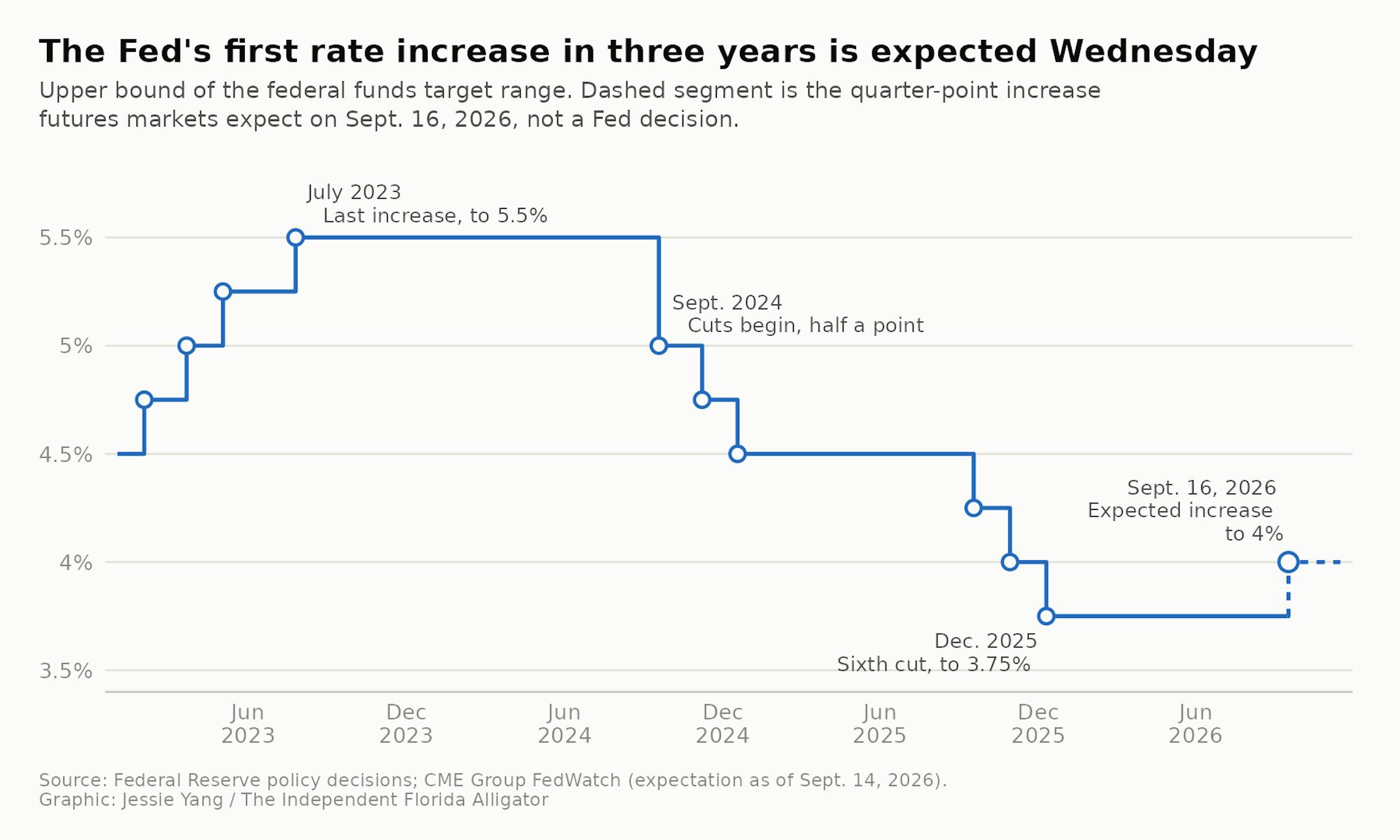
The Federal Reserve is expected to raise interest rates on Wednesday for the first time since July 2023, reversing a series of cuts made in 2024 and 2025.
The Fed, which is the U.S. central bank, conducts monetary policy by setting the interest rate banks charge each other to borrow money overnight. Any changes ripple outward, and it impacts Gainesville differently than the rest of the country, affecting credit card rates long before rent. The rate sets the floor for what banks charge borrowers and pay savers.
The Fed has two goals assigned by Congress that often contradict each other: Maintain stable prices and maximum employment. Raising rates makes borrowing more expensive, which can cool consumer spending and, in turn, ease inflation.
The Federal Open Market Committee meets eight times a year. Its two-day September meeting began Tuesday, and a decision is due Wednesday at 2 p.m.
Across its last five meetings, it has held its target rate between 3.5% and 3.75%. In July, three of its 12 voting members dissented, favoring an increase to 3.75% to 4%. With inflation still above the Fed’s target, markets increasingly expect officials to raise rates this week.
As of Sept. 14, CME Group’s FedWatch tool, which tracks expectations in the futures market, reports an increase is more than 90% likely.
The same markets were much more divided last month. Two developments shifted expectations, according to PBS and CBS:
- A speech by Fed Chair Kevin Warsh at the Jackson Hole symposium Aug. 28, in which he said recent inflation improvement didn’t mean underlying trends had gotten better, so the Fed remains open to raising rates.
- New inflation data showing consumer prices had risen by 0.4% in August and 3.4% over the past 12 months, according to data from the Bureau of Labor Statistics, remaining well above the Fed’s 2% target. Expectations of a September hike continued to climb after the report.
People often think of rate changes as only impacting homeowners. But Gainesville looks different from much of the country: Only about four in 10 residents own their home compared to nearly seven in 10 nationally, according to Census Bureau estimates.
A change in interest rate doesn’t have as big an impact on renters because they aren’t taking out mortgages.
So, rather than seeing immediate changes to housing, most Gainesville residents will notice differences in their credit card statements, private student loans, savings accounts and, years from now, apartment buildings that are not yet built.
For the minority of Gainesville residents who do buy a home, inflation and steady high rates over the last five years have already left a mark. The median single-family home in Alachua County sold for $373,750 in July, about 53% more than the $245,000 median in July 2019, according to Florida Realtors data compiled from the county's listing service.
The average 30-year mortgage rate was 6.76% as of Sept. 10, up from 6.35% the previous year, according to Freddie Mac.
What moves fast and what barely moves at all
Hector Sandoval, the director of the Economic Analysis Program at UF's Bureau of Economic and Business Research, said the impact on credit card users is often overlooked.
Most credit cards, including Chase Sapphire Preferred and Capital One Quicksilver Student, carry variable rates that reset with market conditions, which makes them the first thing to shift after the Fed changes interest rates.
Monetary policy works with a lag — the Fed's moves take months or years to fully affect the economy. But credit cards are the rare exception, and card owners can see changes reflected in their rates within a couple of billing cycles.
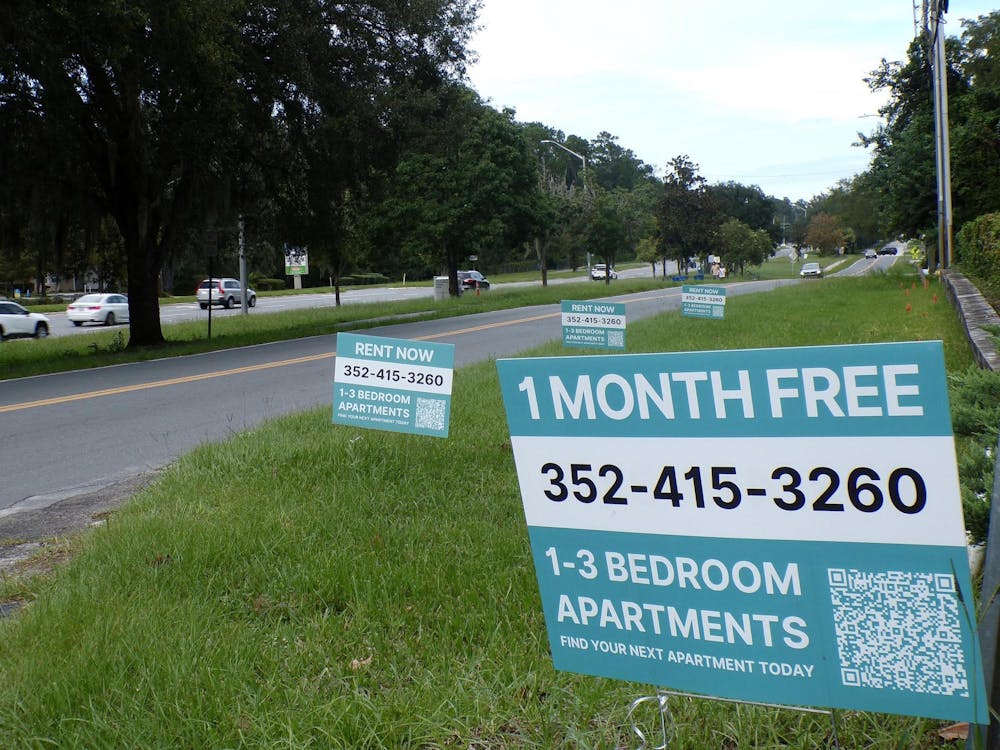
Even when the Fed lowers interest rates, it can take a while for those decreases to show, Sandoval said, especially in housing, where prices are easier to raise than lower. When a landlord has empty units, they usually opt for temporary concessions, like a free month or waived fees, instead of lowering rent as a whole.
For landlords, "something is more than nothing," Sandoval said, and they’d rather give out freebies than have to deal with an empty room.
But for tenants, they’re seeing higher prices with no explanation.
"It never goes down, always goes up," he said.
The renter who's already watching
Nick Attanasio pays $1,200 a month for his room at Theory Gainesville, and unlike most renters, he closely follows what the Fed might do as prices remain high.
Attanasio, a 19-year-old UF finance sophomore, will be watching Wednesday’s decision closely.
His landlord is watching, too. The complex is already pushing residents to re-sign less than a month after many moved in, he said. The first 50 residents to renew are being offered their current rate, while everyone after that must wait to see the new price.
When asked whether he would notice a quarter-point increase, Attanasio drew a distinction.
"I would notice because I pay attention to it,” he said. "Would an average consumer notice? No, probably not."
Why Gainesville rents are flat and why that won't last
The rate-lock offer Attanasio received from his apartment complex is not out of generosity. It is arithmetic.
About one in 10 Gainesville apartments are vacant, and asking rents have remained almost flat over the past year, according to figures provided by the Florida Apartment Association, the trade group for apartment owners and managers in the state.
More than 550 new apartments entered the Gainesville housing market this year, while renters took up only 191 units, the association said. The influx has given renters more options with costs remaining relatively consistent across the board.
It’s the best position Gainesville renters have been in for years, but it has an expiration date.
Recent construction has finished, and there aren’t any plans to add more units in the near future, wrote Amanda White, vice president of the Florida Apartment Association, in an email to The Alligator.
She attributed the slowdown to rising development costs. Regional demand is expected to remain strong, she said, allowing the market to stabilize as new units fill. It’s unclear when building is likely to resume.
The Fed’s decision reaches renters when there aren’t any new units proposed. Apartment complexes are financed with debt, built with borrowed money. When borrowing is expensive, new projects become harder to get off the ground, and the shortage eventually shows up in what tenants pay.
The lag is the point. If the Fed raises rates by a quarter point Wednesday, next month's rent probably won’t change. But higher borrowing costs could influence which projects are proposed next year and eventually dictate the housing supply that shapes rents for the years to come. By then, most of the students currently competing for those units will have graduated.
Yousef Dakkak, a 20-year-old UF computer science junior, is one renter who could see a rate increase through his credit card well before it reaches his rent.
Dakkak has lived at Varsity House since his freshman year. His base rent is about $850 a month, he said, but after accounting for utilities and $75 a month for parking, his monthly cost is closer to $980. His rent has climbed by nearly $100 since he moved in during 2024, and he said he doesn’t plan to renew.
"It's getting to be more expensive than anywhere near campus," Dakkak said. "I'd rather live on campus. Now it's all at the same price."
Dakkak doubts his lease would ever be reduced.
"If they increase the rate, I know credit card companies will increase their APR," he said, referring to the annual percentage rate, the annual cost of borrowing on a credit card. "I guess that would be a more immediate effect."
He said most people will likely notice effects as they manifest in regular transactions — like an increase to their minimum payments — but they might not realize the connection to the Fed.
"I'm sure they notice changes," Dakkak said. "I don't know if they correlate it."
Contact Jessie Yang at jyang@alligator.org. Follow her on X @jessie_yang_22.

Jessie Yang is a sophomore studying statistics. She's interested in business, technology, and finance, and is a member of the Caimanes Student-Managed Hedge Fund, where she researches companies and develops investment theses. She's currently exploring a career in investment banking. Outside of The Alligator, she enjoys playing tennis, golfing, and pretending not to struggle on hikes in pretty places.