

Spiders aren’t just scary arachnids; they are filled with wisdom about humans.
Ghanaian folktales tell the story of Ananse, a mischievous spider who tries to shortcut his way through life. In various legends, Ananse learns virtues such as exercising self-control by making mistakes and reevaluating his approach.
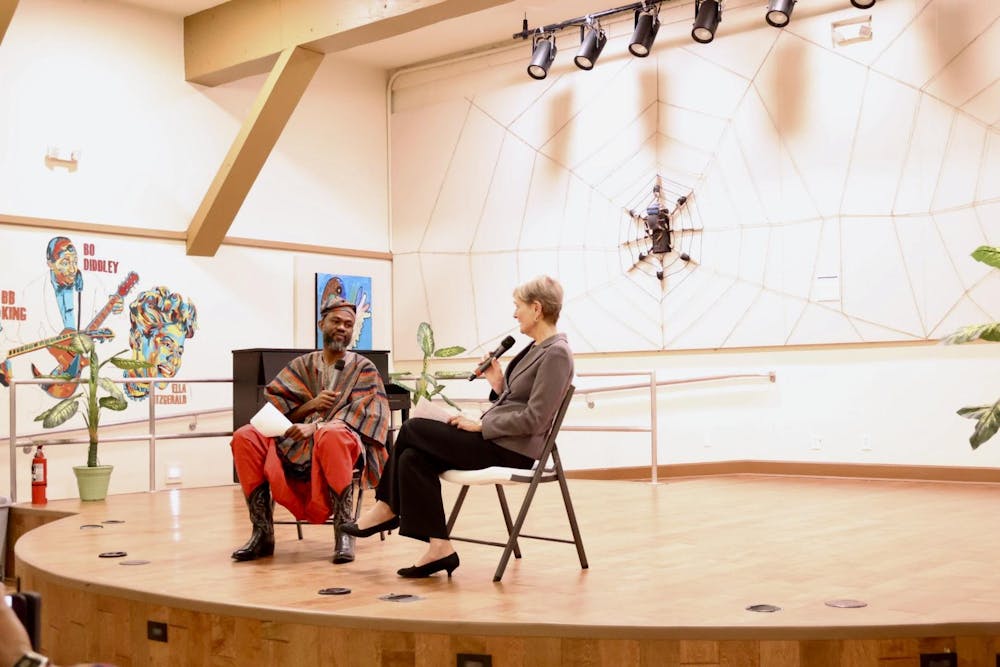
Alex Awuku, a 40-year-old UF fine arts graduate student, captured the mythical spider's essence in his immersive ceramic art exhibit, which debuted Friday evening at the Cotton Club Museum and Cultural Center in the Springhill neighborhood near downtown Gainesville.
“We all have the dream in Ghana to come to America,” Awuku said. “I thought of upgrading my knowledge and skills, so that I can go back and give to the community.”
Each piece is a deep, textured brown in the general shape of Ananse. To match each story, Awuku added technological elements, such as cords and keyboard keys, to illustrate the connection between the traditional and contemporary worlds.
Sometimes the spider is caught in the web of cords and cables, and sometimes Ananse sits atop spherical clay sculptures that resemble cauldrons.
Two colorful spider pieces occupy an entire wall, positioned in the center, with an outstretched web made of rope. They were bordered by computer mice that seemed to be encroaching on the colorful spider.
Awuku said he chose ceramics for this project because it was his medium back home in Ghana, and he feels connected to the clay because he used to have to process it from scratch. He said he feels sick if he goes one day without working with ceramics in the studio.
Awuku wanted to convey the depth of Ananse’s character in Ghana to his American audience. Ananse is often viewed as a trickster, but he has a complex nature and ambiguity in his character, Awuku said.
“What you are seeing here is the moral aspect of it, which is well known in Ghana,” Awuku said. “That is what I want to share with those also in the Western world.”
Awuku said he hoped attendees would “not forget our traditional culture — at least, let’s have our culture and let’s have the modern age also.”
Caitlin Field, a 26-year-old UF archaeology doctoral student, said she enjoyed the composition of the exhibit.
“I think the use of these sort of traditional folkloric motifs was really powerful,” Field said. “I use folklore a lot in my research, and so seeing that applied in another field is really interesting.”
Field took photos of the pieces because she said the themes and lessons of the work remind her of her personal life. She said she sees herself going back to them and reflecting on their meaning.
The exhibit was also impactful to Maria Arrieta, a 47-year-old UF fine arts graduate student. She related to Awuku’s past, being an immigrant herself.
“I’m from Lima, Peru, and so it’s very interesting for me,” Arrieta said. “It inspired me, how he is talking about tradition and merging the topics of that and technology.”
Arrieta said she was moved by his pieces and felt seen by the lessons Ananse was learning in each sculpture and story.
Rebecca Nagy, a former director of the Harn Museum of Art, was a guest curator for Awuku's exhibit. She fell in love with his work when she saw it at a student gallery on campus.
Nagy said the biggest takeaway from this event is technology is good, but society shouldn't forget about traditional ways and stories that have a lot to teach people.
“We’re always wedded to our devices,” Nagy said, “and we’re not engaging in the kind of old-fashioned storytelling where one generation talks to the next generation and relays the stories about what they’ve learned about life.”
Awuku is continuing his work with Ananse and technology through a partnership with the UF Digital Worlds Institute to create animations of the spider’s stories.
The physical exhibit at the Cotton Club Museum will be available through Aug. 29.
Tess Lippincott is a contributing writer for The Alligator.
Tess Lippincott is a third-year journalism major, spanish minor, and meteorology and climatology certificate student. This is Tess' first semester at the Alligator and first time on the university desk. She also works as a deputy editor for WUFT-FM. In her free time, Tess loves playing pickleball, running, and reading. If she's not working you can find her with her roommates and friends.