

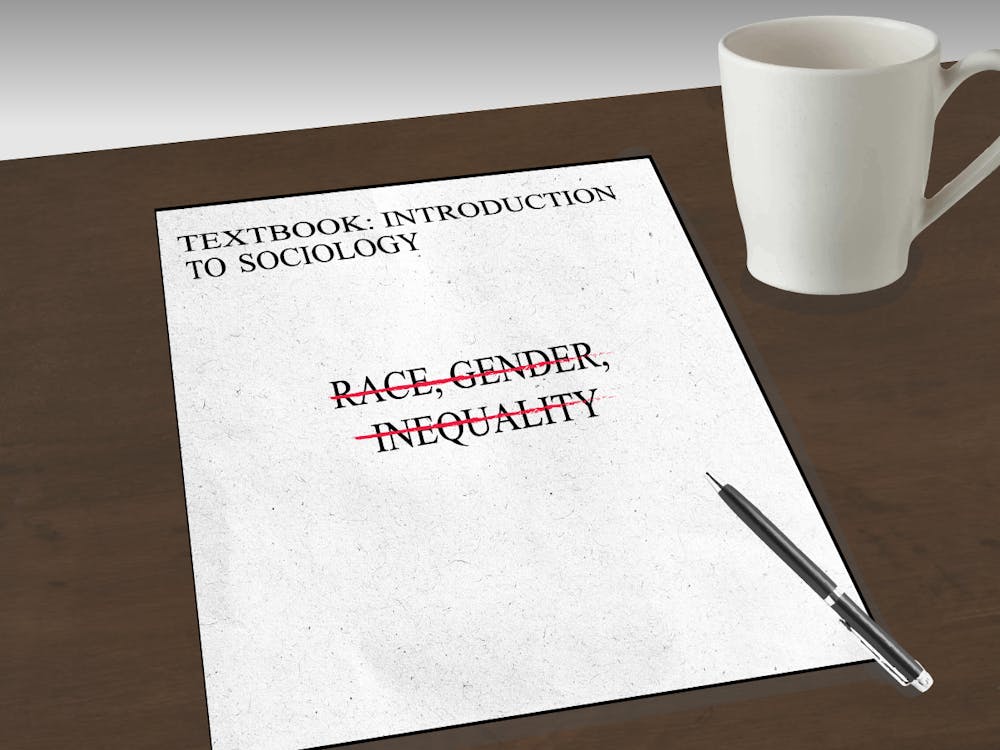
Florida’s public university system has approved a significantly shortened Introduction to Sociology textbook that eliminates several core subject areas, a move faculty members say reshapes how the discipline is introduced to thousands of students statewide.
The Florida Board of Governors approved and distributed the revised syllabus and textbook framework for the course, which is now available for adoption at all state public universities. So far, Florida State University and Florida International University are using the new version. UF has declined to adopt it officially, treating it instead as a resource or recommendation, according to professor William Marsiglio.
The state-approved textbook is 267 pages — compared to about 665 pages in the original Openstax Introduction to Sociology 3e edition used by UF. Introduction to Sociology at UF enrolled about 1,450 students during the 2025-26 academic year, according to public records acquired by The Alligator.
Faculty say the new version removes entire units on media and technology, global inequality, race and ethnicity, social stratification, gender, sex and sexuality. According to Inside Higher Ed, it also eliminates a section addressing the government-led genocide of Native Americans.
Marsiglio, a UF sociology professor who has taught the introductory course for four decades, said the revised textbook is an “affront on academic freedom.”
“It’s something that never has happened in my career before,” Marsiglio said, “where administrators, even close or far removed from the topic, are pushing to have a course taught in a certain way which really is inconsistent with the discipline.”
Sociology studies have been the subject of increasing scrutiny from Florida lawmakers over the past few years. The Board of Governors eliminated sociology courses from general education curriculum in 2024, a move Gov. Ron DeSantis touted as “sensible” in a speech he delivered on UF’s campus last year.
Marsiglio said introductory sociology is designed to expose students to how social forces — including race, class and gender — shape outcomes in education, health and employment.
“It’s hard to imagine thinking about how people live their everyday lives and assume that social stratification, class, race, gender don't matter, because they do,” he said.
Marsiglio added narrowing the curriculum could disadvantage students preparing for professional exams such as the MCAT, which assumes familiarity with sociological concepts including inequality and social determinants of health.
Some students who recently completed the course say the removed material represents central components of the class.
Heidi Storch, an 18-year-old UF biochemistry freshman who took the course in Fall 2025 with Marsiglio, said removing units on social norms, race and gender stereotypes, and social media would significantly diminish the class, as they were among the most valuable lessons she learned.
“It’s kind of the whole point of the class,” Storch said.
Faculty seek clarification
At FSU, sociology associate professor Shantel Buggs said faculty members have sought guidance on how the changes affect classroom discussion.
Instructors have asked whether they may address removed topics if students bring them up independently, she said. The clarification hasn’t been provided. Still, she said she doesn’t feel demoralized and hopes people will push back against the change.
“If you want to say that race and gender don't actually have any impact on why people have different outcomes … then of course you're going to be opposed to sociology,” Buggs said. “Because sociology tells you that individual choices are not the only things determining our lives.”
As questions mounted, the Board of Governors scheduled a webinar with a sociology committee composed of FSU and FIU faculty members to address concerns in January. The board canceled the session hours before it was set to begin.
It is unclear whether it will be rescheduled.
Robert Cassanello, president of the statewide union United Faculty of Florida, said he believes the webinar was canceled after officials learned attendance would be high.
“This was not something that they wished to defend publicly,” Cassanello said.
Meghan Thomas, the Board of Governors communications coordinator, wrote in an email to The Alligator the subject’s newly formatted learning materials came alongside input from university faculty.
“University faculty participated in a statewide sociology workgroup and developed a framework that could be used for the course and developed a resource to align with the framework,” she wrote.
Still, the implementation of the new framework was met with some confusion. In December 2025, the FIU provost instructed faculty to adopt the board-approved syllabus and textbook for all sections of the course with one business day’s notice. Faculty had previously been told implementation would not be required until Fall 2026.
In January, FIU’s Department of Global and Sociocultural Studies submitted a letter to the university’s faculty senate raising concerns that the revised textbook could disadvantage pre-med and social work students, who rely on foundational sociological concepts.
The letter, approved 19-0 with one abstention, asked the Faculty Senate Academic Freedom Committee and UFF-FIU, the university’s chapter of the faculty union, to review the changes and recommend corrective action.
FIU faculty also said the textbook conflicts with the American Sociological Association’s code of ethics and prevents instructors from presenting the discipline comprehensively.
Union president Cassanello said he believes the revisions reflect a broader shift in state oversight of university curricula. He added while tenured faculty may feel more secure raising concerns, non-tenured instructors could feel pressure to self-censor.
“It sets a dangerous precedent by which people who are not at all content experts are demanding a veto power over subject material we teach in our classes,” he said.
Contact Sara Dhorasoo at sdhorasoo@alligator.org.

Sara is a journalism senior at UF. She is currently serving as The Alligator's race and equity reporter, and previously served as the first amendment reporter, in Spring 2026. Before transferring to UF, Sara earned her Associate of Arts in Mass Communications/Journalism from Miami Dade College, where she served as staff writer for The Reporter. She grew up in France and aspires to return there and work as a journalist after graduating.


