

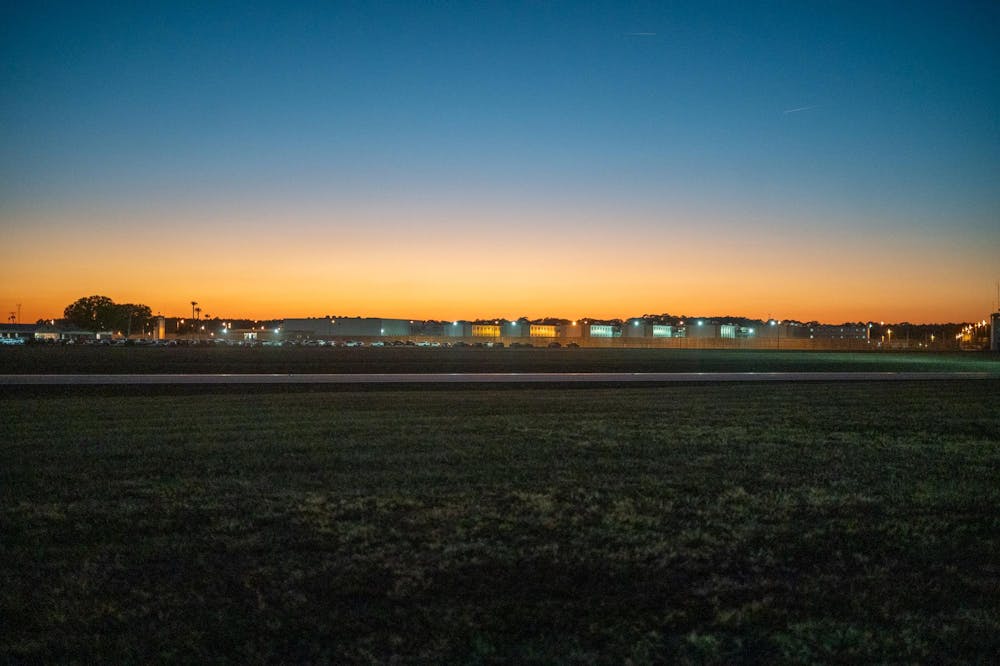
Florida’s death row inmates spend 23 hours a day in their 6-by-9 foot cells, passing time by watching TV on prison-issued devices, reading books or magazines, studying their case files or writing letters.
For some, those letters become a lifeline.
There are 265 people on Florida’s death row, according to the Death Penalty Information Center — 264 men and one woman.
In 2025, Florida executed 19 inmates, more than any other state that year and a record for the state. The previous record for executions in Florida in any single year was eight.
Across the country, dozens of organizations connect people on the outside with death row inmates through pen pal programs. Sometimes the correspondence ends after a few letters. Other times, it lasts decades.
Some pen pals choose to keep a strict emotional distance and not disclose their personal lives; others form deep, lasting bonds.
‘I Love You’
Ines Aubert, who lives in Switzerland, was present when her pen pal was executed eight years ago.
He was 38 when he died, but Aubert began writing to him when he arrived on Texas’ death row at age 22.
Hours before the execution, he was granted a final phone call. His loved ones gathered in a room, passing the landline receiver from person to person.
When the phone reached Aubert, she said, “I love you. I love you. I love you. Thank you.”
“We just wrote more often at the end; I wrote him everyday,” she said. “Everything else was not important anymore, just the gratefulness and the love, which is actually beautiful in a situation where you wouldn't expect any beauty.”
Aubert, a special education teacher born and raised in Switzerland, shared her day-to-day life with pen pals on death row in the U.S. for 24 years.
During the past two decades, she has corresponded with multiple other death row inmates, including three in Florida and one in Texas.
Two have since been executed: Mark Geralds in Florida on Dec. 9, 2025, and her longtime pen pal in Texas eight years ago.
“It’s a window to the world,” Aubert said. “I show them the outside of the cell, and I talk about my everyday life.”
She said writing to people in prison benefits both sides.
“It enriches our lives and broadens our horizons,” she said. “We learn about the life of someone else and about a life that we will never have, and that is very interesting.”
Aubert said she believes the experience has made her more grateful for everything she has and for her freedom.
After hearing the stories of her pen pals and realizing the benefits of writing to them, she founded Connect Death Row, an organization that connects students to pen pals and publishes essays written by death row inmates.
‘Ten years since my toes touched the grass’
Sigrid Wade shares similar reasons for writing.
She started writing to death row inmates over 20 years ago while living in France, where she was born and raised. Her fascination with the death penalty started when she was 14 and found out the United States still practiced capital punishment, something she said she couldn’t believe.
Wade moved to Florida nine years ago and has spent every Sunday since visiting her pen pal on Florida’s death row.
Something written in one of this pen pal’s first letters put her life into perspective.
“It’s been 10 years since my toes touched the grass,” he wrote, according to Wade.
She said reading it made her feel more grateful for “all the things we don’t think about,” like seeing the stars or the moon at night.
When Wade turned 18, an anti-death penalty organization recommended she write to a death row inmate as a way to get involved with the movement.
“The worst thing that can happen to someone [is] being sentenced to death,” she said. “This is all I can do. I’m just going to support someone who is facing, to me, my worst fear.”
She sent her first letter to a man in California to whom she still writes today. She continued to write to him even after she found out the details of his crime, which she said gave her nightmares.
Wade has corresponded with three others, but now she always looks up inmates’ crimes early so she isn’t surprised later on.
In 2019, she started her own organization, Wire of Hope, to connect prison inmates with pen pals to foster rehabilitation.
Wade decided not to take on more pen pals after the execution of one of her long-time pen friends last February in Texas, at least for now. After that experience, which she described as one of the hardest things she’s gone through, her “heart is not ready” to take up another correspondence with someone eligible for execution, she said.
She said he called her an hour before he was executed.
“The last thing I want[ed] him to hear is that I do love him,” she said.
‘I want to be a part of this somehow’
Debbie Vomero, a volunteer for the prison ministry at the Diocese of St. Augustine and a Gainesville resident, tends to keep her pen pals at arm’s length. She doesn’t look up any of her pen pals’ crimes after doing so for her first pen pal.
“It’s not about what he did. That’s not why I write,” she said.
Her first pen pal, Darryl Barwick, was executed in May 2023, as she stood outside Florida State Prison in protest. She has attended several protests outside the prison in the two years since.
Vomero's journey started in 2017, she said, when she got the opportunity to tour a gang rehabilitation program in Los Angeles.
“I couldn’t believe what I was seeing, you know, listening to the stories of where these people had been in their lives and what I was seeing now,” she said. “I want to be a part of this somehow.”
Vomero became involved with the prison ministry at the Diocese of St. Augustine in 2020. She was given a list of inmates from which to choose as a pen pal.
“I deliberately chose a man on death row,” she said. “I felt like, of all the people in prison, these are the people who would feel most isolated, most forgotten.”
In their letters, he talked about how he played basketball in the yard, and she told him about how COVID-19 was affecting the world.
The content of the letters changed when his execution date was set. In the first letter after the date was set, Barwick wrote, “I have good news, and I have bad news,” Vomero recounted.
In the month between the death warrant and the day of the execution, they wrote several letters to each other.
He assured her he had come to terms with it. In one of the last letters Vomero received from him, he told her not to worry about him because he would be closer to God.
“I found great comfort in that,” Vomero said.
However, as she stood outside the prison on May 3, 2023, and the man leading the vigil outside the prison said the injection had been administered, it was hard for her to take, Vomero said.
Vomero now enters the prison regularly with the prison ministry after attempting to write to another death row inmate without receiving a response.
Contact Alexa Ryan at aryan@alligator.org. Follow her on X @AlexaRyan_.

Alexa is a junior journalism and international studies student and The Alligator's Fall 2026 Enterprise editor. She previously served as the criminal justice reporter and the Enterprise politics reporter. In her free time, she enjoys running, traveling and going on random side quests.


