

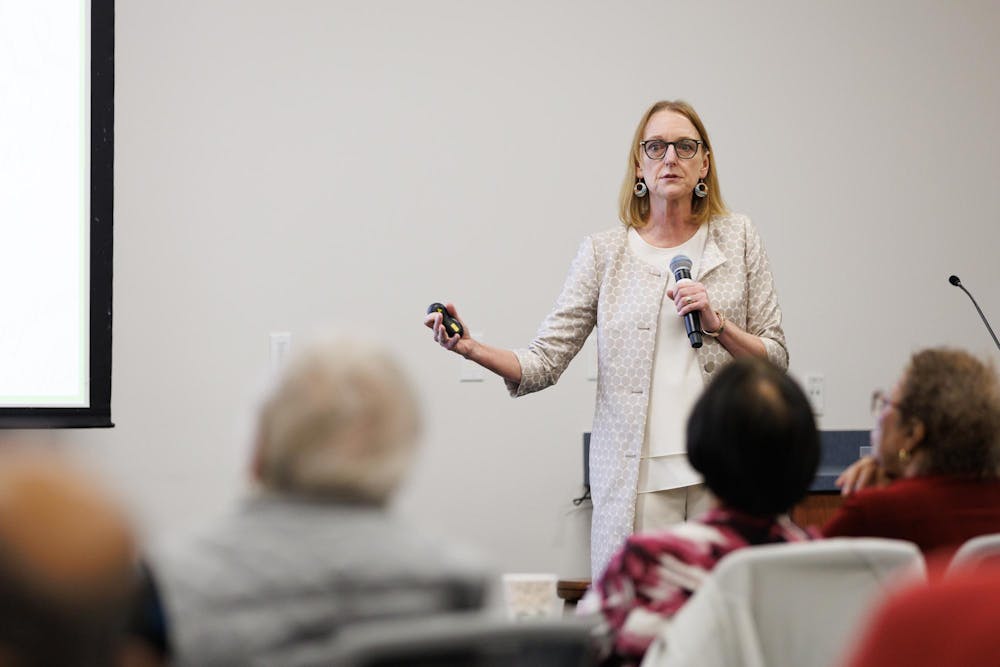
About 70 retired UF faculty members gathered Wednesday to hear a constitutional law expert unpack how UF’s new institutional neutrality policy intersects with academic freedom and First Amendment protections.
The discussion, led by UF constitutional law scholar Lyrissa Lidsky, came after UF implemented a policy that limits when university leaders may comment on public issues.
While supporters say the policy protects free expression by preventing universities from taking political stances, critics worry it could chill speech in the classroom and erode long-standing principles of academic freedom.
Speaking to the Retired Faculty of the University of Florida, Lidsky framed institutional neutrality not as censorship, but as a boundary between institutional speech and individual expression.
“Nobody should be claiming to speak for the department,” Lidsky said. “When they're really speaking for their own political position.”
Neutrality policies don’t violate the First Amendment, Lidsky said, so long as they are applied to prevent leaders — such as deans or department chairs — from taking positions unrelated to a university’s educational mission.
Faculty members and students can still advocate, research and teach freely in their individual capacities while following the policy, a distinction Lidsky said separates neutrality from censorship.
That distinction has been at the center of recent legal debates involving public universities.
Lidsky referenced a 2022 ruling by U.S. District Judge Mark Walker, who affirmed that UF faculty members are protected by the First Amendment when speaking outside their official job duties on topics related to their expertise.
However, neutrality policies should be limited in scope and clearly defined, Lidsky said. Broad or ambiguous rules, she said, risk creating uncertainty that could discourage scholars from speaking publicly.
Anna Calluori Holcombe, a retired professor emeritus in UF’s College of the Arts, said she felt strongly about the issues raised during the discussion. She pointed to the case of Jeffrey L. Harrison, a retired UF law professor who lost his emeritus status after posting a political comment on Facebook.
“All of this is disturbing, and makes me thankful on a daily basis that I am retired.” Calluori Holcombe said.
While she said Lidsky’s explanation eased some of her concerns, she questioned what neutrality could mean for faculty.
“If the faculty becomes neutral, then what’s the use of us teaching,”she said.
But Chris Curran, director of UF’s Education Policy Research Center, supports institutional neutrality. He said the policy seems to be aimed exclusively at institutional leaders, and it’s meant to discourage public statements that could divide campus communities.
Curran said the First Amendment doesn’t guarantee the right to “say anything,” and there are reasonable limits in employer‑employee relationships when speech disrupts the workplace.
“Individuals would still have a right outside of the work environment to have an opinion on a political or social issue,” Curran said.
When acting in an official capacity, leaders may have different limits — both under the First Amendment and under neutrality policies that help guide employees in how they represent their schools, he said.
He said UF distinguishes between commentary grounded in academic expertise and broader social or political advocacy — a line faculty members need clearly defined guidance to navigate.
Curran said the policy’s impact will depend on how the university implements it, noting that faculty need more guidance. If those boundaries are clearly defined, researchers should still be able to do their work within the policy’s framework, he added.
“With any kind of policy, I think there's always a need for further kind of guidance and, you know, some of it just takes time,” Curran said. “I think I can understand that that creates a sense of uncertainty in the meantime.”
UF plans to provide additional clarification through a set of frequently asked questions, said university spokesperson Cynthia Roldán.
Until then, Lidsky said, uncertainty is likely to persist — shaped as much by the political climate surrounding higher education as by the policy itself.
“If it didn't come from this context where there's been a kind of a political campaign against ‘woke’,” Lidsky said, ”then I don't think people would be as nervous about the idea of institutional neutrality. I think they might be more prepared to embrace it.”

Sara is a journalism senior at UF. She is currently serving as The Alligator's race and equity reporter, and previously served as the first amendment reporter, in Spring 2026. Before transferring to UF, Sara earned her Associate of Arts in Mass Communications/Journalism from Miami Dade College, where she served as staff writer for The Reporter. She grew up in France and aspires to return there and work as a journalist after graduating.