

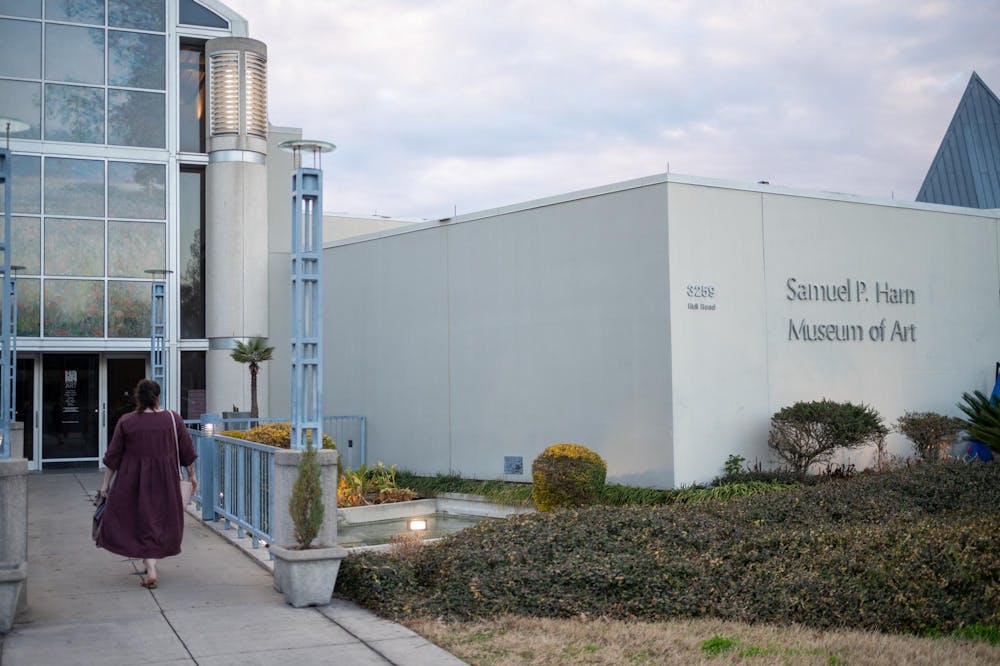
Leonardo López Luján, the director of the Templo Mayor Project at Mexico’s National Institute of Anthropology and History, presented the most significant findings from his team over the past 48 years at the Harn Museum of Art Feb. 4. The talk kicked off a UF series of lecturers in Latin American archaeology.
López Luján directs a project focused on excavations in the historic center of Mexico City, his hometown. A full auditorium of eager listeners gathered to hear his discussion on the artifacts his team uncovered, including Templo Mayor foundations, sculptures and other treasures.
“In Mexico City, the past is always present,” López Luján said. “It’s always there, it’s part of us, and like in all societies, it gives us identity.”
The first excavation occurred 48 years ago, López Luján said, when a group of utility workers attempted to install an underground electrical substation. While excavating the site, they discovered just about 5 feet below the surface something that drew worldwide attention: Coyolxauhqui, a monolith representing the Mexica goddess of the moon.
Over the years, researchers have also uncovered remains of the Mexica Empire’s main pyramid, sculptures and offerings placed in stone boxes dedicated to revered gods. These boxes mostly contained plant remains, unworked jade, red pigments, marine sand, animals and even human remains from ritual sacrifices buried there.
Cultural roots are essential for people to understand their origins, López Luján said, as they help explain who they are today, how they behave and what cultural heritage they carry.
He said he hopes attendees came away with a greater appreciation not only for Mexico’s cultural legacy, but for Latin America as a whole.
“They see there is a world that is not only very large but very rich culturally to the south of the United States,” López Luján said.
He was most surprised by UF’s international composition, noting the diversity of both its professors and its students.
Gabriel Prieto, an associate professor in UF’s Department of Anthropology and a native of Peru, played a key role in the effort to bring López Luján to UF. He said the goal is to invite a different archaeologist each year whose work focuses on Latin America.
For Prieto, it was important that López Luján was able to visit the anthropology faculty and deliver his lecture at the Harn.
“As a human being, [it means] a dream,” Prieto said. “As a professor, [it means] a breakpoint in our department and at our university, because we show the interdisciplinarity of anthropology and give our students the opportunity to see projects of this magnitude and the inspiration that can come from that.”
Prieto added that students are already building connections with López Luján to visit Mexico and learn firsthand about the work being done there.
Nailah Barnes, a 25-year-old curator, writer and scholar, attended the event because she is considering doctoral programs, and anthropology is one of her disciplines.
Barnes was drawn to the event because she wanted to spend time with a field of anthropology she doesn’t normally get to experience, she said.
“I think it's really interesting that there are so many layers of metropolises on top of the excavation site,” Barnes said. “And then even once the excavation site is reached, there's more below and further below.”
Autumn Rose, a 29-year-old UF anthropology graduate student, went to the event because she also works in Central America and has a background in archeology.
She enjoyed the opportunity to come and see one of the leading researchers of the field, she said, and to have a firsthand account of some of these huge deposits.
“Its just an amazing opportunity to be able to get to meet [them] personally and hear from and have one-on-one conversations with leading researchers,” Rose said. “And just to feel that the department is connected to such a wide variety of people doing different things.”
Rose, who works in zooarcheology, added it was interesting to see all of the animal deposits shown in López Lujan’s presentation.
Margarita Vargas-Betancourt, the UF Latin American and Caribbean special collections librarian, also attended. She traveled to Mexico in September 2025 with Leonardo Villalón, the interim director of the UF Center for Latin American Studies, and Prieto. During their visit, they toured the Templo Mayor with López Luján and saw excavations not yet open to the public.
Vargas-Betancourt described the experience as mystical. As a native of Mexico City, she said she does not remember her first visit to the Templo Mayor because she went so often growing up. As a Mexican migrant, she said the experience filled her with pride.
“It gives me hope,” she said. “A lot of hope that you, young people, know and feel proud of where we come from and who we are.”
Contact Ornella Moreno at omoreno@alligator.org. Follow her on X @ornellamorenom.

Ornella Moreno is a senior journalism student with a concentration in psychology in her second semester at The Alligator. She covers El Caiman. Previously, she worked as a radio anchor for WUFT Noticias. In her free time, Ornella enjoys doing yoga, reading and going to the movies.


