

Read other stories from the "These stories were not AI-generated" special edition here.
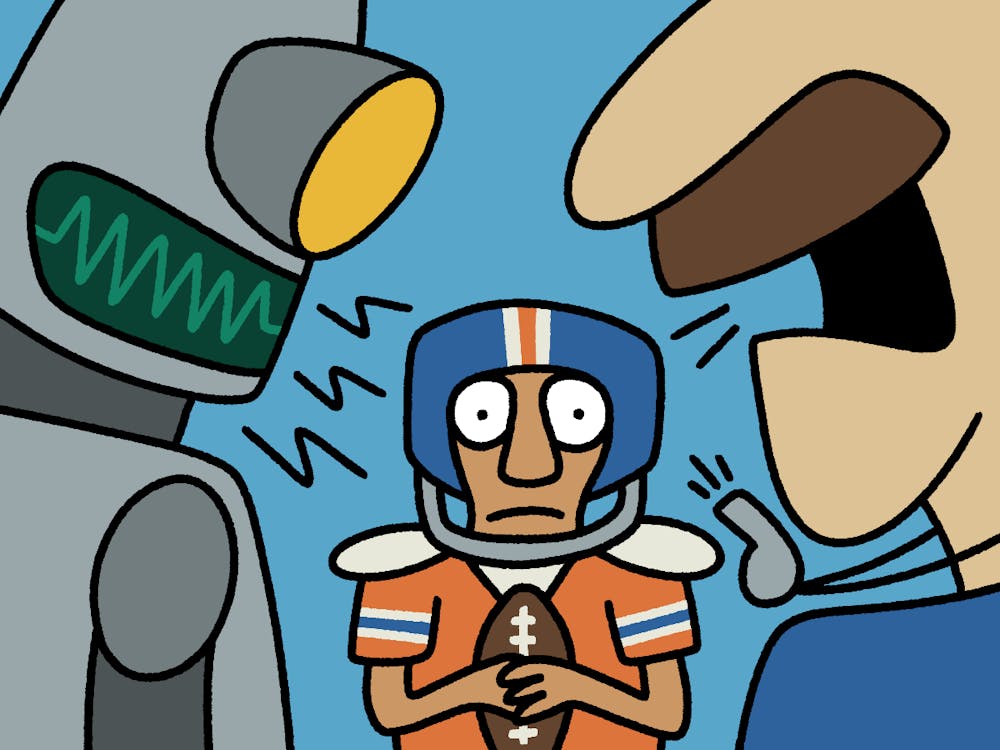
The clock is winding down, and your team is down by two. There’s time for one final play. Who do you want to call it? A human, or artificial intelligence?
To some, it may seem like everything is pointing toward robots replacing coaches. But not all experts agree. Jennifer Nichols, a UF biomedical engineering assistant professor, said AI hasn't reached a level where it can replace coaches.
“AI can make the easier decisions for a coach,” Nichols said. “But it can’t call the final play of a championship game.”
Nichols is a leader in UF’s AI-Powered Athletics project, which was launched with a $2.5 million donation from former UF President Ben Sasse in 2024. The goal of the initiative is to better understand athlete performance and help student-athletes thrive through advanced data analysis.
Nichols’ research focuses on understanding human movement using data from wearables and biomechanics, and using that data to predict and prevent injuries.
While AI may give a deeper data analysis of a performance, Nichols said, it still lacks the trust found in a coach-athlete relationship.
“Some athletes are data junkies,” Nichols said. “Others are like, ‘No, my coach can make that call.’”
In the same way athletes may be uncertain about AI, some coaches and staff are hesitant to use it.
However, that’s not the case for strength and conditioning coordinator Markus Fürst, who sees AI as a complementary tool. Working with the UF men’s golf and tennis teams, Fürst uses platforms like Claude AI to analyze trends in athlete data, like serve speed, footwork patterns and unforced errors.
“Sometimes getting inspiration [from AI on] how I can do something differently,” Fürst said.
With response times ranging from just a few seconds to half a minute, AI speeds up the brainstorming process for many professionals. Still, Fürst isn't worried about being replaced.
“Every coach is different,” Fürst said. “It's hard to rely on that [AI], because all of us have different philosophies.”
Fürst believes a major downside to AI is its lack of human connection with athletes, an aspect he deemed necessary in coaching.
Garrett Beatty, an instructional associate professor and assistant dean for innovation and entrepreneurship at UF, also believes AI hasn’t advanced enough to replace coaches. However, he emphasizes the importance of adjusting to these tools.
“There will be some who will not adapt,” Beatty said. “But on the whole, AI implementation will lead to more coaches choosing to learn to leverage data efficiently and effectively and improve the overall quality of coaching available.”
At UF, these tools are already advancing through projects like the UF Athletes Databank, a system that organizes athlete data in one platform. Bringing together performance, health and academic data, the Databank allows coaches and researchers to utilize AI to better understand athletes.
Brooke Black, a freshman tennis player on the UF women’s team, said she has already seen how useful AI can be in understanding performance.
“It can analyze the way that people hit their balls, how much top spin they need or how flat they hit it,” Black said.
Systems like Hawk-Eye technology, which tracks the trajectory of a ball, began being implemented at collegiate tennis matches around 2020. Explaining that AI can analyze a match in just a few seconds, Black said these platforms can perform tasks that would take coaches a lot longer and risk human error.
However, Black said AI still comes up short in one area.
“The main thing that AI can't do is it can’t tell the emotions of the player,” Black said. “It's great for maybe line calling and certain technical things, but the mental side, I don’t think it can replace.”
Contact Sofia Alamo at salamo@alligator.org. Follow her on X @alamosofiaa.

Sofia Alamo is a Sports Journalism freshman at UF and the university’s Women’s Tennis beat reporter. Her favorite sports are soccer and tennis, and she aspires to be a sports broadcaster in the future.