

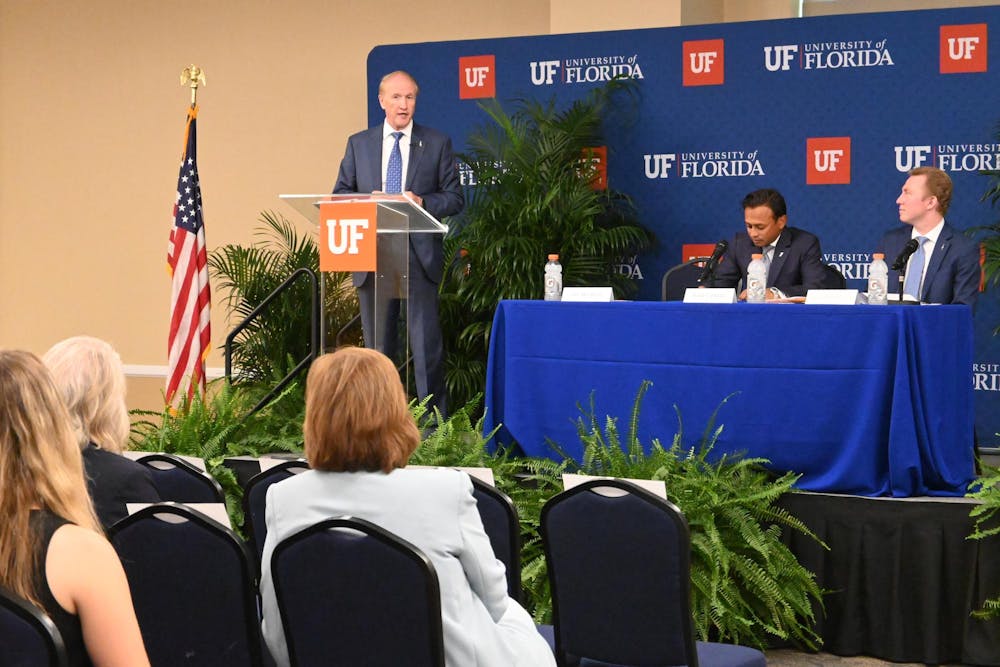
Standing before students, faculty and administrators, UF presidential finalist Stuart Bell introduced himself to the campus community in a series of forums that offered one of the first public glimpses into how he would lead the university.
Bell answered questions from attendees across three time slots.
He took to the stage with Rahul Patel, the chair of the presidential search committee. Bell’s appearance comes after a six-month-long search following the Florida Board of Governors’ rejection of presidential finalist Santa Ono last summer.
Ono faced criticism for his investment in diversity, equity and inclusion programs when he was president of the University of Michigan. Bell has faced similar criticism since he was announced as the sole presidential finalist.
Linda McMahon, the U.S. secretary of education, is one critic of DEI. She posted on X urging UF’s next president to pursue reforms against DEI. UF responded in a May 22 post calling DEI “discriminatory by design.”
Despite these criticisms, Patel said the presidential search committee’s recommendation of Bell was unanimous.
At the forum June 3, he said Bell is committed to academic achievement. Bell increased the population of National Merit Scholars at the University of Alabama by nearly 40%.
Incoming university students are given national merit recognition by scoring high on the Preliminary SAT, or PSAT, in high school.
Bell also expanded access to mental health resources on campus through the addition of therapists to various college departments, Patel added.
Members of the UF community were invited to submit questions through email ahead of the day’s forums. The email stated not all questions may be answered, and some would be consolidated to avoid similar ones.
The form closed three days ahead of the event, which took place at Emerson Hall.
Joshua Brawn, a 34-year-old forum attendee who previously worked at UF Information Technology, said it felt like organizers tried to limit the number of questions asked by closing it early.
Brawn said six months after requesting workplace accommodations, his employment with the university was not renewed. He said Bell’s stance on neurodiversity and accessibility was important to him, although neither topic was addressed during the forum.
“What is he [Bell] going to do to bring the University of Florida out of basic compliance and into actual job place protections for staff who are neurodiverse?” Brawn asked.
Neurodiversity describes the range of differences in how people think, learn and process information. It includes conditions such as autism spectrum disorder and attention-deficit/hyperactivity disorder.
Brawn, who has autism and ADHD, said DEI helps him and other disabled Americans gain employment and achieve equal representation in the workforce.
Brawn said he disagreed with Bell’s opposition to DEI, a topic the candidate addressed at length during the student forum.
“Merit, performance and opportunities are what drive success — not ideology and certainly not identity politics,” Bell said in response to a question about his strategic plan for UF.
Bell’s remarks come as a federal judge considers a closely watched First Amendment case involving former UF law student Preston Damsky, who sued the university after being expelled over antisemitic social media posts.
Another question asked about freedom of expression, to which Bell said he supports Jewish students and recalled a past December visit to Israel.
Bell also answered a question about a gender-neutral bathroom at the University of Alabama, which he said was not an official university resource. As for whether it still existed, Bell replied that it had “surely come down.”
Attendance was sparse during the student forum, at around 15 people. The later faculty and administrator sessions drew a crowd of about 75 people each in business attire.
Leonardo Villalón, the director of the Center for Latin American Studies, said Bell had an extensive history in higher education, which Villalón said would help him improve UF.
Before serving as president of the University of Alabama for a decade, Bell was executive vice president and provost at Louisiana State University and dean of the School of Engineering at the University of Kansas.
While Villalón said the questions asked were general, he said Bell appeared to be enthusiastic and made a good impression.
“He said the things we wanted to hear,” Villalón said.
He submitted a question about how Bell would promote international engagement, he said, but the question was not answered during the forum.
Other questions asked during the administrator and faculty sessions included how Bell would address criticisms of higher education, what brought the Texas native to Florida and his thoughts on improving university rankings.
Bell said much of the criticism of higher education comes down to better communication with the public. His first step toward addressing it, he added, would be to review UF’s existing resources and identify areas for improvement.
He said he came to UF because of the high level of state support it receives. While Bell was at the University of Alabama, its rankings steadily declined, falling from No. 31 to No. 40 this year.
Improving UF’s rankings, he added, would require focusing on student success, research programs and scholarships.
As the administrator section wrapped up, Bell said he can’t wait to make a difference at UF.
“I’m just excited to be able to work with the trustees and be able to work with you all to impact young people,” he said.
Contact Julianna Bendeck at jbendeck@alligator.org.
Julianna Bendeck is a first-year journalism student and the Summer 2026 criminal justice reporter. She previously worked as a contributing writer and race and equity reporter at The Alligator. Outside the newsroom, she enjoys reading, surfing the web and playing video games.