
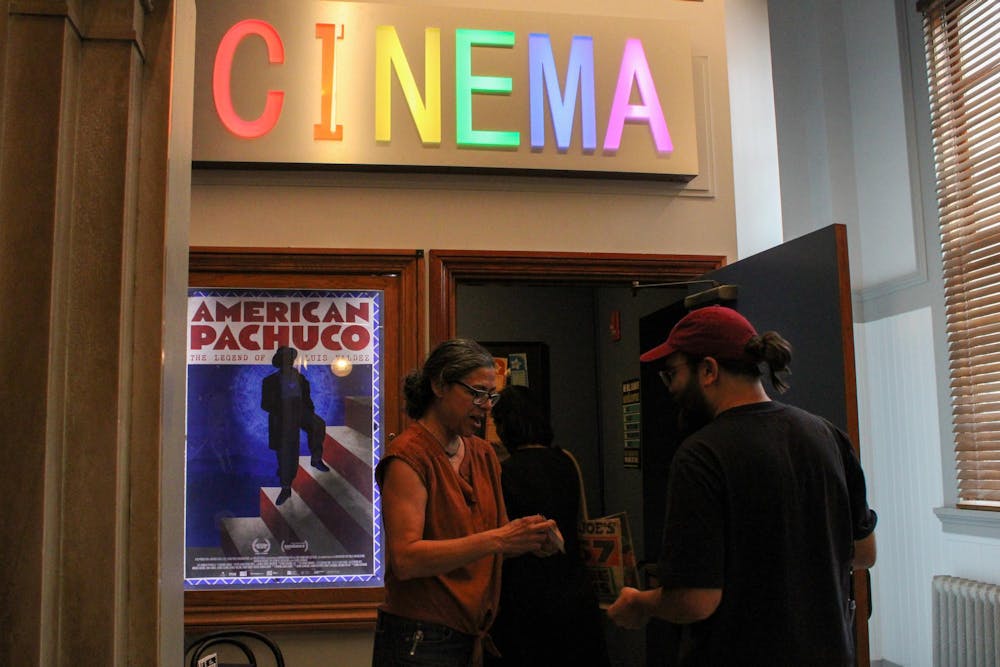
Under the dim lights of the Hippodrome Theater, “American Pachuco: The Legend of Luis Valdez” received a standing ovation at its sold out screening Aug. 29.
“American Pachuco: The Legend of Luis Valdez” tells the story of Broadway icon Luis Valdez’s journey through stage and screen as a Mexican-American Chicano.
The documentary follows Valdez through his creation of the Chicano theater company El Teatro Campesino. He wrote and directed the 1979 play “Zoot Suit,” which made history as the first Chicano play on Broadway. He went on to release his most influential film to date, “La Bamba,” in 1987. Known as the “Godfather of Chicano Theater,” Valdez’s story is one of social justice and the struggles of the Chicano community.
Producer Lauren Filippo and director David Alvarado worked with 80-year-old Luis Valdez to create over 24 hours of interviews for the documentary.
“It’s a story both about his incredible career and trajectory,” Filippo said. “It also has this theme of Chicano and Latino belonging in the U.S. and how we can understand one another.”
The documentary also recovered and digitized 80,000 feet of unseen film footage of El Teatro Campesino to use in the retelling of Valdez’s story, Filippo said.
The film covers events like the 1970s Chicano moratorium, one of the largest Los Angeles Mexican-American anti-war demonstrations against the Vietnam War. Founded by Valdez in 1965, El Teatro Campesino created and performed “actos,” or short skits, on flatbed trucks and in union halls to demonstrate the politics of survival for Latino farmworkers.
“We need new understandings,” Filippo said. “We need new ways of looking at things and being in a minority, no matter what, gives you a different perspective than the majority.”
Director Alvarado met Valdez during his undergraduate studies at the University of North Texas. When Alvarado won the Hispanic Scholarship Fund Award, Valdez was the award ceremony’s keynote speaker.
As a young filmmaker, hearing of Valdez’s accomplishments and how he “conquered Hollywood with ‘La Bamba’” blew Alvarado away, he said. Valdez’s journey continues to inspire Alvarado’s own path in the industry, he said.
Alvarado grew up knowing little of his Chicano heritage, he said, and was never taught the history behind it. Meeting Valdez was the first time he started to learn about Chicano culture, he said.
Alvarado didn’t realize the significance the documentary would have when shooting started in 2021. He wanted the film to be about Latino-American belonging in America amid the increasing wave of ICE raids across the country.
“American Pacheco” also details the life of Ritchie Valens, the singer of “La Bamba,” the only non-English song on Rolling Stone’s “500 Greatest Songs of All Time.” Valens died at 17 in a plane crash known as “The Day the Music Died,” which also saw the deaths of Buddy Holly and J.P. Richardson, and inspired Don McLean’s “American Pie.” Valdez interviewed Valens’ family when creating “La Bamba,” his 1987 film of the same name, gathering all he could to convey the meaning of Chicano culture.
“All that matters was that we were all American, and this person achieved this incredible cultural achievement before he tragically died, and that's why that film was amazing,” Alvarado said, referring to Valdez’s film.
“That’s why I love Luis' work,” Alvarado said. “There’s a chance to get to today’s political horror by just telling stories of hope and joy, reminding people why America can be great.”
In attendance for “American Pacheco’s” opening night was Silvana Fajardo, who co-founded Somos Magazine, a bilingual Gainesville magazine. Fajardo said people should watch the film because it’s entertaining, invokes emotion and tells the story of Valdez and the social movements of his time.
“I enjoyed the emotions of watching people see something they created become a reality,” Fajardo said.
Claribel Santiago, a Spanish teacher at Newberry High School, also attended the screening. Santiago said she thinks many of her students would be able to see themselves in the film.
“It was not only about culture and identity as a Mexican American or as a Chicano,” Santiago said. “It’s about recognizing where you belong, and it’s OK to be who you are, and it is OK to express it however you want to. You don’t have to be like anybody else.”
In her teaching, Santiago said she always welcomes anything that allows people to embrace their passions. She loves to celebrate culture and represent the Hispanic community with her students.
Santiago hopes to bring her Spanish Honor Society to watch the film, she said.
“I want people to see this,” Santiago said. “This was amazing. His story is amazing, but I think it’s our story, too.”
“American Pachuco” appealed to Santiago, she said, because of the way it conveys the importance of shared culture and identity.
“If we don’t know where we come from, we don’t know where we’re headed,” she said.
Contact Emily Medina-Finsen at medina-finsen@alligator.org. Follow her on X @EmilyMedFinZ27.
Emily is a UF journalism senior and The Alligator's Fall 2026 El Caimán reporter. This is her second semester working with The Alligator and enjoys reporting on the community and stories surrounding Hispanic culture. Emily adores horses, teaching and riding in her spare time, adores reading and picking up new hobbies.